





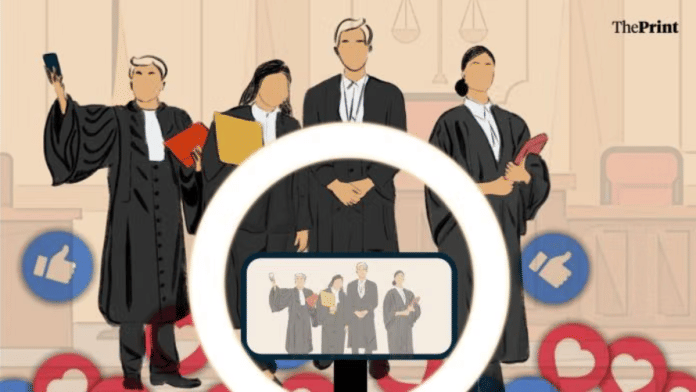


New Delhi: The Bar Council of India (BCI) has issued extensive guidelines to regulate the use of social media by lawyers, advocates, law students and interns, signaling a decisive shift in how the profession must navigate the digital age.
The circular, released 17 July, arrives at a time when lawyers are increasingly building digital profiles that resemble those of influencers—posting reels, memes, dramatic portrayals, promotional posts and other digital content featuring Court premises.
The move is a statutory intervention rooted in the Advocates Act, 1961 and the BCI Rules.
For advocates, it means that social media presence must be carefully curated to avoid solicitation, sensationalism or misuse of professional identity. For law students and interns, it underscores that participation in legal literacy must be academic and educational, not promotional.
The circular frames the legal profession as sui generis, meaning it is unique in character and cannot be equated with ordinary business or the influencer‑style content creation that dominates social media. It reinforces that this uniqueness carries a corresponding requirement of higher discipline, restraint, and ethical responsibility
Over the past few years, social media platforms have seen a surge of legal content creators. Advocates and interns alike have taken to Instagram, YouTube, and LinkedIn to post reels from court corridors, edited clips of live‑streamed hearings and promotional content showcasing chambers or internships.
The Council notes that the increasing misuse of digital platforms for spreading legal misinformation by individuals who are not enrolled advocates and, in some cases, by law students, interns or self‑styled “legal influencers.”
Oversimplified, sensational or inaccurate content is frequently presented as legal advice, it says.
The circular elaborates that advocates refrain from engaging in a wide spectrum of conduct that compromises the dignity of the profession and the integrity of the justice system.
They are expressly prohibited from recording or posting reels, videos, dramatic posts, lawyer like content or memes from court premises, chambers or judicial hearings and from selectively clipping live‑streamed proceedings. Such acts, the Bar Council warns, trivialise judicial processes and corrode public confidence in courts.
The circulation of fake judgments, misleading summaries, anonymous legal opinions and posts promising guaranteed outcomes can mislead litigants, exploit vulnerable persons and weaken public confidence in the administration of justice, it adds.
Advertisements
On advertisement and solicitation, the Council reiterates the long‑standing prohibition under the Bar Council of India Rules, which states that “an advocate shall not solicit work or advertise, either directly or indirectly.”
This means that, in the social media landscape, lawyers cannot use reels, short videos, chamber‑display clips or court‑corridor recordings as a way of promoting themselves or attracting clients.
The test, the Council explains, is not whether a post explicitly says “hire me.” Rather, the question is whether the content, viewed as a whole, uses court premises, judicial proceedings, robes, chambers, or client matters to promote oneself, sensationalise legal work, or gain followers.
The circular specifically prohibits clickbait guarantees such as “guaranteed bail,” “instant divorce,” or “sure acquittal,” which mislead the public by suggesting certainty of outcomes or special influence.
It also bars monetised legal content, influencer collaborations and client testimonials that amount to commercial self‑promotion.
Also Read: The tattoo clause in paramilitary: As 2 CRPF inspectors lose promotions, HC says location matters
Live streaming & transparency
The Council acknowledges that transparency is valuable. Citizens benefit when legal information is accessible and live‑streaming of proceedings was approved by the Supreme Court precisely to promote open justice.
But transparency cannot be confused with mockery or sensationalism. The circular stresses that clipping, editing or dramatising fragments of hearings with disparaging captions or memes undermines public confidence in courts. Transparency is meant to educate and inform, not to trivialise or ridicule judicial processes.
The circular also reinforces confidentiality. Professional information, client identities, case details and chamber work cannot be casually shared online.
At the same time, it allows space for responsible engagement. Advocates may disseminate legal awareness content online, provided it is accurate, restrained and not promotional. Where they do so, they must disclose their full name, State Bar Council, enrolment number and broad area of practice, not as advertising, but as a measure of transparency, according to the circular.
Short formed legal education in digital format are allowed provided the context is accurate, non confidential and non sensational.
Sensitisation of education centres
Institutions are encouraged to conduct sensitisation sessions, obtain undertakings and designate nodal officers to monitor compliance.
The Bar Council mandates standalone affidavits at enrolment, student undertakings at admission and before internships and monitoring by State Bar Councils, Bar Associations, chambers, and Centres of Legal Education.
It also proposes a Digital Ethics Nodal Cell and a breach classification system. The aim is to ensure that digital ethics are not treated as a routine formality but as a lived professional responsibility.
Interns are prohibited from making “day in court”, “day in chamber”, “courtroom drama” “lawyer life” or similar content which trivialises court work.
Centres of Legal Education must incorporate the circular into admission, internship, moot court and placement guidelines, designate nodal officers and maintain records of sensitisation sessions. They are required to include short orientation module on “Digital Ethics, Court Decorum, Confidentiality and Professional responsibility during internships “
State Bar Councils must circulate the circular individually to every Advocate, require Bar Associations to adopt it and establish mechanisms for reporting and counselling violators.
Social media intermediaries are urged to cooperate promptly when offending content is reported, recognising their due diligence obligations under the IT Rules, 2021.
Alfreza Ahmed is an alum of ThePrint School of Journalism, currently interning with ThePrint.
(Edited by Tony Rai)