



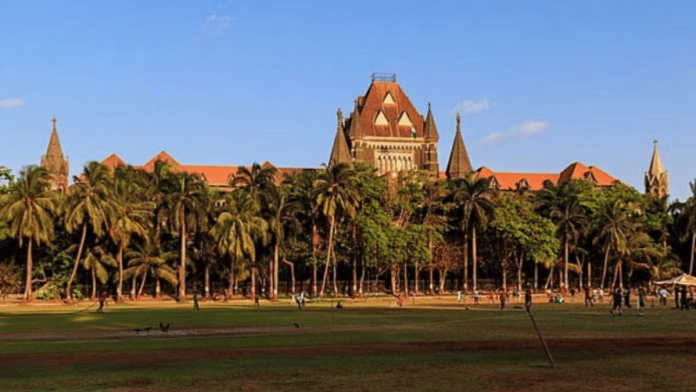
New Delhi: The Bombay High Court has declared illegal the arrest of a Mumbai-based businessman in an alleged extortion case. Calling it an instance of sheer abuse of the process, the court directed the Maharashtra government to pay the businessman Rs 5 lakh as compensation and ordered strict action, including immediate suspension, of the police officers concerned.
A division bench of Justices A.S. Gadkari and Kamal Khata, in the order pronounced on 22 October, found that a police sub-inspector had colluded with a property developer to falsely implicate Bipin Satish Chandra Agrwal in an extortion case in 2017.
The court also directed its registry to place the judgment before the High Court’s Administrative Committee for appropriate action concerning the magistrate or magistrates who approved Agrwal’s detention without adequately examining the legality of his arrest and recording reasons for remand.
“Clearly this is a case of sheer abuse of process by the developer in collusion with the police,” Justice Khata wrote in the judgment.
The bench said the sub-inspector had “weaponised police machinery” to advance the developer’s interests against Agrwal, apparently because he had resisted pressure and threatened to expose alleged wrongdoing by the developer and certain members of the housing society.
Arrest after property negotiations
Agrwal’s mother-in-law, Asawari K. Kulkarni, owned a flat in New Aarti Co-operative Housing Society in Mumbai’s Andheri East, which was undergoing redevelopment by Seth and Sonal Developers.
After her husband’s death, Kulkarni appointed Agrwal as her constituted attorney to negotiate with the developer over the flat, including its sale or the area she would receive in the redeveloped building.
On 4 August 2017, Agrwal visited the developer’s office for negotiations over the proposed sale of the flat for approximately Rs 1.64 crore. According to Agrwal, the developers handed him Rs 2 lakh as an advance to demonstrate their willingness to proceed with the transaction.
The police arrived shortly after he received the money, handcuffed him and took him to Azad Maidan police station. The developers subsequently lodged a complaint accusing him of extortion under Section 384 of the Indian Penal Code.
Agrwal challenged the arrest before the High Court, alleging that the case had been fabricated to prevent him from pursuing complaints against the developers. He also alleged that the police had manipulated official records to justify his detention.
Examining the documents, the bench found serious inconsistencies in the police’s account, including discrepancies concerning the timing of the FIR, the alleged earlier complaint and the arrest records.
Arrest records raised questions
The High Court noted that the police claimed to have received a written complaint on 23 June, 2017. However, an RTI response contradicted this claim. The alleged written complaint was not even annexed to the chargesheet.
The bench further found that the arrest form originally recorded 5 August 2017 as the date at four places, with the arrest date overwritten as 4 August at three places. The police arrest registration number, however, continued to record 5 August.
The court also noted that the sections of the arrest form requiring details of the grounds of arrest, the arrested person’s legal rights and intimation to his wife had been left blank.
It found Agrwal’s contention credible that signatures had been obtained from him and his wife between 1.20 am and 2 am on 5 August.
The bench also questioned why the police had classified him as a repeat offender likely to abscond on bail, despite there being no material establishing previous criminal antecedents. The High Court said the police had failed to investigate why the developer had paid Agrwal Rs 2 lakh, which could have been an advance towards the sale consideration or another contractual obligation.
Section 41A notice served after arrest
A key issue was the police’s failure to comply with Section 41A of the Code of Criminal Procedure, which provided for a notice requiring appearance instead of arrest where arrest was not necessary under the law.
The High Court noted that Section 384 IPC carried a maximum sentence of three years. It found no evidence that Agrwal was given a genuine opportunity to comply with the notice or that the police had recorded reasons establishing his failure to comply.
The bench relied on the Supreme Court’s judgments in Arnesh Kumar v. State of Bihar (2014) and Satender Kumar Antil v. Central Bureau of Investigation (2026), which emphasise that arrest cannot be routine and must be justified by the requirements of the investigation.
“The [olice officer cannot simply arrest a person to ask questions,” the bench observed while referring to the principles laid down in Antil v. CBI.
It concluded that Agrwal’s arrest and subsequent remand were arbitrary and undertaken without proper application of mind.
The court also criticised the magistrate for authorising police and judicial custody without recording adequate reasons. It said the magistrate had adopted a “very casual approach,” contributing to Agrwal’s wrongful detention.
State directed to pay within two weeks
Agrwal spent six days in police custody and 20 days in judicial custody before securing bail from the Sessions Court on 28 August, 2017.
The High Court directed the Maharashtra government to pay him Rs 5 lakh within two weeks, acknowledging the financial loss and damage to his reputation caused by the unlawful arrest.
It also directed the State to initiate strict action, including an order of immediate suspension against the sub-inspector and other concerned officers. The State may recover proportionate compensation from their salaries, if it considers appropriate.
The High Court allowed Agrwal’s petition and disposed of a connected application filed by the developer seeking intervention in the proceedings.
Aditya Edara is an alum of ThePrint School of Journalism, currently interning with ThePrint.
(Edited by Amrtansh Arora)
Also Read: Supreme Court backs Rs 5-lakh compensation for illegal arrest of Kodagu homestay owner