



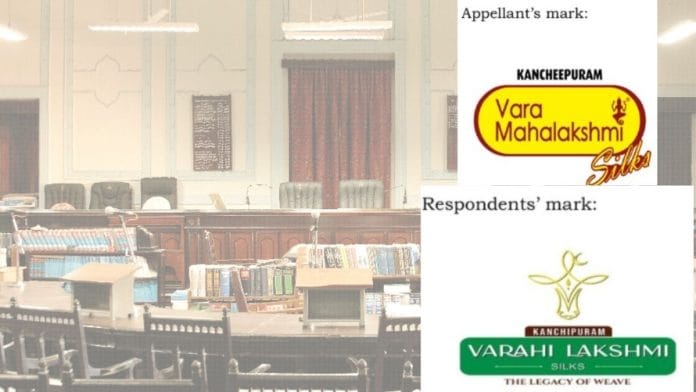

New Delhi: Can retail business owners claim exclusive ownership over the name of a deity? Can a divine title be exclusively trademarked for one business owner, meaning no competitor can use it? For instance, take ‘Kancheepuram Vara Mahalakshmi Silks’ and ‘Kanchipuram Varahi Lakshmi Silks’.
The Telangana High Court last week ruled that no single business can monopolise religious names or divine titles, noting that a trial court rightly concluded that “the dissimilarities between the two marks were sufficient to differentiate both the marks to the extent of removing any possibility of causing confusion to customers”.
A division bench comprising Justice Moushumi Bhattacharya and Justice Renuka Yara dismissed the case filed by M/s Sai Silks (Kalamandir) Limited, affirming that sacred names and common trade terms in composite label marks cannot be claimed as exclusive corporate property.
The conflict began when Sai Silks filed a suit for trademark infringement and passing off against SKP B. Gopinath Private Limited and two others in the City Civil Court at Hyderabad. Sai Silks, which holds registered trademarks including ‘Kancheepuram Vara Mahalakshmi Silks’, ‘Vara Mahalakshmi Silks Kancheepuram’, and ‘Vara Mahalakshmi’, alleged that the respondents’ store name, ‘Kanchipuram Varahi Lakshmi Silks’, was deceptively similar and infringed upon its brand identity across south India.
Sai Silks sought an interim injunction to stop the respondents from operating under ‘Kanchipuram Varahi Lakshmi Silks’, and asked the court to direct a local commissioner to seize alleged infringing material. In response, the respondents cited Section 17 of The Trade Marks Act, 1999, arguing that Sai Silks could not claim exclusive rights over non-distinctive or generic components of a composite label mark. After the trial court dismissed Sai Silks’ interim applications in 2025, the retail owner appealed to the high court.
Sai Silks also told the court that the respondents adopted the trade name, ‘Kanchipuram Varahi Lakshmi Silks’, which is “phonetically, visually and structurally deceptively similar to the appellant’s distinctive trade dress”.
The court was also told that another respondent entered into a business Memorandum of Understanding (MoU) with Sai Silks to manage the day-to-day affairs of its retail outlet in Chennai, Tamil Nadu, but commenced their independent business under the “offending” trade name in 2024 in violation of Sai Silks’ intellectual property rights.
Also Read: Telangana HC orders removal of HYDRAA chief for repeat violations of court order, no apology
What the court said
In its 16-page judgment, the High Court focused directly on the religious roots of the competing marks. The bench noted that ‘Vara’ and ‘Mahalakshmi’ translate from Sanskrit to the deity Lakshmi, the deity of wealth and prosperity. Meanwhile, ‘Varahi’ represents a boar-faced manifestation of the deity Lakshmi or Bhoodevi, associated in ancient texts with material abundance and the Varaha avatar of the deity Vishnu.
The High Court ruled that because the expressions make direct references to divine feminine power, Sai Silks cannot claim proprietary rights over ‘Vara Mahalakshmi’ or stop competitors from using variations such as ‘Varahi Lakshmi’.
The bench emphasised that religious names, much like geographical indicators, remain non-distinctive components that cannot be locked away under an exclusive monopoly by one trader.
Applying Section 17(1) and Section 17(2)(b) of The Trade Marks Act, 1999, the bench clarified that registering a composite mark grants exclusive protection to the mark taken as a whole, but does not confer exclusive rights over individual non-distinctive parts.
The court said that the differences in the two label marks are “obvious to the eye to the eye and outweigh the similarities between the marks so as to negate the possibility of being deceptively similar”. The necessity of focusing on the dissimilarities is by reason of the fact that the Sai Silks mark is in the form of a label, as opposed to a word mark, or simpliciter. Its mark contains words which are common and hence cannot entitle them the exclusive use of the said words. It said that under the 1999 Act, it is well settled that common words cannot be trademarked unless those words have acquired distinctiveness.
The court observed that ‘Kancheepuram’ designates a city famous for silk sarees that received Geographical Indication (GI) status in 2005-06, making it a word indicating geographic origin. It also reiterated that both ‘Kancheepuram’ and ‘Silks’ are words common to the saree trade. None of these individual terms, including the religious names, serve as a single dominant or unique feature distinctively identifying Sai Silks alone.
Saree shopping and ‘perceptive consumer’ standard
In addition to the legal status of religious titles, the High Court highlighted that “saree-shopping is rarely a random activity where the person would be indifferent to or unaware of the shop. Thus, the test of a person with average intelligence and imperfect recollection would be unsuitable in instances of this nature”.
Moreover, “ordering sarees simply on the trust of the sound of a shop is rare, if not impossible,” the bench noted, adding that buying a saree is invariably a combination of visual and tactile sensations—hence, the phonetic similarity of the two marks would not be the sole determining factor in the present case.
Refusing to apply the traditional legal benchmark of a consumer with “imperfect recollection”, the bench declared that in today’s digital and social media era, the standard must evolve to a “perceptive consumer with informed associations” who is conscious of brand, store, quality, and origin. Concluding that striking visual dissimilarities between the logos removed any real chance of customer confusion, the high court dismissed the appeal.
(Edited by Nardeep Singh Dahiya)