



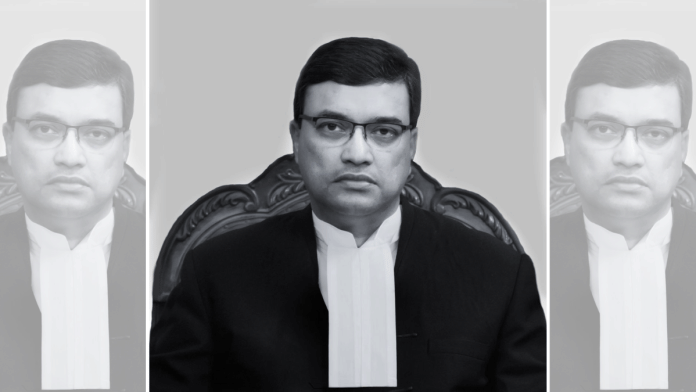
New Delhi: Rebutting the widespread characterisation of judicial selections, Justice Dipankar Datta of the Supreme Court explicitly labeled the phrase ‘judges appoint judges’ as a falsehood spread to mislead the public.
He went on to emphasise how the executive holds decisive control over judicial appointments, leaving the judiciary to play “second fiddle”.
“The oft-repeated phrase that ‘judges appoint judges’ is a myth, which people have been fed by vested interests through motivated narratives, often drawing sustenance from certain controversial decisions taken in this century in relation to appointment of judges,” Justice Datta said Wednesday.
He said that a sweeping generalisation—that the Supreme Court Collegium acts as a law unto itself—completely ignores the constitutional framework.
This was stated in a judicial opinion delivered as part of a split verdict on the 2023 Act pertaining to the appointment of the Chief Election Commissioner and Election Commissioners.
The selection process, Justice Datta asserted, involves a detailed consultative procedure, including background checks and credential vetting by state and central governments as well as intelligence agencies, culminating in the formal approval and imprimatur of the President.
“Perhaps, none other than the government knows better how the Collegium system works.”
The discourse arose during oral hearings when Solicitor General Tushar Mehta defended the exclusion of neutral selectors from the Election Commission panel by drawing a parallel to the judiciary.
Mehta argued that if outsiders are excluded from judicial appointments under the Collegium system, the executive cannot be faulted for excluding outsiders from the Election Commission.
Refusing to let the criticism pass without a response, Justice Datta noted that while such oral remarks were avoidable in the present case, “the judiciary cannot always be at the receiving end”. Silence, he said, should not be misunderstood as tacit acceptance of “unworthy criticism in circulation”.
Collegium role ‘purely recommendatory’
Justice Datta emphasised that the actual balance of power in judicial appointments rests squarely with the government, asserting that the Collegium’s role in candidate selection is “nothing more than recommendatory”.
“What is, however, unmissable is that even at the end of the day, acceptance of the recommendations is within the exclusive domain of the executive; it may, or may not, accept the recommendations. The final say rests with the executive,” he wrote.
Highlighting the practical reality, he noted that the executive routinely holds back recommended names, overrides the Chief Justice of India (CJI)-led Collegium recommendations despite binding judicial precedents, and leaves files to “gather dust for years” without disclosing reasons even after the Collegium reiterates its choices.
“If the recommendations of the Collegium of the Supreme Court were binding in nature, the same would certainly have been implemented in their entirety. Unfortunately, the records tell a different story.”
‘Hobson’s choice’
Justice Datta expressed grave concern over the executive’s practice of selective implementation, wherein the government approves a majority of recommended judges while withholding targeted names. This practice, he said, erodes the sanctity of Collegium resolutions and forces the judiciary into a corner.
“Undeterred by such piecemeal approvals and regardless of the fate of those not cleared by the executive, the Collegium chooses to proceed, seemingly, to avoid a head-on conflict with the executive and left with Hobson’s choice to keep the institution running,” he wrote.
Warning that this dynamic has placed jurist-social reformer B.R. Ambedkar’s vision of an independent judiciary under serious strain, Justice Datta questioned why the government continues to demand outside intervention when it already holds decisive control.
With the judiciary’s status reduced to “playing second fiddle to the executive”, he said, the government’s attempts to cite the Collegium to justify executive dominance in other appointments are “disingenuous, evasive and disquieting”.
While acknowledging that the Collegium system has occasionally faltered and contains aberrations, Justice Datta maintained that executive supremacy cannot be the cure. Recalling that Parliament’s National Judicial Appointments Commission (NJAC) was struck down for violating judicial independence, he pointed out that no demonstrably superior alternative model has ever been proposed.
Despite its imperfections, the Collegium remains the most viable mechanism under Article 50 of the Constitution to protect judicial independence from executive encroachment, he noted.
Justice Satish Chandra Sharma, the other judge that heard the petitions related to the poll panel, clarified that the Solicitor General’s reliance on the NJAC case—where the inclusion of the Law Minister in the judicial selection body was struck down—was “not as a criticism of the Collegium system or regarding the role of the executive in the appointment of judges”.
He observed that the government’s argument was built on a constitutional principle: if the Supreme Court held that the presence of outsiders in the judicial Collegium violates the separation of powers, “a similar independence should be read in the executive also” when framing selection rules under Article 324.
In Justice Sharma’s view, the government was not initiating a debate on how the Collegium system has functioned or worked in practice; the argument was confined strictly to whether the executive is entitled to a corresponding degree of institutional independence.
(Edited by Tony Rai)
Also Read: Hearing challenge to CEC selection law, SC asks govt: ‘Why should panel include Cabinet minister?’