



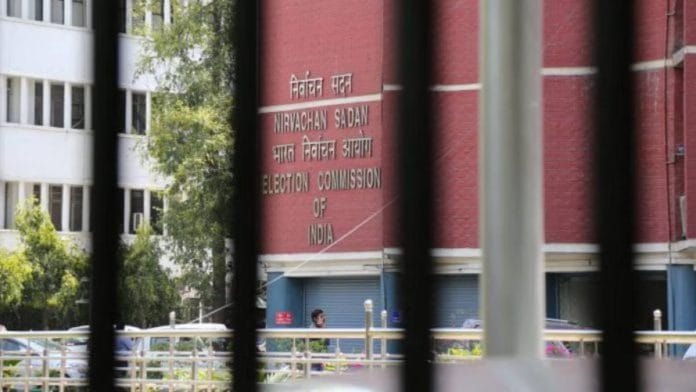
New Delhi: The Supreme Court has delivered a split verdict on the government’s request to refer the batch of petitions challenging The CEC and Other Election Commissioners Act, 2023, to a Constitution bench.
While Justice Dipankar Datta rejected the government’s request for reference, Justice Satish Chandra Sharma disagreed with him, emphasising instead that the matter revolved around a substantial question of law, which must be decided by a larger bench.
However, both judges were in agreement that the Chief Justice of India should constitute a five-judge bench, to avoid further delay.
Usually, a split verdict by a two-judge bench would mean that a three-judge bench would hear the matter, which would include the two judges who first heard the matter.
“Pendency of reference for far too long, any period between five and 20 years or more, does not reflect well on the institution,” the division bench said, acknowledging delay in judgments pronounced by the top court. It said that, “given that resolving constitutional issues is the primary task of judges of this Court, that must remain its core priority”.
A detailed verdict is awaited.
The 2023 Act is under challenge for excluding the Chief Justice of India (CJI) from the three-member selection panel which appoints Election Commissioners, and whether it is contrary to the Supreme Court’s decision in Anoop Baranwal v Union of India (2023).
The petitions challenge Section 7 of the Act, wherein the committee that appoints the CEC and Election Commissioners comprises the Prime Minister, Leader of the Opposition, and a Union Minister nominated by the Prime Minister. This challenge remains pending.
India had a legislative vacuum regarding the selection process until the Supreme Court in March 2023 ruled that the Chief Election Commissioner (CEC) and the two Election Commissioners (ECs) must be appointed by the President on the advice of a high-power committee consisting of the Prime Minister, the Leader of the Opposition in the Lok Sabha, and the Chief Justice of India.
This decision was given by a five-judge bench on a PIL filed by Anoop Baranwal.
However, the order was expected to be in operation only until Parliament enacted a law under Article 324(2) of the Constitution.
In December 2023, Parliament passed The CEC and Other Election Commissioners Act, 2023, replacing the CJI with a Cabinet Minister on the three-member panel, essentially handing the government a 2:1 majority. This was challenged before the top court, which—without going into the merits of the challenge—had to decide who would hear it.
While pronouncing the verdict Wednesday, Justice Dipankar Datta went on to make prima facie observations on the merits of the case.
“It is far-fetched to expect that a minister who is part of the Cabinet of Ministers would adopt a stand disagreeing with the leader or government. Inclusion of Cabinet ministers fails to provide an independent counterweight that a neutral selector would,” he said.
Justice Datta added, “Free and fair elections depend on a truly independent ECI. It is not enough for the ECI to be independent; it must appear to be independent. The member nominated by the Prime Minister cannot be expected to defy the Prime Minister.”
Justice Datta was also particularly dismissive of the criticism of the Collegium system made by the Solicitor General Tushar Mehta during the hearings. “The oft-repeated phrase that judges appoint judges is a myth, which people have been fed by vested interests through motivated narratives,” he said, emphasising that a sweeping generalisation portraying the Collegium as a “law unto itself” completely overlooks the intensive consultation process involving input from both state and central executives as well as intelligence agencies.
He also drew a comparison with Dr B.R. Ambedkar’s vision and the present times, highlighting that the real issue undermining the system is selective implementation by the executive.
Justice Sharma, on the other hand, observed that the issue has to be authoritatively determined by a Constitution Bench in terms of Article 145(3) of the Constitution, which requires a minimum of five Supreme Court judges to hear and decide any case that involves a substantial question of law about constitutional interpretation or a presidential reference under Article 143.
(Edited by Amrtansh Arora)
Also Read: Hearing challenge to CEC selection law, SC asks govt: ‘Why should panel include Cabinet minister?’