





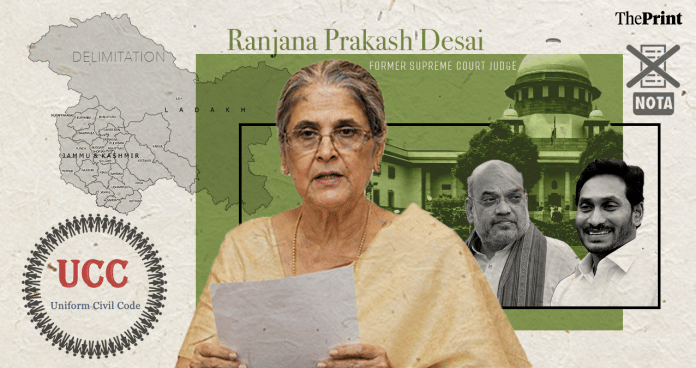


New Delhi: What do the delimitation exercise in Jammu and Kashmir, Uniform Civil Code (UCC) panels in Uttarakhand, Gujarat, Maharashtra and West Bengal, the Lokpal Search Committee, the Press Council of India (PCI), and the 8th Central Pay Commission have in common? They are all headed by retired Supreme Court judge, Justice Ranjana Prakash Desai.
Justice Desai appears to be a government favorite when it comes to commissions and panels.
The 76-year-old studied Bachelor of Laws from the Government Law College, Bombay and joined the legal profession in July 1973. As a lawyer, she worked as a junior in the chambers of Justice S.C. Pratap, before he became a judge. She also worked with her father and renowned criminal lawyer, S.G. Samant.
She was appointed as a judge of the Bombay High Court in April 1996, and was elevated to the Supreme Court in September 2011. She served as a judge till October 2014.
As a Supreme Court judge, she was a part of benches that delivered several significant orders, including confirmation of death penalty to 26/11 convict Ajmal Kasab, refusal to cancel Home Minister Amit Shah’s bail in the Sohrabuddin Sheikh fake encounter case, refusal to grant bail to YSR Congress head Y.S.Jagan Mohan Reddy in a disproportionate assets case, recognition of ‘NOTA’ as a voting option, rejection of Novartis’ patent claim for the cancer drug Glivec, and phasing out of the Haj subsidy, among others.
Her post-retirement life has been quite busy as well.
Within a month of her retirement, she was appointed as the chairperson of the Appellate Tribunal for Electricity from 1 December 2014, holding the position till November 2017.
Right after this, she was selected as chairperson of the Advance Ruling Authority [Income Tax] from July 2018 to October 2019. Her next stint was as the chairperson of the Delimitation Commission from March 2020, till May 2022.
It was under her watch that the exercise of delimitation was conducted in Jammu and Kashmir, increasing the total assembly constituencies in the Union Territory from 83 to 90.
Delimitation Commission for Jammu & Kashmir UT, headed by Chairperson Justice (Retd.) Smt. Ranjana Prakash Desai & Ex-Officio Members CEC Sh. Sushil Chandra & State Election Commissioner, J&K Sh. K.K Sharma, finalises the Delimitation order @DDNewslive @PIB_India @airnewsalerts pic.twitter.com/iYUsdDA0qL
— Spokesperson ECI (@SpokespersonECI) May 5, 2022
The exercise faced stiff criticism from the Kashmir-based parties, alleging that the exercise consolidated Hindu votes in the Jammu parliamentary constituency by removing the Muslim majority districts from it, and consolidating Shia votes by restructuring of Baramulla.
Justice Desai was also tasked with redrawing constituencies in Assam, but the exercise was subsequently conducted directly by the Election Commission.
She then headed the eight-member Lokpal search committee to recommend the chief and members of the anti-corruption ombudsman in September 2018. The panel was reconstituted in 2023, and Justice Desai was retained as its head.
Meanwhile, she was appointed as the PCI chief in June 2022, and has been reappointed for a second term as well. She was made the chairperson of the 8th Central Pay Commission in November 2025.
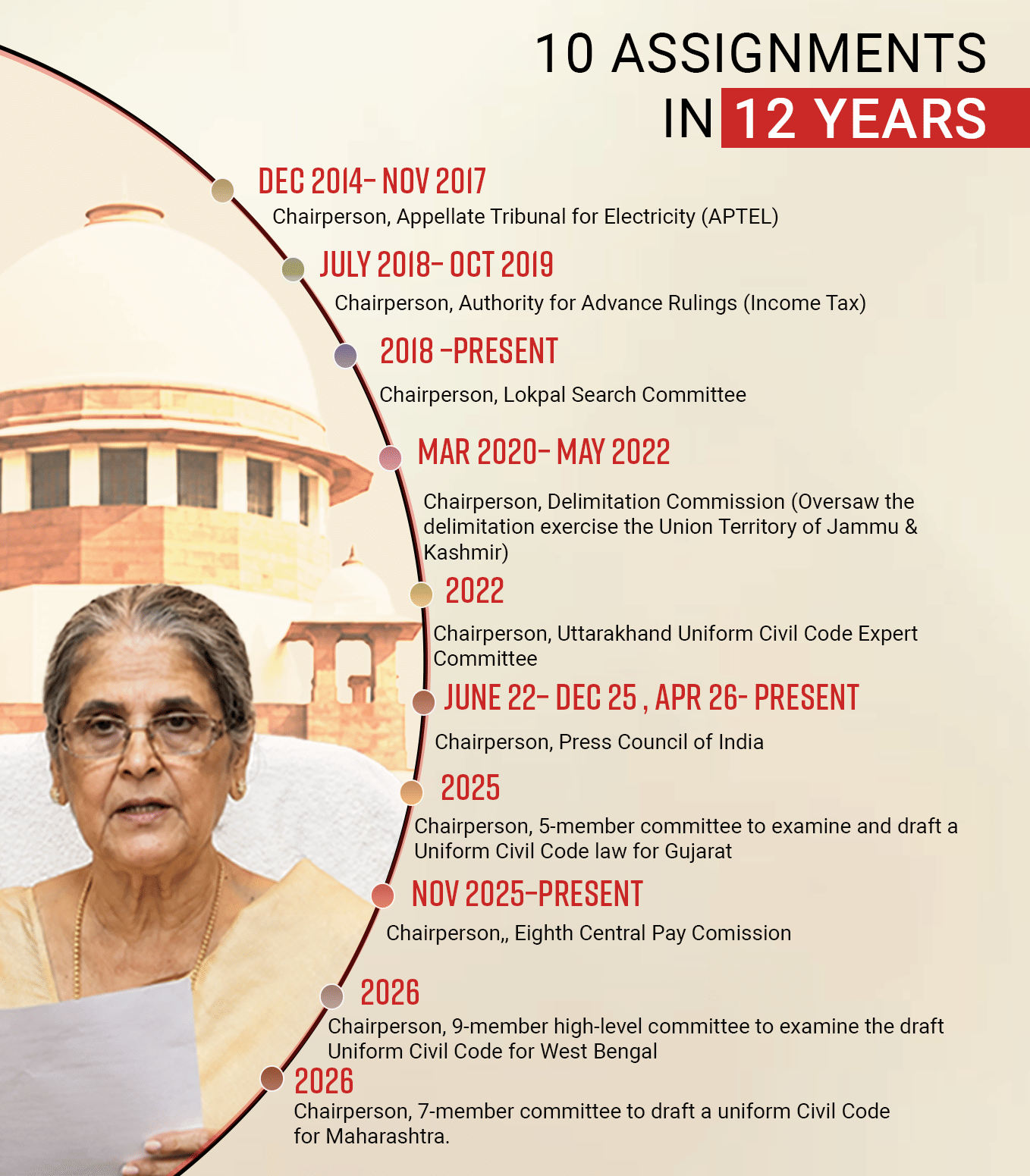
Additionally, she served as the chairperson of the panel constituted by the Uttarakhand government in 2022 to look into a UCC. She also headed a similar committee in Gujarat.
Earlier this month, Maharashtra announced the formation of a panel headed by her to draft rules and recommendations for implementing a Uniform Civil Code. Soon, a similar responsibility came upon her from West Bengal.
Former Supreme Court judge Justice M.B.Lokur, whose tenure at the Supreme Court overlapped with Justice Desai’s, says that he knows her to be a “good and fair judge”.
“I may disagree with what she may have done (in the commissions headed by her), but I don’t doubt that she has done it bona fide, and not to side with a party. I have no doubts about her impartiality, and she is being appointed because she is perceived to be doing a good job,” he told ThePrint.
ThePrint looks at some of her judgments.
Also Read: Life term for a 14-strong lynch mob: The order that made an MP judge the target of communal threats
Amit Shah’s bail, Snoopgate scandal
During her tenure as a Supreme Court judge, she presided on benches that dealt with some politically sensitive cases.
Back in September 2012, a bench comprising Justices Aftab Alam and Ranjana Prakash Desai had rejected the Central Bureau of Investigation’s plea to cancel the bail granted to former Gujarat Home Minister Amit Shah in the Sohrabuddin Sheikh fake encounter case, while agreeing to transfer the trial to Mumbai.
The order, authored by Justice Alam, had also directed the CBI to positively complete the investigation within six weeks and submit the final chargesheet before the court in Mumbai.
In August 2014, two months before her retirement, a bench headed by Justice Desai rejected a petition filed by suspended IAS officer Pradeep Sharma’s plea to conduct a probe against Prime Minister Narendra Modi and Shah, among others, for putting him and a lady under surveillance in what came to be known as the ‘Snoopgate controversy’.
The bench, also comprising Justice Ranjan Gogoi, refused to transfer the investigation of cases against Sharma from the Gujarat Police to the CBI. Sharma had alleged that the state administration was biased against him.
During the hearing of Sharma’s petition, his lawyer had in May 2011 agreed to remove personal allegations against Modi.
However, when a bench of Justices Desai and N.V.Ramana, noticed in August 2014 that the amended petition carried more accusations, the court reiterated it would not entertain any accusation against the personal conduct of Modi, according to an Indian Express article from the time.
In October 2012, a Supreme Court bench comprising Justices Alam and Desai denied bail to YSR Congress Party president Y.S.Jagan Mohan Reddy, in the disproportionate assets case, noting that the CBI probe was yet to be completed.
The bench, headed by Justice Alam, was assured by the lawyer for the CBI that the probe was being conducted without wasting any time and that the investigation will be completed as early as possible. It also said that it will be open to Jagan to renew his bail application before the trial court on completion of the CBI probe.
Jagan was granted bail in September 2013 by a special CBI court in Hyderabad, after the federal agency said that it concluded the probe against him.
Kasab’s death penalty, NOTA
In February 2011, a two-judge bench of the Bombay High Court comprising Justices Desai and R.V.More upheld the death sentence awarded to Ajmal Kasab in the 26/11 terrorist attack case. The judgment was authored by Justice Desai.
As a Supreme Court judge, she was a part of a bench that dealt with another high-profile case—that of former Youth Congress leader Sushil Sharma who was on death sentence in the 1995 Naina Sahni murder case, popularly known as the ‘Tandoor murder case’.
The bench comprising Chief Justice of India (CJI) P.Sathasivam and Justices Desai, Gogoi commuted Sharma’s death sentence to life imprisonment in October 2013, opining that while the offence was brutal “but the brutality alone would not justify the death sentence in this case”.
In September 2013, the same bench delivered two prominent judgments emphasising on voters’ rights.
The CJI-led bench ruled that in a vibrant democracy, the voter must be given an opportunity to choose none of the above (NOTA) button, which, it said, “will indeed compel the political parties to nominate a sound candidate”.
In the second judgment, it ruled that a candidate should not be allowed to contest elections if he or she fails to disclose information, including that of assets and criminal background.
“The voter has the elementary right to know full particulars of a candidate who is to represent him in the Parliament/Assemblies and such right to get information is universally recognized. Thus, it is held that the right to know about the candidate is a natural right flowing from the concept of democracy and is an integral part of Article 19(1)(a) of the Constitution,” the top court observed.
The Article pertains to freedom of speech and expression for citizens.
The same year, in November 2013, she was a part of a five-judge Constitution bench that delivered a landmark verdict making it mandatory for the police to register an FIR when it receives a complaint about a cognizable offence.
Haj subsidy, life-saving drug
A prominent judgment passed by a bench comprising Justices Alam and Desai came in 2012, when the top court directed the central government to progressively reduce the amount of Haj subsidy so as to completely eliminate it within a period of 10 years.
“The subsidy money may be more profitably used for upliftment of the community in education and other indices of social development,” the judgment, authored by Justice Alam, observed.
The issue arose when certain private operators and travel agents approached the Bombay HC, challenging the Government of India 2011 Haj Policy that required a private operator/travel agent to have “minimum office area of 250 sq. ft.” as one of the eligibility conditions for registration for ferrying Hajj pilgrims.
The HC rejected the challenge but directed the government to allocate certain seats to some of the writ petitioners from the 800 seats in the government quota that had not been allocated to anyone till the time of passing of its order.
The central government then approached the Supreme Court. Eventually, the subsidy was discontinued in 2018.
In April 2013, a bench of Justices Alam and Desai passed a landmark 112-page verdict rejecting Novartis’ patent claim for the cancer drug Glivec, allowing generic drug companies to keep crucial, life-saving drugs affordable.
After a seven-year long litigation, the apex court asserted that Glivec did not satisfy the patentability requirements, emphasising on the law that does not allow patents on new forms of existing medicines unless they demonstrate a significant increase in efficacy.
The verdict, authored by Justice Alam, was hailed for facilitating access to life-saving drugs.
(Edited by Tony Rai)