



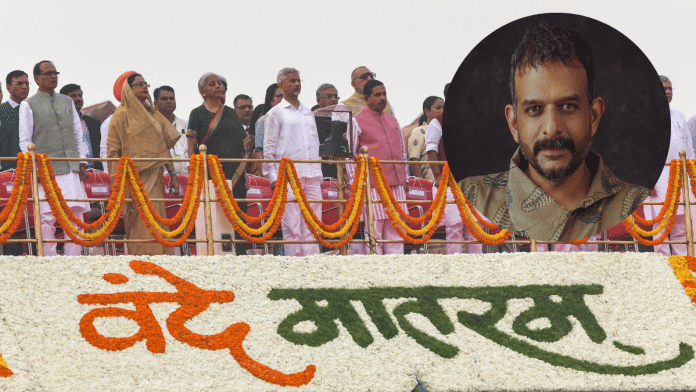
New Delhi: The Supreme Court on Tuesday agreed to examine Carnatic vocalist T.M. Krishna’s petition on the legal question of whether a person who conscientiously objects to singing Vande Mataram can be subjected to penal consequences.
But at the same time, a three-judge bench led by Chief Justice of India (CJI) Surya Kant observed that homage to a particular God or form of God in a national song would not, by itself, appear to offend secularism.
Krishna’s petition challenges the Modi government’s directive to sing all six stanzas of Vande Mataram. The last four stanzas, according to him, contain explicit references to Hindu religious imagery and compelling people of other faiths to sing raises serious questions concerning the constitutional principle of secularism.
The hearing witnessed a sharp exchange between Krishna’s lawyer, senior advocate S.Muralidhar, and Solicitor General Tushar Mehta.
Muralidhar took serious exception to Mehta’s statement that “law making is as per the Constitution” and “cannot be as per Naxalites’ idea”.
He demanded that Mehta withdraw the remark. “He must withdraw the expression he used just now. This is going live. I do not want this expression from a Solicitor General of India going on live. I strongly object. Unnecessarily, he used an expression. Mr Solicitor, you withdraw it,” the senior advocate asserted.
Mehta questioned Muralidhar’s challenge to the Constitution. With the bench’s intervention and remark that it had not taken account of Mehta’s statement, the contentious argument got resolved.
During the hearing, Justice Joymalya Bagchi observed that the question to be examined was “whether a conscientious objector could be subjected to penal consequences.”
He verbally observed the Supreme Court’s decision in the Bijoe Emmanuel and Others v. State of Kerala and Others (1986) case, which laid down the law on conscientious objection in the context of the national anthem, is the law of the land and will also govern the law on Vande Matram.
“What the national song is, is not in dispute. The declaration of law in Bijoe Emmanuel is not yet questioned.”
In the 1986 case, the SC had declared that compelling individuals to sing the national anthem against their conscientious religious beliefs violates the fundamental rights to freedom of speech and expression and freedom of conscience and religion.
Justice Bagchi made clear that the court was not questioning the Centre’s authority to determine a national song or its form.
However, if a person feels that singing the song infringes rights under Articles 25 or 26—the right to practice one’s faith—or a conscientious objector, such a person could not be subjected to criminal consequences merely for refusing to sing one or all of its stanzas.
“It’s not the remit of the court to second-guess what the national sentiments or aspiration associated with Vande Mataram are. It is for the State,” he said, adding the court is open to examining whether not singing should invite penal consequences.
Justice Bagchi shared his opinion on whether the rendition of Vande Mataram would offend secularism in a constitutional democracy. As he answered in the negative, he pointed to the American national anthem, which contains the words: ‘In God We Trust.’
The US, he said, is nevertheless cited as an example of positive secularism.
Also Read: Vande Mataram was always a Congress song. It’s the latest symbol BJP-RSS has claimed
The secularism debate
Mehta opposed the narrow understanding of secularism, as argued in the petition.
Muralidhar focused on the question of statutory vagueness and penal consequences. While the amended law introduced the expression “national song”, it did not define what a national song was, he said.
The senior advocate claimed the office memorandum was legally flawed since it was not gazetted and did not cite any statutory provision. “A penal statute cannot be in the realm of vagueness. You do not define what a national song is in the statute and you make it a punishable offence.”
But Justice Bagchi pointed out that “by custom and usage, the national song has always been understood as Vande Mataram”.
To this, Muralidhar said for 80 years, only two stanzas had been treated as the national song. The Centre’s attempt to prescribe all six stanzas raised a larger question of public consensus, he said.
“You can’t thrust it and you cannot have penal consequences. That is what is most worrying.”
Justice Bagchi reiterated that the “extent of penal consequences” required the court’s consideration. But he felt the State was best to articulate national aspirations associated with the song.
On Mehta’s request, the court did not issue notice but asked him to examine the petition and respond to the prayers.
Mehta argued issuance of notice would “create sensation”, which he suggested was the intent behind the petition.
It was Mehta’s use of Naxal in his argument that Muralidhar got upset. “Why is the law officer using this kind of expression? This doesn’t behove a law officer. I have never seen a law officer use these kinds of expressions. Some decorum he needs to observe. We don’t expect this of law officers.”
The bench told him that it was confining itself to the legal issue.
Unconvinced, Muralidhar reiterated his demand, accusing the Solicitor General of “playing to the gallery”.
While Mehta claimed he was not labelling anyone individually but was referring to constitutional ideology, Muralidhar maintained that the comments were “most objectionable”.
He registered his protest against Mehta’s remark on Naxalites even after the court dictated a short order, asking the Centre to file its response. “The learned Solicitor used an expression which does not behove a law officer. I have to register my strong protest.”
Mehta remained unapologetic, even as the bench assured Muralidhar that it had not taken note of the Solicitor General’s comment and was concerned about the constitutional issue raised in the petition.
“I can repeat what I said. He said he is objecting to the way in which the decision-making was done. Decision-making was by the Parliament. I said that is the Constitutional way, and not what the Naxalites want. I am not sorry about it,” Mehta told the court, prompting a sharp response from the former Chief Justice of Odisha High Court.
“He is playing to the gallery. He is unnecessarily repeating it. I am registering my strong protest. Your lordships will not encourage this from a law officer,” Muralidhar urged the bench.
The confrontation saw another senior advocate Sanjay Hegde interrupt the exchange. “To have a mind of one’s own is not to be a Naxalite,” he told the bench. Hegde was present in the court awaiting his matter to be heard.
Justice Bagchi reached out to Muralidhar and Hegde, saying that someone does not lose constitutional rights even as they are labelled as Naxalite.
Mehta immediately clarified that he was not labelling anyone as a Naxal, but was only referring to an ideology. Hegde, however, retorted: “To think is not to be a Naxalite.”
After Muralidhar left the court, Justice Bagchi turned to the Solicitor General.
“At least from my personal experience, we have continuously fought against extra-constitutional forces, both as members of the bar and of the bench. Our survival and our justification with the Constitution is to defeat these forces. Why will people come to courts and not to kangaroo courts? There are kangaroo courts,” he said. “Constitutional courts have the respect and credibility. Why? Because we feel, even alleged terrorists, must have equal rights. We have tried terrorists as per the law. Even those who shot down people in public were given fair trial.”
Mehta again clarified his remark was for individuals who do not believe in constitutional decision-making. “I don’t know why he took it personally,” he told the bench about Muralidhar.
At this, Justice Bagchi told him: “Mr Solicitor, we have not take note of the comments.”
This is an updated version of the report with Muralidhar & Mehta’s exchange of words.
(Edited by Tony Rai)
Also Read: Vande Mataram was anti-British. Here’s how it became ‘anti-Muslim’