







The recent row over reciting all six stanzas of Vande Mataram once again highlights the BJP and RSS’s unabashed appropriation of symbols rooted in opposing ideologies.
The irony is unmistakable. Vande Mataram was one of the first nationalist elements adopted by the Indian National Congress after its birth in 1885. Early renditions included Rabindranath Tagore’s recital at the Congress’s 1896 Kolkata session and his niece Sarala Devi Chaudhurani’s stirring recitation at the party’s Varanasi session in 1905. The tradition of opening proceedings with the song has been one of the party’s oldest and most enduring rituals for decades. Over time, it became inseparable from the Congress, even as revolutionaries adopted Vande Mataram as a rallying cry of sacrifice.
Though some Muslims objected to the song in the first decade of the 20th century (Vande Mataram, The Biography of a Song, Sabyasachi Bhattacharya, p 24), opposition was limited. It changed in 1937, when the Muslim League, after defeat in provincial elections, turned to communal politics. Leaders like MK Gandhi and Jawaharlal Nehru acknowledged the song’s historic weight but resisted imposing it, seeking to preserve the Congress’s inclusive character. The Congress sought the counsel of Tagore, who advised limiting the recitation to the first two stanzas (Bhattacharya, p 33). Even after that, the song’s stature never waned. Generations of Indians sang it in schools during Congress-led governments, and All India Radio broadcast it regularly.
Yet communalists on both sides bristled. The Right condemned the Congress’s inclusive policy as “Muslim appeasement,” while some Muslim voices rejected even the shorter version, citing idolatry.
In time, matters reached a point where what had once been Congress’s anthem of the freedom struggle, and a cherished post-Independence tradition, was hijacked as the Right’s rallying cry. Their strident sloganeering turned Vande Mataram into a badge of identity, climaxing in the coercive chant: “Hindustan mein rehna hai to Vande Mataram kehna hoga.” In doing so, they tainted the song’s sacred association with martyrs and robbed the Congress of its symbol.
Inspiration behind RSS uniform
The appropriation did not stop with the song. The Rashtriya Swayamsevak Sangh (RSS), founded in 1925, mirrored the Hindustani Seva Dal in uniform, salute, and emphasis on ‘physical culture.’ The Hindustani Seva Dal itself had been established in December 1923 at the Kakinada Congress session by Narayan Subbarao Hardikar, with Nehru’s support. (Autobiography, Jawaharlal Nehru, p 120)
The Seva Dal carried its mission across the country, training volunteers from its headquarters in Karnataka. It even instituted a ‘National Flag Day’, with the tricolour hoisted at 8 a.m. on the last Sunday of every month nationwide (History of the Indian National Congress, Pattabhi Sitaramayya, p 586). One of its core values was Rashtravad (nationalism), a term that has become a buzzword of the Right over the past few decades.
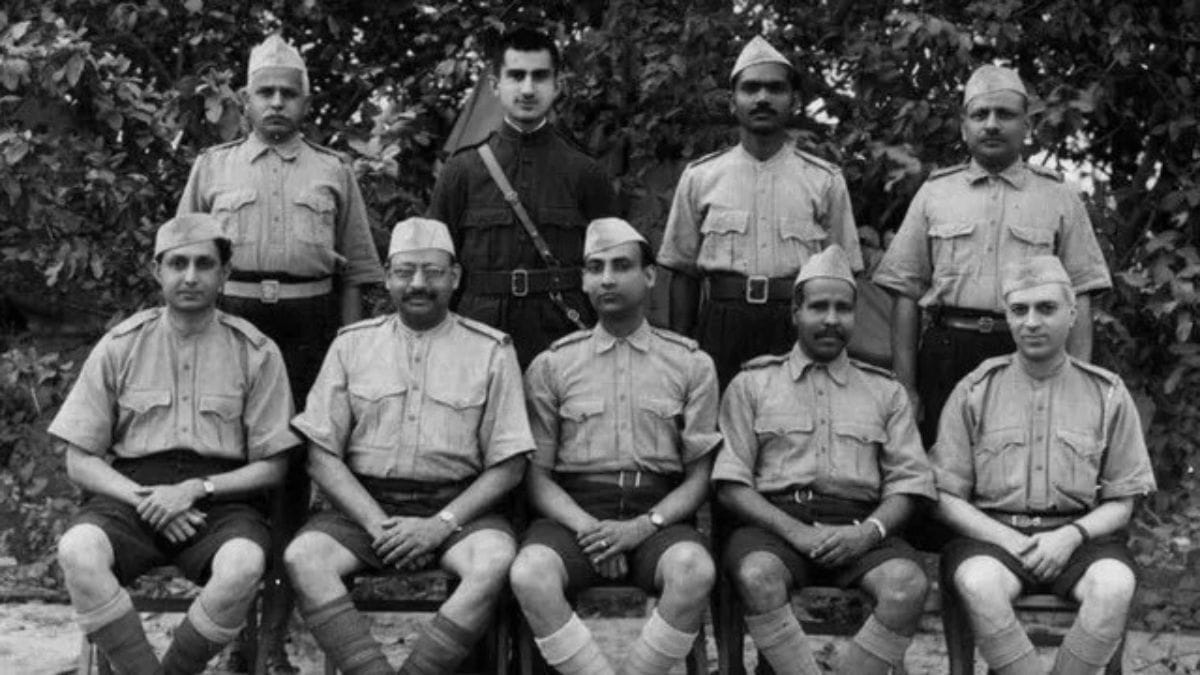
Seva Dal volunteers wore blue shorts, white half-sleeve shirts, and white caps (Dr. N.S. Hardiker, by VS Narayan Rao, p 166). Its resemblance to the uniform later adopted by the RSS is striking. Given the torrent of falsehoods churned out by the BJP’s IT cell, if they weren’t bent on completely assassinating Nehru’s character, it would suit them to portray him as a ‘devout Sanghi’ by circulating his old photographs in Seva Dal attire.
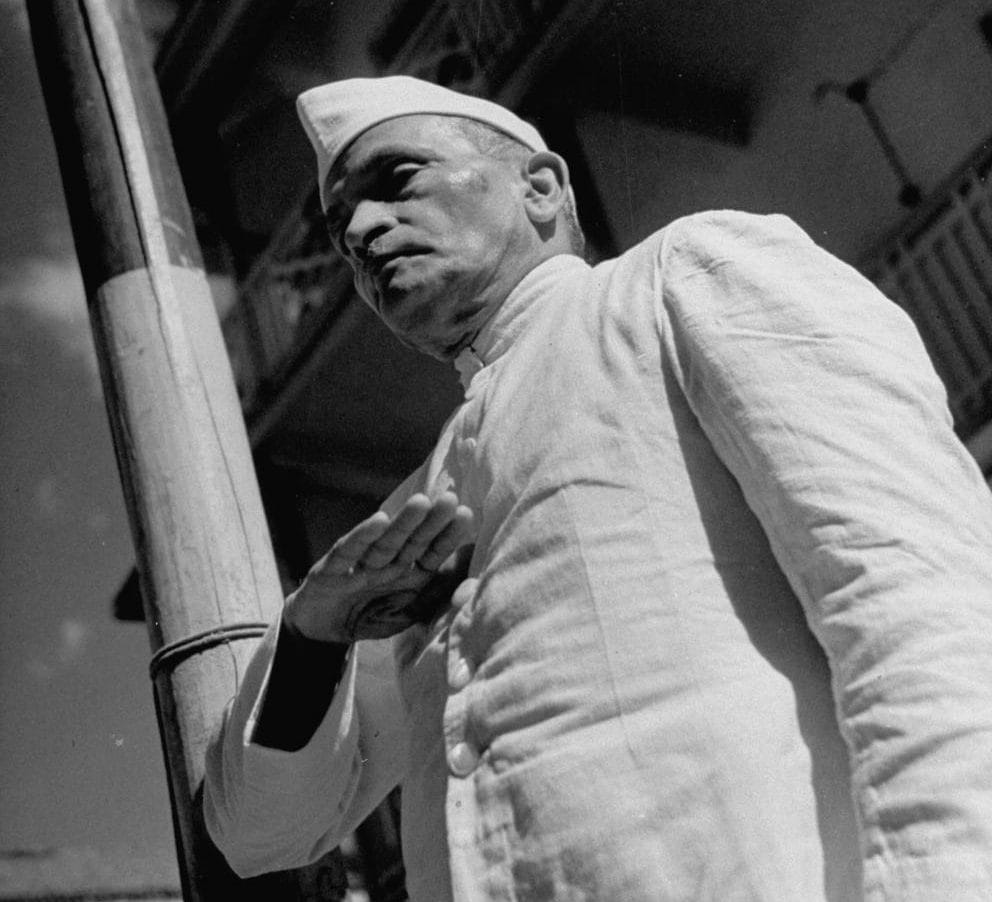
Hindustani Seva Dal, which merged with the Congress to become the Congress Seva Dal in 1931 and later evolved into the Rashtriya Seva Dal in 1941, had a distinctive style of salutation. It was captured in an old photograph of Mumbai Congress leader Nagindas Master: his right arm bent, palm flat across the chest. Today it is instantly recognised as the ‘Sangh style’, revealing the inspiration behind the RSS’s own salute.
The Nehru-Gandhi playbook
The RSS’s hostility toward Nehru ran deep, rooted in his refusal to trust the Sangh because of what he called its communal and fascist mentality. In response, the RSS set about appropriating nearly every nationalist figure except Nehru and Gandhi. Sardar Patel proved handy, first as a stalwart to diminish Nehru, and later even to undercut Gandhi. The irony, of course, was that Patel was a lifelong Congressman and Gandhi’s trusted lieutenant, drawn into the freedom struggle by Gandhi’s unique leadership.
Yet the Right weaponised the ‘injustice to Sardar’ narrative to claim he was the rightful prime minister, unfairly denied by Gandhi’s supposed favoritism toward Nehru. This served a dual purpose: tarnishing Gandhi while reducing Nehru’s stature, regardless of his bright record as India’s first prime minister. The irony of ironies: it was Patel who, as home minister, banned the RSS after Gandhi’s assassination, lifting the ban only six months later under certain conditions.
In the decades after Independence, Patel’s memory gradually faded within the Congress, making the Sangh’s task easier. The erection of Patel’s statue in Gujarat, hailed as the world’s tallest, was, in fact, appropriation on the grandest scale. It might be called the Statue of Appropriation.
Anyone who had differences with Gandhi or Nehru was ripe for appropriation by the Right. Thus, Prime Minister Narendra Modi played the ‘injustice to Subhas Chandra Bose’ card, claiming to rectify it by installing his statue at the canopy behind India Gate—while conveniently ignoring Bose’s disdain for right-wing politics.
Likewise, the memory of the martyr trio Bhagat Singh, Sukhdev, and Rajguru is routinely appropriated by the Right. Over a decade ago, a false claim spread in Gujarat that the revolutionary trio was executed on Valentine’s Day. This misinformation was used to co-opt their legacy and shame people for celebrating Valentine’s Day as an ‘anti-Indian’ cultural practice. Even after it was debunked, the myth lingered in online discourse for several years. A few years ago, I attended a book fair organised by the Surat Municipal Corporation. At one of the stalls run by the Vishwa Hindu Parishad, I noticed photographs of the revolutionary trio prominently displayed, clearly intended as part of their effort to recruit young people.
Bhagat Singh embodied everything the Right despises—leftist, secular, atheist, intellectual. Yet Modi tried consistently to appropriate his legacy, disregarding history. At a function celebrating 20 years of Gujarat’s urban development in 2025, he paid tribute to Bhagat Singh, Sukhdev, Rajguru, Bose, Gandhi, and Patel—conspicuously omitting Nehru while adding Savarkar to the list. Earlier, in 2018, he claimed that no Congress leader had visited Bhagat Singh, Batukeshwar Dutt, or Savarkar when they were imprisoned. In reality, it is well-documented that Nehru met Bhagat Singh and other revolutionaries in Lahore Jail in 1929.
Facts, however, have never been the Right’s strength. Turning anyone who ever sparred with Nehru-Gandhi into a trophy of appropriation has long been both its sport and strategy, and a rather successful one.
Urvish Kothari is a columnist and writer based in Ahmedabad. He tweets @urvish2020. Views are personal.
(Edited by Prashant Dixit)