



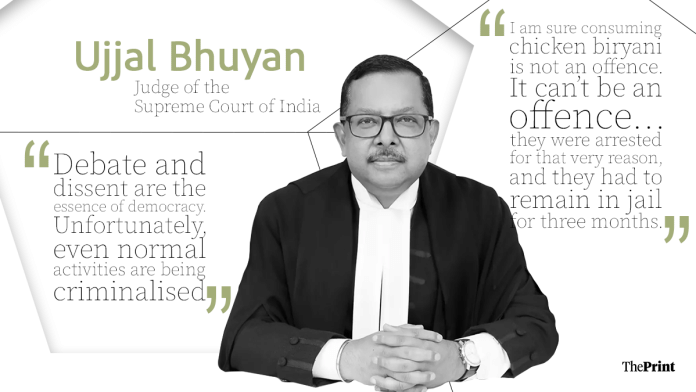
New Delhi: Most weekend memorial lectures by sitting judges pass with little public attention. Not those delivered by Supreme Court Justice Ujjal Bhuyan, who has often used such platforms to candidly critique the judiciary’s role in some of India’s most politically and constitutionally sensitive issues—a rarity in today’s judiciary.
The issues and incidents he has spoken about with unusual candour for a SC judge over the past year are varied—the criminalisation of protests and shrinking space for dissent, arrests of 14 Muslim youths in March for holding an Iftar on the Ganga in Varanasi, Bombay HC refuting to allow a solidarity demonstration in support of Palestine, judicial independence and post-retirement appointments.
Appointed the Additional Judge of Gauhati High Court in 2011 and confirmed in 2013, Justice Bhuyan was elevated to the top court in 2023. In between, he served in the Bombay High Court in 2019, and the Telangana HC in 2021, where he also took charge as the chief justice in 2022. Set to retire in August 2029, he is not in line to become the chief justice of India.
In his latest speech—delivered on 25 July at the 4th Memorial Lecture of Justice G.P. Singh at the National Law Institute University (NLIU), Bhopal—the sitting Supreme Court judge raised critical structural concerns about civil liberties, the criminalisation of protests, and the functioning of the judiciary.
“The right to express one’s views and to demonstrate peacefully are fundamental freedoms of the citizens. Debate and dissent are the essence of democracy. Unfortunately, even normal activities are being criminalised”, he said, making a reference to the Cockroach Janta Party-led protest, and agitation by other student groups.
He noted how dissent and protests are very central to India’s democracy.
“These issues raise serious questions…though the courts are responsive and do grant bail, many a time it is belated. But it is the restrictive conditions which are imposed while granting bail that are causing the greatest concern. By such restrictive orders, are the courts indirectly telling the citizens or discouraging the citizens not to express their dissent?” he said.
Justice Bhuyan also spoke on the ‘Ganga-Iftar boat’ case. In March 2026, 14 Muslim weavers were arrested for allegedly hurting religious sentiments after they organised an Iftar party on a boat in the middle of the Ganga in Varanasi. They allegedly ate non-vegetarian food and threw leftovers into the river. They were granted bail in May by the Allahabad High Court.
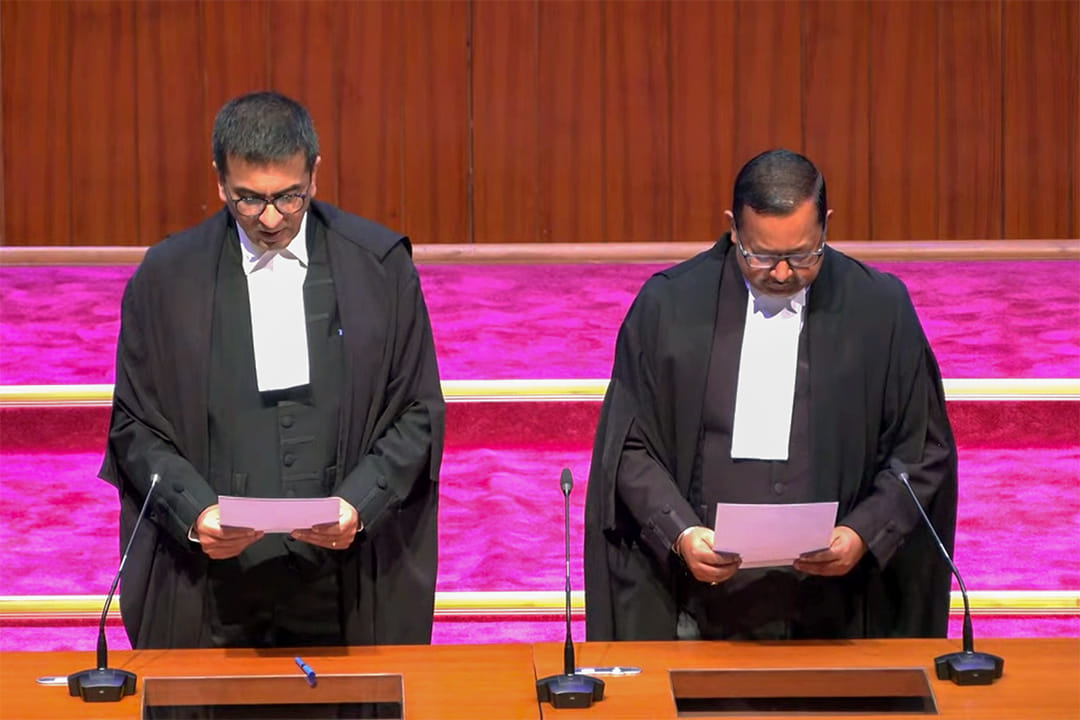
“I am sure consuming chicken biryani is not an offence. It can’t be an offence…they were arrested for that very reason, and they had to remain in jail for three months,” he said on Saturday, criticising their arrest.
On 18 July , speaking on ‘Arbitration in India: Reform, Relevance and the Road Ahead’, organised by The Law Forum, Justice Bhuyan opined it is pointless to celebrate arbitration weeks if court verdicts and policies undermine arbitration.
It was at this event that Justice Bhuyan described the April 2024 Supreme Court curative judgment—which overturned an SC ruling upholding an arbitral award directing the Delhi Metro Rail Corporation to pay nearly Rs 8,000 crore to DAMEPL over the Airport Express Metro Line concession agreement—as one that had caused “the most extensive damage to arbitration in India.”
The Delhi Airport Metro Express Private Limited was a Reliance Infrastructure-led consortium that operated the Airport Express Metro Line under a concession agreement, before handing over the operations to the DMRC in 2012.
It will be a sad day for the judiciary if a decision becomes a foregone conclusion the moment a case is listed before a (certain) judge: Justice Bhuyan.
Referring to the decision, Justice Bhuyan highlighted how the court “undertook a detailed review of the merits of the claims and reappreciated the evidence in what was effectively the fifth round of challenge to the award”.
“Erratic court verdicts and regressive policies like the above act as barriers to India’s efforts to position itself as a global arbitration hub,” said Justice Bhuyan.
In the GV Pandit Memorial Lecture in January in Pune, he highlighted the concern over transfer of judges. Making no direct reference to Justice Atul Sreedharan’s transfer, at the Central government’s request, he questioned the basis of such transfers, asking why a judge should be moved from one high court to another “just because he passed certain inconvenient orders for the government”.
“It will be a sad day for the judiciary if a decision becomes a foregone conclusion the moment a case is listed before a (certain) judge,” he said.
In October 2025, delivering a special lecture on ‘Judicial Professionalism, Etiquette and Expectations from Judicial Officers’ in Guwahati, he said, “It is essential that judgments are pronounced in an atmosphere free from any form of external influence. The judiciary should never be seen to be bestowing any kind of favour”.
On ‘bulldozer justice’
In his GP Singh memorial lecture Saturday, he also spoke about the 2024 SC judgment against punitive “bulldozer justice”. Justice Bhuyan said the ruling was welcomed but it came “two years too late”.
Justice Bhuyan also criticised the recent Bombay High Court order refusing to allow a solidarity demonstration in support of Palestine, calling the court’s observation “very amusing’. He also recalled the petitioners being questioned about their intentions even though India has a Palestinian Embassy.
Justice Bhuyan deprecated the practice of ex-judges getting into political roles after retirement.
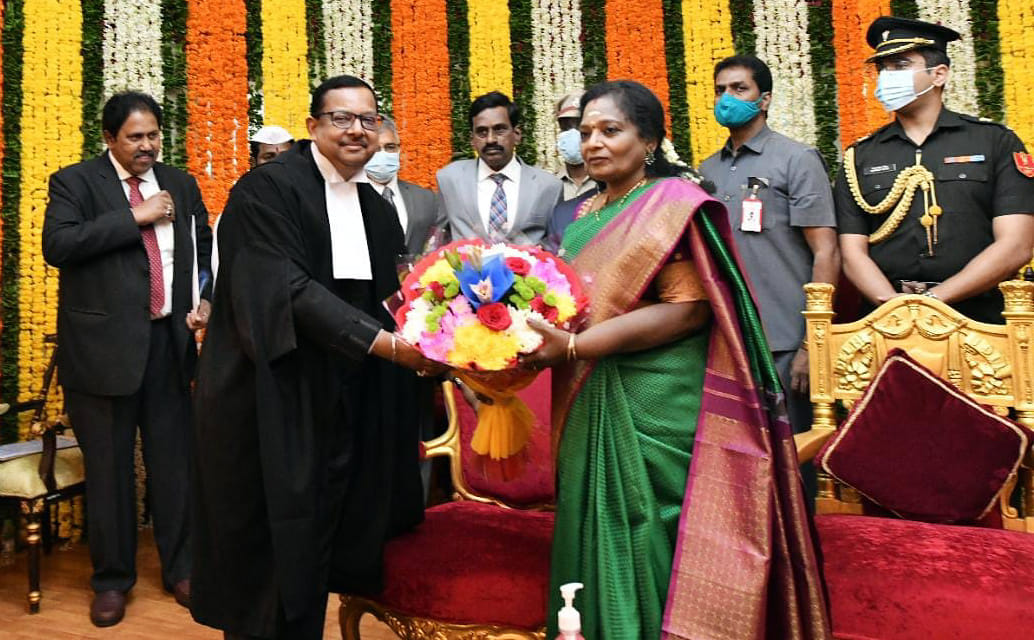
“When a former Chief Justice of India says, ‘I am going to the Rajya Sabha to bridge the gap between judiciary and the Executive’, it is fundamentally wrong… There is a fundamental fallacy in it”, Justice Bhuyan said Saturday.
Addressing the incoming batch of students at Dr. B.R. Ambedkar National Law University, Sonepat, last week, he advised them to not to enter the “rat race” and make their full effort to recognize and take up the many sufficient opportunities provided by the legal profession.
‘When a former Chief Justice of India says, ‘I am going to Rajya Sabha to bridge gap between judiciary and Executive’, it is fundamentally wrong…there is a fundamental fallacy in it,’ Justice Bhuyan.
‘Judiciary neither eternal critic, nor cheerleader’
Speaking at the first-ever Supreme Court Bar Association Conference held in March this year, Justice Bhuyan raised alarms over women’s poor representation in the judiciary and the collegium decisions.
“In the 25 High Courts, we have only two women chief justices – Gujarat and Meghalaya. One more will become a Chief Justice in a month’s time. That is also highly inadequate, three out of 25 HCs,” he said, adding that “my research shows that whenever the recruitment process is objective, more women enter the judicial space. When India becomes a developed nation (Viksit Bharat by 2047), there should be more parity in gender representation in judiciary. SC must be a rainbow institution, truly reflecting the diversity of the nation.”
“My model of Viksit Bharat is equal distribution of wealth and disappearance of acute disparity… which is also the goal set in directive principles of state policies in the Constitution,” he said, adding that in developed India the “judiciary must remain judiciary” and “it can’t be an eternal critic or a cheerleader”.
“Parents cannot insist that their children will not have food prepared by a Dalit woman. That cannot be a Viksit Bharat model. We cannot have Viksit Bharat when Dalit people are made to stand in the corridor and people urinate on them. This can’t be the model of development. Respect for the individual must be protected,” he said.
Importantly, he said, “Debate should not be criminalised. There should be more tolerance towards diverse views. Divergent views should be respected. There should be more tolerance towards diverse views and criticism.”
On the lower rate of convictions under the Unlawful Activities Prevention Act, Justice Bhuyan said, “Low convictions under UAPA show overuse, if not misuse, of the law”, noting the conviction rate is around 5 percent even though thousands are arrested in UAPA cases.
“It shows consistently low conviction. What does it indicate, overuse if not misuse, and its impact on the criminal justice system. How much burden does it put on courts? This shows the vast majority were arrested but could not be convicted. This indicates many arrests were premature and unsupported by sufficient evidence,” the judge said.
(Edited by Ajeet Tiwari)