



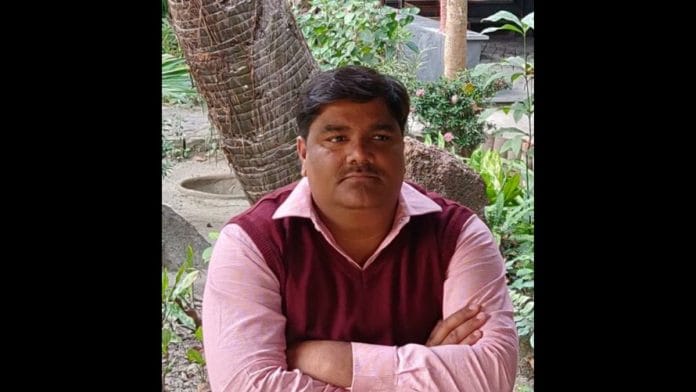

New Delhi: Delhi’s Karkardooma Court has convicted former AAP municipal councillor Mohd. Tahir Hussain, along with four others, for kidnapping with intent to confine and murder of Intelligence Bureau (IB) officer Ankit Sharma during the 2020 North East Delhi riots. In an exhaustive 320-page order Monday, the court said that Hussain was not only a member of an unlawful assembly, but played a pivotal role in instigating the mob that ruthlessly assaulted and killed Sharma before dumping his body in a drain.
In February 2020, when communal violence erupted in North East Delhi after protests against the Citizenship (Amendment) Act 2019 and anticipated National Register of Citizens exercise, 26-year-old IB official Ankit Sharma went missing near the Chand Bagh Pulia. He was dragged by a violent mob into the house of local councillor Hussain, where he was brutally stabbed 51 times, and his body dumped into a nearby drain.
The Aam Aadmi Party later suspended Tahir Hussain following a First Information Report against him. Hussain was subsequently arrested by the Delhi Police Crime Branch in March 2020.
After Monday’s conviction, the court of Additional Sessions Judge Parveen Singh will be proceeding with the sentencing of the convicted individuals from 23 July.
ThePrint looks at the key evidence that led the court to convict Hussain and others.
Hussain’s residence
Physical and forensic evidence has established that Hussain’s building (E-7, Khajuri Khas) served as a primary base for rioters. An inspection by the Forensic Science Laboratory (FSL) team on 28 February 2020, uncovered debris, stones, bricks, and broken glass bottles scattered in front of and inside the premises.
Most damning was the discovery of petrol bombs, acid bombs, and a catapult on the third floor and terrace of the building. Witnesses testified that the mob used these weapons to attack the rival community and their properties, transforming the residence into a strategic location for the riotous assembly.
The prosecution produced several “natural” witnesses whose presence near the crime scene was corroborated by their local business or residence. Priyanka Gaur, an advocate residing in the area, testified to seeing Hussain on the road near his house. She stated that through inflammatory body language and gestures, Hussain was instigating the mob to move towards the Dayalpur side. Vikalp Kochar—the owner of the nearby ‘Bunny Bakers’, which was looted and burnt—gave a vivid account of the murder. While he did not initially identify Hussain in the mob between 3 and 6 pm, the court noted his testimony established the timeline and brutal nature of the killing of the “IB guy”.
Akash and Bharat are brothers who were near the Chand Bagh Pulia when they witnessed Hussain delivering inflammatory speeches, claiming Hindus had looted Muslim homes and exhorting the mob to “teach them a lesson”. Akash even testified to seeing Hussain holding a knife and participating in the assault.
Instigation and vicarious liability
Police witnesses, Head Constables Rahul and Praveen Kumar, “deposed about the presence of an aggressive, communally charged, and heavily armed mob”.
The order noted Delhi Police’s contention that Head Constables Praveen and Rahul, Pradeep Verma, Aakash, Bharat, Vikalp Kochar and Priyanka Gaur have “categorically deposed that they saw Tahir Hussain actively instigating the mob and upon his instigation, the rioting mob became more violent and killed Ankit Sharma”, and “delivering inflammatory speeches and exhorting the mob to attack Hindus and their properties”.
According to Akash and Bharat, “Tahir Hussain was delivering an instigating speech, stating that Hindus had vandalised and burnt Muslim houses and shops and had molested Muslim women, and therefore the ‘kafirs’ should be taught a lesson (Hinduon ne tumhare ghar loote… un kafiron ko sabak sikhana hai).”
The court noted some improvements in the officers’ statements compared to their initial police reports, but it found the core fact of Hussain’s presence and leadership in the mob to be corroborated by other public witnesses.
A critical component of the conviction was the application of Section 149 of the Indian Penal Code (IPC), which establishes vicarious criminal liability for members of an unlawful assembly. The court held that because Hussain was part of a heavily armed mob of hundreds that shared a common object of arson and violence, he was legally responsible for the murder committed by that mob.
The judgement emphasised that “any prudent person, being a member of this assembly, would have known that as this unlawful assembly, which was heavily armed with dandas, stones, petrol bombs and swords, etc. and was clashing continuously with a rival assembly, it was likely that in such clashes which were based upon communal hatred, it was likely that a person belonging to the opposite community could be killed in achieving the common object of causing damage to person and property of the members of the rival community”.
Therefore, Hussain was held liable for murder (Section 302) and abduction (Section 365), even if he did not strike the fatal blow himself.
The court noted how none of the accused has claimed either during the prosecution evidence or their statements or by leading evidence in defence that they were innocent bystanders or curious onlookers, or that they did not share the common object of the unlawful assembly.
“Even a suggestion on these lines was not given to any of the prosecution witnesses to at least indicate an intent to set up such defence. On the contrary, by the nature of the assembly and the activities it was engaged in and the situation which existed at the relevant time, it is less than likely that any person who was a part of this assembly would have been a mere curious onlookers,” Judge Singh said.
Prohibitory order, forensic link
The Delhi Police successfully proved that a prohibitory order under Section 144 of the Criminal Procedure Code was in effect at the time of the incident. Evidence from Assistant Sub-Inspector Naresh Pal and Constable Pawan Kumar—both prosecution witnesses—confirmed that the order had been passed and announcements were made via loud hailers in the Chand Bagh and Karawal Nagar areas.
Hussain’s participation in a large, violent assembly was found to be a direct violation of this legal order, leading to his conviction under Section 188 of the IPC.
Finally, the recovery of Ankit Sharma’s body from the Khajuri nala (drain) was linked back to the violence near Hussain’s building. The post-mortem report revealed 51 ante-mortem external injuries caused by sharp and blunt weapons, confirming a homicidal death. Blood samples collected from the wall of the nala near Hussain’s premises matched the DNA of the deceased, cementing the location of the murder.
(Edited by Nardeep Singh Dahiya)
Also Read: High Court says Athar Khan ‘core conspirator’ in 2020 Delhi riots case, denies bail under UAPA