





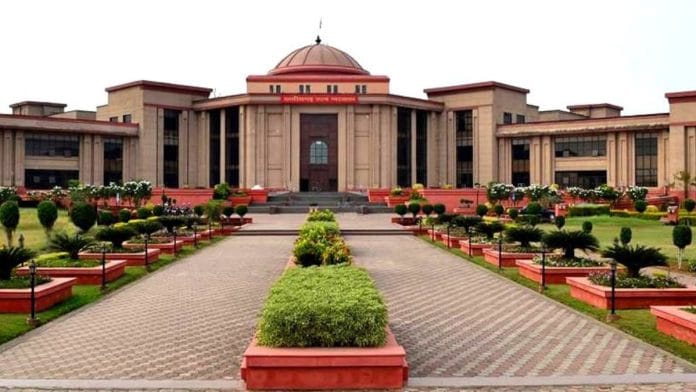


New Delhi: The Chhattisgarh High Court, while deciding the legality of interception orders forming the foundation of a corruption prosecution on 6 August, emphasised: “Interception of telephonic or electronic communications constitutes a serious invasion of the fundamental right to privacy. Such intrusion can only be sustained when it strictly complies with statutory provisions and constitutional safeguards.”
A two-judge bench clarified that the matter before it was not about evaluating evidence but about scrutinising the legality of executive action authorising interception.
It gave the ruling even as it refused to quash the FIR or the chargesheet in a 2025 corruption case, ensuring that the criminal prosecution would proceed.
The bench, however, invalidated the telephonic interception as evidence in the case, holding the procedure adopted was legally unsustainable because it lacked proper authorisation. The court emphasised that telephone tapping is a serious invasion of an individual’s right to privacy guaranteed under Article 21 of the Constitution.
The controversy arose from a corruption investigation into medical college inspections, where the CBI relied heavily on intercepted phone conversations. An FIR registered in June 2025 alleged a nationwide conspiracy involving officials of the Ministry of Health and Family Welfare, members of the National Medical Commission, intermediaries and private medical colleges. Allegations included bribery, ghost faculty, fake patients, and tampering with biometric systems. The petitioner, chairman of a medical institution, was named an accused.
His challenge focused on the legality of the interceptions, arguing that they violated constitutional safeguards. He contended that the authorisation order permitting the interception of telephonic communications was issued on 28 June 2025 for a period between 1 June and 31 July 2025. This made the authorisation letter defective because it was retrospective in nature. Consequently, it was argued any interception between 1 and 27 June was without due process of law.
The central government and the CBI countered that the reference to “1 June to 31 July” was merely an administrative cycle for review purposes, not retrospective authorisation. They insisted that no interception occurred before 28 June.
They further argued that the investigation was supported by multiple forms of evidence: Documents, financial records and witness statements and that the legality of interception should not derail the entire prosecution of the CBI. The admissibility of intercepted material, they maintained, was for the trial court to decide.
The court examined the constitutional and statutory framework governing surveillance. It reiterated that interception is an exception to the fundamental right to privacy under Article 21 and therefore requires strict construction. Citing Supreme Court precedents, it reaffirmed that telephone conversations are private and that procedural safeguards are mandatory to prevent arbitrary surveillance.
At the same time, the court emphasised that under evidence jurisprudence, official acts carry a presumption of validity. Unless mala fides or clear non‑compliance are shown, interception orders cannot be invalidated merely due to discrepancies in wording.
The court adopted a nuanced position. It invalidated interception for the disputed period prior to authorisation, but refused to quash the entire criminal proceeding. It recognised that while the authorisation order was issued only on 28 June and to the extent interception was claimed before authorisation, it was legally unsustainable.
But, the CBI prosecution case rested on multiple forms of evidence, and the court allowed the trial to proceed, with admissibility of the disputed material left open.
The court explained, “This approach preserves both competing constitutional values. On one hand, it ensures that the procedural safeguards protecting the fundamental right to privacy are not diluted by permitting retrospective or jurisdictionally defective authorisations. On the other hand, it equally ensures that a criminal prosecution supported by independent and otherwise admissible evidence is not terminated merely because one part of the investigation is found to be legally unsustainable.”
(Edited by Viny Mishra)
Also read: How SC’s right to privacy judgment influenced rulings — Section 377, trans rights, phone tapping