





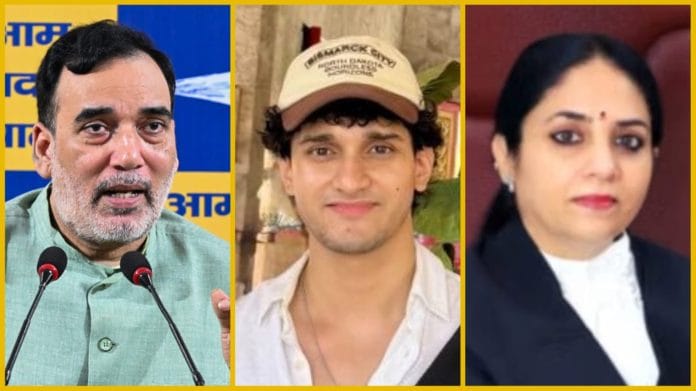


New Delhi: The Delhi High Court Friday sought replies from journalist Saurav Das and Aam Aadmi Party (AAP) leader Gopal Rai on a petition filed by a lawyer seeking contempt action against them for allegedly posting objectionable content against Justice Swarana Kanta Sharma on social media.
The two-judge bench of Justices Navin Chawla and Ravinder Dudeja listed the case for further hearing on 4 August this year. The court also directed the Registry to safely preserve or record the social media content which the petitioner named Ashok Chaitanya relied on to file the case.
Although the plea also sought contempt action against other AAP leaders, such as former Delhi chief minister Arvind Kejriwal and former state minister of health Saurabh Bharadwaj, the court said they had already been issued notices in the suo motu contempt case initiated by the high court bench of Justice Sharma on 14 May. Both cases have now been tagged together and will be heard in August.
“The constitutional guarantee of free speech includes the right, not just of journalists, but of every citizen, to fairly scrutinise and critique judicial functioning and administrative decisions that have a bearing on public confidence in the institution,” Das told ThePrint.
“Journalism that seeks to uncover these uncomfortable facts in the largest of public interests is part of the constitutional duty of the fourth pillar,” he asserted, adding that asking questions cannot amount to contempt.
Asserting that the allegations made in the posts against the judge’s family were factually incorrect, the plea states that empanelment of advocates by government bodies is a routine process based on merit and professional competence.
“The attempt to attribute impropriety to such empanelment is wholly baseless and intended to malign the integrity” of the judge, it adds.
Also Read: A recusal after refusal to recuse: Why Justice Sharma framed contempt charges against Kejriwal & co
Why plea seeks contempt action
Broadly, the plea filed by advocate Chaitanya invoked Section 15 (1) of the Contempt of Courts Act, 1971, which states that the Supreme Court or high courts can take cognisance of criminal contempt based on a motion by anyone. Besides this, the plea also relied on Article 215 of the Constitution which says that every HC has the power to punish for contempt of itself.
Section 2(c) of the Contempt of Courts Act states that actions which scandalise the court, or lower its authority or interfere with judicial proceedings or obstruct the administration of justice squarely fall under the definition of “criminal contempt”. Therefore, the plea argues that the court should take cognisance of the “contemptuous posts” put out by Das and others.
The matter originates from the criminal case investigated by the Central Bureau of Investigation (CBI) where Kejriwal was one of the main accused persons, the plea says. The case related to the Delhi excise policy.
After the trial court this February discharged all 23 accused in the case, including Kejriwal, the CBI had approached the Delhi High Court challenging the order, and the same came to be listed before the single judge bench of Justice Sharma.
However, the plea says that while the case before the HC was still pending, Kejriwal “unsuccessfully attempted” to seek its transfer from the judge’s court to another. Subsequently, he approached the Supreme Court.
After this attempt failed, he moved another plea for recusal of Justice Sharma, the lawyer’s plea states, adding that when the recusal plea was about to be heard, Kejriwal, Das and other respondents initiated a “concerted and orchestrated campaign on social media”.
The social media campaign carried out on X essentially published and amplified content containing serious, unfounded and scandalous allegations against the judge, the plea says.
The said posts, among other things, alleged a supposed conflict of interest, bias, and impropriety, and were based on misleading assertions relating to professional engagements of the judge’s family members, it adds.
This content was not just published by one respondent but was actively endorsed, republished and amplified by other respondents in the case, all of whom are persons of significant public standing and influence, according to the plea.
The coordinated nature of the posts, the fact that these were being released during the ongoing proceedings, and the nature of the allegations clearly demonstrated a calculated attempt to lower the court’s authority, and to interfere with the due course of justice, the plea asserts.
It alleges that Kejriwal, himself a litigant in pending proceedings before the judge, had attempted to exert extra-judicial pressure on the court in order to prejudice the proceedings.
The continued availability of these posts in public, coupled with the large number of abusive and contemptuous comments generated under them, has further aggravated the harm and eroded public confidence in the administration of justice, according to the lawyer’s plea.
(Edited by Nida Fatima Siddiqui)
Also Read: Is Kejriwal vs Justice Swarana Kanta unprecedented? How recusals work in Indian judiciary