



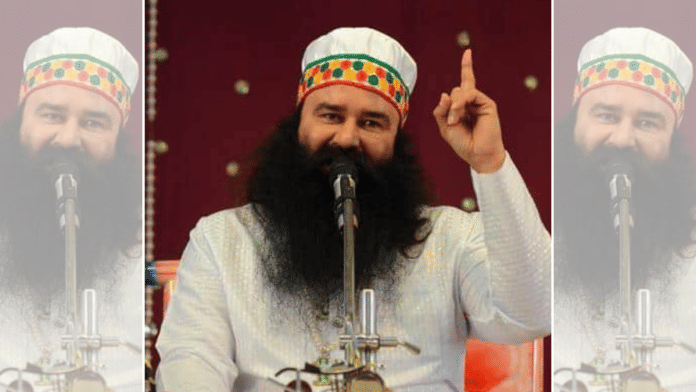
Chandigarh: The Punjab and Haryana High Court has initiated suo motu contempt proceedings against the editors-in-chief and publishers of The Hindu and Dainik Bhaskar over a front-page advertisement the two newspapers carried on 12 September about Dera Sacha Sauda and its controversial chief, Gurmeet Ram Rahim Singh.
The advertisement, titled ‘What is Dera Sacha Sauda? (Facts vs Fiction),’ included a section headed “Was there a conspiracy against Guru Ji?” It answered: “Yes, absolutely”. It alleged that “drug mafias and forces opposed to the Dera” had tried to implicate Ram Rahim through false witnesses and cases, and claimed that these forces were “still engaged in trying to prove this falsehood even today”.
The advertisement appeared while Ram Rahim was out of Rohtak’s Sunaria jail on a 21-day furlough. It was his third release this year and the 17th in nine years since his conviction in 2017 for raping two of his disciples. He is serving a 20-year sentence.
The advertisement also sought to address public criticism over the frequency of his temporary releases. A section titled “Do the paroles and furloughs granted to Ram Rahim amount to VIP treatment?” answered: “No, not at all.” It claimed that his paroles and furloughs had been granted strictly in accordance with the Prisoners Act, 1894, and the Haryana government’s rules.
Nearly a month after the advertisement appeared, a division bench of Justices Vinod S. Bhardwaj and Ravinder Malik on Wednesday issued notices to Dera Sacha Sauda through its management as well as to the publishers and editors-in-chief of the two newspapers. The bench adjourned the matter to 25 November.
The Registry was directed to serve the notices along with copies of the advertisements. The Senior Superintendent of Police, Chandigarh, was asked to assist the Registry in obtaining the details of the persons against whom the proceedings have been initiated.
The proceedings were initiated by Justice Subhas Mehla on 16 September, four days after the advertisement appeared. Taking note of its contents, he initiated contempt proceedings and made the notices returnable on 7 October. The matter was subsequently listed before a division bench in accordance with the roster.
Justice Mehla observed that public appeals and paid narratives portraying courts as part of a conspiracy against a convict or accused, while trials or appeals are pending, could amount to an attempt to mobilise public opinion and influence judicial proceedings. Such conduct, he said, directly obstructs the administration of justice.
Notably, multiple criminal cases against Ram Rahim remain pending before courts including an appeal against his acquittal in the 2002 murder of journalist Ram Chander Chhatrapati and a case involving the alleged forced castration of around 400 Dera followers.
The court took a prima facie view that the advertisement’s contents “may have the tendency to scandalise or lower the authority” of the court, or interfere with the due course of judicial proceedings. It said the allegations therefore required examination under Section 2(c) of the Contempt of Courts Act, 1971. The section defines ‘criminal contempt’, including conduct that scandalises or lowers the authority of a court or interferes with judicial proceedings.
The court also noted that it is a court of record and has the constitutional power under Article 215 to punish for contempt of itself. It added that Section 15(1) of the Contempt of Courts Act, which governs the initiation of criminal contempt proceedings, permits a high court to take cognizance of such contempt on its own motion.
The court accordingly took suo motu cognizance under Article 215 of the Constitution, read with Sections 2(c)(i), 2(c)(iii) and 15(1) of the Act.
The Hindu’s apology
The Hindu had apologised before the court initiated the proceedings. On 13 September, a day after the newspapers carrying the advertisement reached readers, the daily published an apology on its front page, stating: “The Hindu tenders its unconditional apology to its readers for publishing this deeply offensive advertisement.”
Apology — This is a screenshot of the front page of today’s Delhi edition of The Hindu. The apology that appears on this page has been published on the front page of all the editions of The Hindu. pic.twitter.com/manZfhQkER
— N. Ram (@nramind) September 13, 2026
N. Ram, Director of The Hindu Publishing Group and a former editor-in-chief, posted a copy of the apology on X, saying it had appeared on the front page of all editions. The newspaper later said it would not charge Dera Sacha Sauda for the advertisement, describing the decision as being “in keeping with the spirit” of its apology.
(Edited by Chingkheinganbi Mayengbam)