





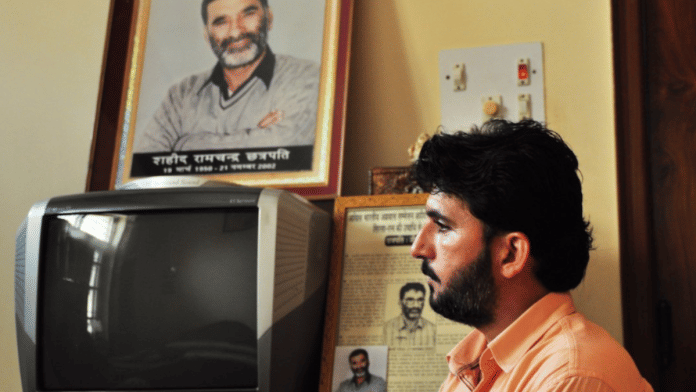


New Delhi: “The journey from High Court to Supreme Court is not a new one and rather unfortunately has been part and parcel of our lives over more than two decades.” Anshul Chhatrapati, a local journalist in Haryana’s Sirsa, says with resignation as he charts his family’s fight for justice for his father.
Anshul’s father, Ram Chander Chhatrapati, was shot in October 2002, months after he had published a series of anonymous letters documenting allegations of sexual assault of disciples at the Dera Sachha Sauda in Sirsa. Chander had published these letters in his newspaper ‘Poora Sach’, originally intended to be delivered to then Prime Minister A. B. Vajpayee and Chief Justice of the Punjab and Haryana High Court.
Chhatrapati had died at a Delhi hospital in November 2002, drawing widespread outrage before the case was handed over to the Central Bureau of Investigation. The central agency charged Gurmeet Ram Rahim Singh, Dera staff Krishan Lal and two assailants who fired at Chhatrapati.
All four of them were sentenced to life imprisonment by a Panchkula court in 2019—which was reversed by the Punjab and Haryana High Court, which acquitted Ram Rahim in March this year. The court, however, upheld the trial court’s sentencing of the trio of Kuldeep Singh, Nirmal Singh and Krishan Lal.
Anshul’s younger brother, Aridaman, moved the Supreme Court challenging the acquittal of Ram Rahim. A bench led by Chief Justice Surya Kant observed at the time of the appeal’s admission that the case required consideration.
“This matter requires consideration. It is a reversal of the conviction. It is not an acquittal affirmed by HC,” the Supreme Court observed earlier this week and listed it for further hearing.
“We are equally conscious that the state (CBI) will not appeal against the acquittal,” the bench further had said at the time.
However, since then, the CBI has started the process of challenging the acquittal.
Anshul has welcomed the CBI’s plan. “The CBI anyway had to come up with the response since we have made them a respondent and a notice has been issued but if they move their own SLP and challenge the acquittal it adds weight to our appeal,” Anshul said.
While the family—comprising the two brothers and two sisters—had decided to challenge the acquittal on the day it was pronounced, they waited a few weeks to review some factors.
“There is a long list of lawyers to fight a case in a professional way, but integrity mattered to us the most. If the person we are looking for to bring justice to us cannot be defiant in the face of the power, money and influence that Ram Rahim has, what hope do we have?” Anshul told ThePrint.
They wanted to list the matter before the Supreme Court in June but could not proceed due to a logistical challenge, he said, adding that the appeal was finally moved by their team of counsel, including senior advocate Nitya Ramakrishnan and Rupali Samuel.
“We have been fighting this battle for 24 years against a person who has such command and influence over the system, who knows all the tricks in the book,” Anshul added.
The world, Anshul said, has moved on from the string of cases against Ram Rahim, but he himself tried to run the newspaper very dear to his father for as long as he could. “I tried very hard to keep the circulation going and ran it until 2015 when I ran out of energy and finances to keep it going,” he said.
“My father never compromised on the integrity of journalism in pursuit of advertisements, and I did not want to dilute that. Hence, I ran the newspaper as long as I could but without diluting the principle of Poora Sach,” he added.
Chhatrapati’s wife and his mother died of a heart attack in 2022, Anshul said.
Single witness with ‘ping pong ball’ behaviour
The entirety of the CBI’s case and allegations against Ram Rahim stood on the testimonies of one Khatta Singh, who was Ram Rahim’s driver during the period of the crime. Chhatrapati was the first journalist to have written and published the anonymous letters related to sexual exploitation of disciples at Dera Sachha Sauda and a series of other stories exposing the alleged wrongdoing at the facility run by Ram Rahim.
The agency had alleged that Ram Rahim had a motive to eliminate Chhatrapti to silence his reporting and rested its case on the revelations made by driver Khatta Singh before the investigating officers.
However, as ThePrint reported earlier, the high court dismissed his witness testimonies, describing him as someone who “kept on tossing from one side to the other like a ping pong ball”.
According to the findings documented in the judgment, CBI recorded Khatta Singh’s statement in June 2007—five years after the incident. Singh had claimed that he had taken Ram Rahim to a congregation in Jalandhar on the evening of 23 October 2002. On their return to Sirsa, the Dera chief was miffed at the report in ‘Poora Sach’, published by Chhatrapati the previous day. Khatta Singh said this provoked Ram Rahim and he directed Dera staff Krishan Lal to “eliminate” the journalist, and the murder took place the following evening.
The CBI recorded this statement under Section 164 of the Criminal Procedure Code (CrPC)—which is recorded before a judicial magistrate. These statements carry greater value than those recorded before an investigating officer under Section 161 of the CrPC.
However, driver Khatta Singh then turned hostile and blamed the CBI officers, alleging that they were coercing him to implicate Ram Rahim by threatening to frame him in murder cases.
In March 2007, he filed an application before a judicial magistrate in Ambala alleging that CBI officers were threatening to implicate him in murder cases unless he made a false statement against Ram Rahim. He also complained to the additional sessions judge at Ambala and to the superintendent of police in Sirsa.
Khattar Singh changed his stance before the court once again in 2017 when Ram Rahim was convicted in a separate but related case of sexual exploitation of disciples at the Dera in Sirsa. Claiming that Ram Rahim’s conviction had given him “courage” to tell the entire truth, he requested the court to recall him as a witness.
After a long legal tussle, during which the trial court rejected his plea before the high court allowed it, Singh appeared before the court and supported the CBI’s case.
However, his flip-flop had already destroyed the credibility of his testimonies and the fact that he was the sole witness to prove the charge of criminal conspiracy against Ram Rahim meant the agency’s case was on a very weak footing.
“It appears that he was coerced by CBI into making a statement as CBI was under pressure to conclude the investigation. It is a matter of grave concern that a premier investigating agency adopted this kind of methodology,” the high court had observed in the judgment, indicting the agency.
Moreover, the court documented an even more damning failure on the part of the central agency, as the investigating officer conceded during cross-examination that Singh’s claim that he took Ram Rahim to Jalandhar on 23 October 2002 and returned the following day was never corroborated by the agency during the investigation.
On the other hand, Aridaman argued that the High Court failed in understanding the structure of decision making at Dera and that no Dera staff can execute such a conspiracy without go-ahead from Ram Rahim.
“The high court has glossed over the fact that all three co-accused—shooters Kuldeep Singh and Nirmal Singh, and the provider of the weapon Krishan Lal—were all employed at Dera and under the control and influence of Ram Rahim,” Aridaman argued in his appeal moved before Supreme Court.
“It is well known that the Dera follows a unitary structure, i.e., the Dera chief is the all-powerful head of the Dera and exercises exclusive and sole authority over the entire organisation. The possibility that employees of the Dera, including the manager, could have acted in deliberate secrecy from the Dera chief over several months, making threats in his name, vandalising newsrooms, beating up journalists, and ultimately to plan and execute the murder of the journalist writing about the Dera chief’s own criminal actions, is too remote to raise any “reasonable” doubt about the involvement of Baba Gurmeet Singh in the conspiracy,” he further argued, pinning the blame of the murder squarely on Ram Rahim.
For Anshul Chhatrapati, the dark history of 24 October 2002 is a legacy that will cast a shadow over the rest of their lives. “My brother was the complainant in the case, and he is the appellant before the Supreme Court. We have not told anyone where he is currently,” Anshul said about his younger brother Aridaman.
(Edited by Viny Mishra)
Also read: Ram Rahim out on 16th release, 2nd this year; arrives at Sirsa Dera in convoy of luxury vehicles