


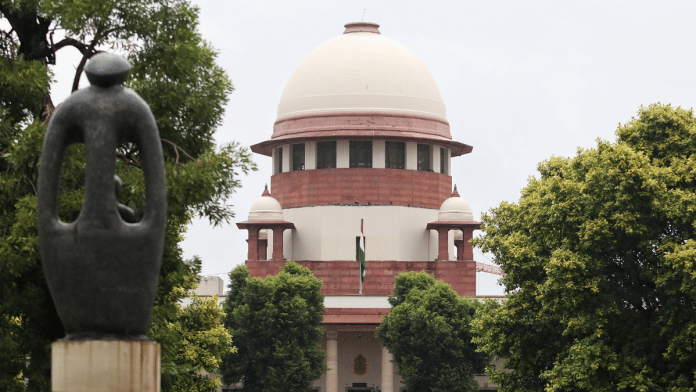
New Delhi: The Supreme Court Thursday held that the 24-hour constitutional deadline for producing a person before a magistrate begins from the time of detention, and not when the law enforcement agency formally records the arrest.
In a judgment reaffirming personal liberty as a fundamental constitutional safeguard, a bench of Justices Ujjal Bhuyan and Atul S Chandurkar said there was no distinction between “arrest” and “detention” for the purpose of Article 22(2) of the Constitution.
“The view that 24 hours begins only from the formal arrest is contrary to the constitutional mandate and Section 58 of BNSS,” the bench said.
The court clarified that the only period that can be excluded while calculating the 24-hour deadline is the time required to travel from the place of arrest to the magistrate’s court. Time spent on investigation, enquiry or search and seizure before a formal arrest cannot be excluded.
It also said that detention must be reasonable in the circumstances of the case, even if it does not exceed 24 hours. Magistrates must examine whether the period of detention was reasonable when the person is produced before them.
What is Article 22(2)
Article 22(2) of the Constitution mandates that every person arrested and detained in custody must be produced before the nearest magistrate within 24 hours. Section 58 of the Bharatiya Nagarik Suraksha Sanhita (BNSS), 2023, similarly prohibits police officers from detaining an arrested person without a warrant for more than 24 hours.
The bench said the expressions “arrested” and “detained” in Article 22(2) must be read together and not treated as separate stages. Creating an artificial distinction between the two could allow law enforcement agencies to keep a person in custody during an investigation before formally recording the arrest, thereby circumventing the constitutional safeguard.
“Therefore, the dichotomy that the period of 24 hours for clause (2) of Article 22 commences from the completion of such search and seizure and only from the time of arrest recorded by the arresting authority is not only unsustainable in law but is entirely unconstitutional,” the court said.
Also Read: 22 protesters booked for obstructing police during march towards Jantar Mantar
Reservations on NDPS cases
The bench also expressed reservations about a two-judge bench ruling earlier this year in Sukhwinder Singh vs Union of india, which held that the right to a speedy trial under Article 21 cannot override the stringent statutory conditions for granting bail under the Narcotic Drugs and Psychotropic Substances (NDPS) Act.
The court said the 2026 ruling failed to adequately consider the Supreme Court’s 2021 three-judge bench judgment in K A Najeeb vs Union of india. The latter held that prolonged incarceration and the denial of a speedy trial could constitute grounds for granting bail even under stringent laws such as the NDPS Act and the Prevention of Money Laundering Act (PMLA).
The 2026 judgment had acknowledged that the right to a speedy trial was rooted in Article 21 but held that, in cases involving commercial quantities of contraband under the NDPS Act, this right had to be exercised within the framework of the law and could not override statutory restrictions on bail.
The bench on Thursday disagreed with this approach, observing that fundamental rights guaranteed under Article 21 could not be diluted by special legislation.
“We have our reservations on the aforesaid observations made by the bench. First and foremost, the rights conferred by Article 21 of the Constitution are not only constitutional rights, but these are fundamental rights. The right to life and liberty as enshrined in Article 21 is at the core of our constitutional jurisprudence. These fundamental rights cannot be tinkered with so lightly, not even under a special statute,” it said.
What was the case about?
The judgment came on an appeal filed by four persons arrested in connection with the seizure of 11.03 kg of Yaba tablets. The Tripura High Court had denied them bail, holding that the stringent conditions under Section 37 of the NDPS Act had to be satisfied in cases involving commercial quantities of contraband.
The accused had challenged the legality of their arrest, claiming they were detained on September 29, 2025, at 2 pm during a search and seizure operation but were formally shown as arrested only at 11 am the following day.
The High Court rejected their argument, relying on the Supreme Court’s 2026 ruling in Sukhwinder Singh. It also held that prolonged incarceration and delays in trial could not, by themselves, override the statutory restrictions on bail under the NDPS Act.
Allowing the appeal, the Supreme Court rejected the argument that detention for a brief period before formal arrest did not amount to arrest.
Guidelines for magistrates
The court overruled judgments of the High Courts of Orissa, Kerala and Madras that had held that pre-arrest detention could be excluded while calculating the 24 hours under Article 22(2). It held that these decisions did not lay down the correct position in law, while approving another Kerala High Court ruling that had taken the contrary view.
Flagging the possibility of law enforcement agencies misusing the detention period, potentially leading to custodial violence, the bench issued directions to ensure compliance with the constitutional safeguard.
It directed magistrates to record the actual date and time from which a person’s liberty was curtailed and examine whether they were produced within 24 hours. They must also assess whether the detention was reasonable in the circumstances.
If the magistrate finds that detention has exceeded a reasonable period, they may decline remand. If a person has been detained beyond the constitutionally permitted 24 hours, the magistrate must order their immediate release.
(Edited by Anupama Yadav)