


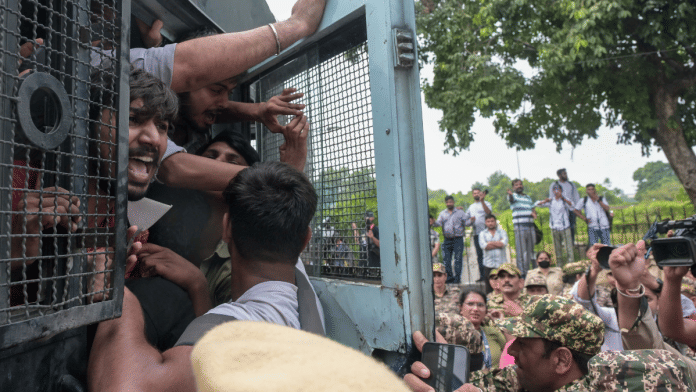
New Delhi: Issuing notices on close to 46 fresh matters linked to detentions of protesters and restrictions in Delhi on 10 October, and the de-notification of Jantar Mantar as a designated protest site, a bench of the apex court led by Chief Justice of India Surya Kant observed Thursday, “Nobody can browbeat the Supreme Court.”
On the petition filed by the Opposition against the allegedly unilateral decisions taken by Chief Election Commissioner Gyanesh Kumar and “irregularities” in Special Intensive Revision (SIR) of voter rolls, the bench—also comprising Justice Joymalya Bagchi—issued a notice to the Election Commission of India.
However, it also sought a response from Opposition leaders themselves—Congress’s Rahul Gandhi and Mallikarjun Kharge, Samajwadi Party’s Akhilesh Yadav, and Kerala Congress—on a petition demanding contempt action against them for their procession inside Supreme Court premises on 12 October, the day they filed the petition.
“You also have to explain your conduct,” the bench verbally remarked. “We don’t live in ivory tower. Nobody can browbeat the judiciary. These are futile attempts and nobody takes note of it.”
The remarks were made when senior advocate Gaurav Bhatia, appearing for the petitioners who have sought contempt action against Gandhi and others, argued that a political rally was held inside the apex court premises. He said it was an attempt to browbeat the judiciary.
The Supreme Court has also issued a notice to Centre and Delhi Police on a plea challenging Jantar Mantar’s de-notification as designated protest site. The bench also asked Delhi Police to file a response to petitions questioning the imposition of Section 163 of Bharatiya Nagrik Suraksha Sanhita (BNSS) that prohibits a gathering of more than five persons in selective areas. On 10 October, Delhi Police had invoked this provision to prevent the protest called by the Cockroach Janta Party against CEC Gyanesh Kumar.
The bench has also asked the two Bar Associations of the Supreme Court—Supreme Court Bar Association and Supreme Court Advocates on Record Association—to give suggestions to protect the dignity of the judiciary.
Women journalists’ alleged harassment
Tempers flew high in the courtroom as a group of lawyers, representing those who were detained and allegedly tortured on 10 October, traded charges with the opposite side, comprising Delhi Police and individuals who questioned the manner in which protests were and Gandhi’s 12 October rally was held.
The two sides contested each other, when senior advocate Indira Jaising accused police personnel of sexually harassing women journalists present at the protest site. She said the problems faced by them required to be addressed specifically since they go out on field to perform their duties in exercise of their right to work.
She gave the example of the woman journalist against whom an FIR under Scheduled Castes and Scheduled Tribes (Prevention of Atrocities) Act has been registered at the instance of the police officer that she had accused of sexually harassing her. Women journalists are at the risk of facing criminal prosecution, Jaising said, offering to give, in a sealed envelope, names of women journalists who had allegedly been victims of harassment at the hands of police officers while on duty on 10 October.
She demanded that the court set up a committee, preferably headed by a woman, to lay down guidelines on how police and other government authorities should deal with women journalists who form a “class apart”.
Jaising also urged the bench to pass an order asking the police to refrain from registering fresh FIRs against any woman journalists, and said that every citizen has a right to be an independent journalist. She further questioned Delhi Police’s view that only Press Information Bureau-accredited journalists should be on field, and said that as long as a mediaperson carries an identity card issued to them by their employer, they should not be stopped from reporting.
Responding to this, Solicitor General Tushar Mehta sought to clarify that in a protest-like situation, it is difficult to know who is a “reel maker” and who is an independent journalist. He said that no woman should be mistreated, and that would include women police personnel. He objected to Jaising’s plea to issue a blanket ban against registration of FIR against female journalists, and the constitution of a committee, saying that the court should do so only upon concluding that enough is not being done.
Bhatia, too, intervened and raised the issue of the two-month pregnant woman journalist, who alleged that Rahul Gandhi pushed her during his 12 October protest march to the Supreme Court. He urged the top court to take note of this, even asking Jaising to take up the journalist’s cause. To this, one of the counsel from the protesters’ side said Bhatia was politicising the issue.
On Delhi curbs, Jantar Mantar
During the hearing, the Supreme Court bench told Mehta that it would like to know why and when the notification to impose BNSS Section 163 to prohibit gatherings was issued and what procedure was followed.
Concerns over de-notification of Jantar Mantar as a designated protest site in the national capital was also raised before the bench, which asked Mehta to explain the reasons behind the decision. “We want to know whether there was an application of mind or just on the oral observations of the court (SC) you took the decision,” the bench said.
Senior advocates Mukta Gupta and Gopal Sankaranarayanan said that the government could not have taken this step, especially since there is an earlier top court judgment on this subject. Back in 2018, the court had stopped the government from de-notifying the space as a designated protest site.
On 9 October, the top court had remarked orally that the Delhi Police’s hesitation in allowing CJP to protest at Jantar Mantar could be due to its geographical location.
Mehta denied that the decision was taken pursuant to the court’s observation. He said a committee was constituted, and after receiving a detailed report, the de-notification order was issued.
Gupta submitted that every citizen has the right to protest, and that the top court had noted in its 2018 judgement that the protest site should be somewhere where they can be heard. “New Delhi is not meant for a select few,” she told the court.
The court also directed the Delhi Police to preserve CCTV footage from 10 October, including that of the Supreme Court area and its precincts. A response was also sought on petitions alleging that the police had seized electronic devices of journalists covering the protest.
This is an updated version of the report.
(Edited by Mannat Chugh)
Also Read: 10 Oct protest: Home secy, police chief apologise to SC over Delhi curbs—‘no wilful breach’ of order