



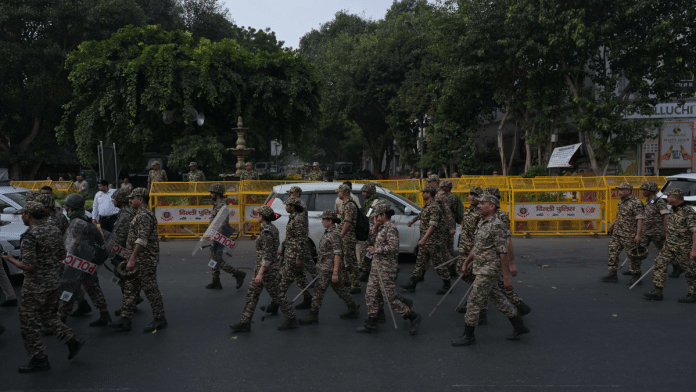
New Delhi: Union Home Secretary Govind Mohan has offered an unconditional and unqualified apology to the Supreme Court for the alleged breach of its 9 October order for no unregulated restrictions on 10 October, when the Cockroach Janata Party had called for a protest against Chief Election Commissioner Gyanesh Kumar.
In a short six-page affidavit, Mohan has, however, explained the causes for suspension of cellular internet services in various parts of Delhi, saying the step was taken to maintain peace and public order.
In a separate affidavit, Delhi Police Commissioner Anurag Kumar, too, tendered an unconditional apology with regard to the force’s request to Delhi Metro Rail Corporation (DMRC) for closure of entry and exit to a number of stations. He submitted that there was no wilful violation on his part, and that the police decision to refuse permission to CJP was taken on account of its past conduct.
He added that in July, CJP had taken permission to hold the protest for one day with a cap of 1,000 persons. However, the group had failed to keep up its promise and on 20 July, more than 30,000 persons had gathered at the site, leading to chaos and violence that injured 250 policemen.
With regards to detentions, he said, people were removed in accordance with law and released within two to six hours. They were made to sit in makeshift centres, not lock-ups, and given meals.
Mohan and Kumar have filed their affidavits in response to the contempt notice issued by the top court, which, on 11 October, took cognisance of a set of contempt petitions, alleging that the authorities had brazenly violated the 9 October order.
Mohan’s affidavit maintained that there was no wilful or deliberate non-compliance with the court’s directions. The court has been called upon to consider the circumstances leading to suspension of internet services and discharge him in the contempt proceedings.
Orders issued to restrict internet services in certain parts of Delhi were part of measures taken to maintain law and order and prevent any disturbance of public order, the affidavit said, adding that these measures were necessitated by a call given by an organisation to hold a protest, without obtaining the requisite permission and despite refusal of the permission to protest at the site.
To back his claim, Mohan referred to the 20 July protest and the violence that ensued thereafter, and cited the Supreme Court judgement where, while stopping the government from de-notifying Jantar Mantar as a permanent protest site, the court had underlined conditions and guidelines for holding peaceful protests there.
According to the affidavit, Delhi Police had requested suspension of cellular internet services for one day, until 10 pm on 10 October. This request was processed in accordance with law as it was found to be a proportionate measure, and a reasonable restriction, given the magnitude of the situation and necessity to ensure public law and order, it added.
Such a time-bound internet suspension within a limited geographical area, subject to statutory safeguards, “is a recognised measure that may be considered to maintain public order in appropriate circumstances”, the Home Secretary further said.
Internet suspension on 10 October was only within a four-kilometre radius of Raisina Hills, the affidavit clarified, stating that it did not extend to non-cellular services or Wi-Fi and broadband connections.
Mohan also requested the court to modify its 11 October order that restrained authorities from curbing internet services. He said it should be modified to the extent necessary to permit the suspension in situations of necessity, strictly in accordance with law and subject to applicable statutory requirements and safeguards.
Police Commissioner Kumar’s affidavit said that there was no deliberate violation of the court order. He said that in the past, CJP had breached its undertaking of holding a peaceful protest with 1,000 people. But that protest ran for 36 days with tents and loudspeakers. On 20 July, the group called for a march to Parliament without permission, and over 30,000 people turned up in an area, where restrictions are imposed on a gathering of more than five persons, his affidavit added.
Even the protests carried out by the Congress between 6 and 8 October caused traffic chaos and violence, he said, adding that CJP’s letter to Delhi Police given on 7 October was only an “intimation”, and not a request for permission.
Kumar said that initially, as per the inputs received, DMRC was requested to stop access to its 57 stations on 10 October, but later, the number was reduced to 45.
The request to suspend internet services within four-km of Raisina Hill was based on intelligence inputs and was proportionate, the affidavit submitted.
(Edited by Mannat Chugh)