





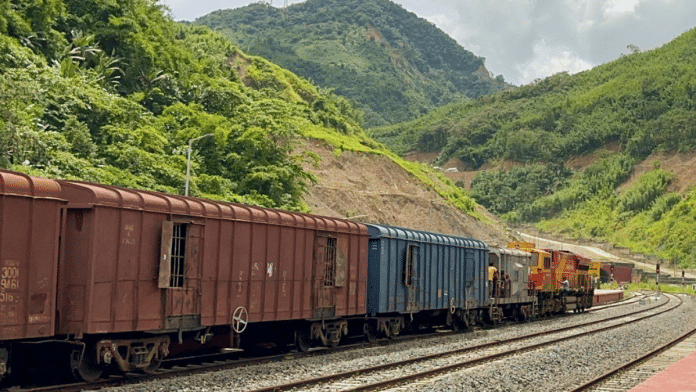

Gurugram: A wagon carrying 106 bags of copper scrap left Lahore in May 1989. By the time it reached Amritsar, nine bags had vanished. It took the Punjab and Haryana High Court 37 years—through two railway laws and one Partition-era statute—to finally decide who is liable for the missing cargo.
Justice Pankaj Jain has ruled that it was the insurance company, not the railways, that had to prove where the bags actually went missing. And since the seals fixed at Lahore were still intact when the wagon reached India, the insurance company doesn’t have proof that copper went missing while it was in the railway’s custody.
The claim also missed a crucial cut-off: the shortage certificate came just weeks before a new railway law would have shifted the burden onto the railways.
The court was hearing an appeal filed by The Oriental Insurance Company against an award of the Railway Claims Tribunal, Chandigarh Bench, which had already thrown out the insurer’s claim for compensation.
Also Read: Railways’ massive Dedicated Freight Corridor nears completion 2 decades later — why it’s a big deal
The missing cargo
The case goes back to 4 May 1989, when M/s World Wide Traders of Lahore booked 106 bags of copper scrap for India under Railway Receipt No. 00124. When the wagon was opened at Amritsar, nine bags were missing altogether. Seven to eight more had been found open, tampered with. On weighing, the shortfall came to 1,104 kg.
Railway authorities eventually issued a shortage certificate, but not until May 31, 1990, more than a year after the goods first went astray.
The consignment was insured, so Oriental Insurance paid Rs 36,732 to the consignee. In return, the consignee signed a letter of subrogation and a special power of attorney, handing the insurance company the right to chase the railways for the loss.
The insurer’s claim before the railways was rejected. Oriental then moved the Railway Claims Tribunal, which rejected it too, setting up the appeal before the High Court.
Sealed wagon, clean defence
The railway administration’s defence was simple. The wagon had been sealed at the forwarding station in Lahore, in the presence of the consignor himself, and it reached India in the same sealed condition. Since the seals were intact, the railways argued, there was nothing to show that any loss had occurred while the goods were in their custody, and no liability could be fastened on them.
The Tribunal agreed, relying on Section 76(E) of the Indian Railways Act, 1890. Since the loss occurred somewhere in Pakistani territory before the consignment crossed over, the Tribunal held, the railways could not be blamed for it.
Before the High Court, insurance company counsel RC Gupta argued that the Tribunal had picked the wrong law altogether. He wanted Section 93 of the Railways Act, 1989 applied instead, a provision under which the railway administration cannot escape liability even in cases covered by recognised exceptions, unless it proves it took reasonable foresight and care while carrying the goods.
In effect, Gupta argued, it was for the railways to prove they had been careful, not for the insurance company to prove they hadn’t.
The counsels for the railways, Harneet Singh Oberoi and Anmolpreet Kaur, disagreed. Section 93 of the 1989 Act, they said, simply did not apply here. The Tribunal, they argued, had rightly gone by Section 76(E), the provision that specifically governs responsibility when goods travel over railway lines both inside and outside India.
Where the case turned
Justice Jain settled the matter on a point of timing. The consignment was booked on 4 May 1989, and the shortage certificate was issued on 31 May 1990. The Railways Act, 1989 came into force only from 1 July 1990. So the new Act simply did not apply, the court held. The dispute was governed entirely by the older 1890 Act.
Under Section 76(E) of that Act, where goods travel from a place outside India to a place inside India, the railway administration is not responsible for any loss unless the owner of the goods proves that the loss actually occurred on railway lines within its administration. The burden, the court made clear, was on the claimant, not the railways, to show the shortage happened after the wagon entered Indian territory.
Justice Jain also noted that once the wagon reached India, the railways were duty-bound to check whether the original seals fixed at Lahore were still intact.
Tellingly, the counsel for the insurance company did not dispute the Tribunal’s finding that the original wagon seals had indeed been produced and found intact, which meant there was no evidence of any tampering after the consignment crossed into India.
With no proof that the loss had occurred on tracks administered by Indian Railways, the court found no reason to disturb the Tribunal’s findings and dismissed the appeal, closing a claim that had been travelling through the system since 1989.
(Edited by Ajeet Tiwari)
Also Read: Indian Railways only chugging along, a new business plan could put it on superfast track
It is so sad that it take 37 years, means half the life of a person to settle a case in India
This is the reason most of the people not filing a case and not reaching the court for solving their problems.
******** Incredible India*******