





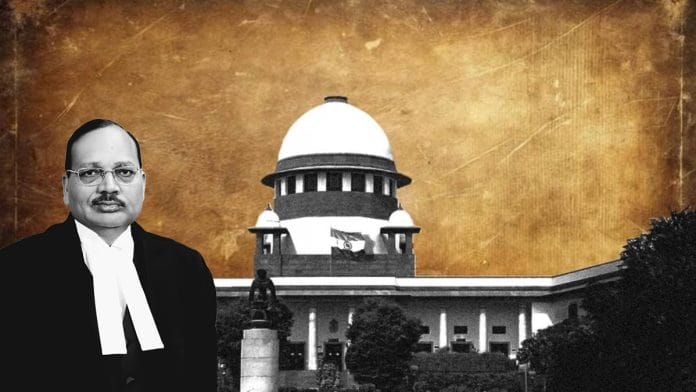

New Delhi: A petition that invokes visionary 20th century author Franz Kafka in seeking a CBI probe into the Cockroach Janata Party (CJP) and the unauthorised commercial exploitation of viral courtroom remarks has reached the Supreme Court.
A bench of Chief Justice Surya Kant and Justices Joymalya Bagchi and V. Mohana Tuesday issued notice on the same, seeking responses from various central government ministries, the CBI and Bar Council of India (BCI). The matter will be next heard on 10 September.
Specifically, the petition highlights how the CJI’s “cockroach” remark during the “course of spontaneous courtroom interaction” on 15 May was circulated through “outrage algorithms” and “trolling cultures”. This digital amplification, the petition says, led to the emergence of a political formation known as the CJP and alleged attempts to trademark symbols arising from the controversy. The petitioner argues that converting judicial interactions into “monetised digital spectacle” erodes the rule of law and reduces justice to a “mere textual ideal”.
Addressing the “organised commercial exploitation of constitutional controversy” and “digital distortion of judicial proceedings, the Public Interest Litigation (PIL) has been moved by advocate Raja Choudhary, also the petitioner-in-person. The petition argues that contemporary democracy functions within digital ecosystems where solemn courtroom exchanges are increasingly “transformed into viral spectacles detached from procedural context”.
The petitioner submits that constitutional courts derive their legitimacy from public confidence and “procedural seriousness”, not algorithmic approval. The petition contends that the “selective clipping” and “meme-ification” of oral observations create a distorted public perception.
Also Read: Segregate FIRs against students & criminals, SC tells Centre, says states can close CJP protest FIRs
Demands for investigation and regulation
The petition clarifies that it is not directed against legitimate criticism, satire, or dissent protected under Article 19(1)(a). Instead, it seeks limited intervention to ensure that public discourse remains “anchored in the truth of its proceedings and record”.
The petitioner has requested the top court to direct an independent investigation (preferably by the CBI) into the prevalence of fake advocates and fraudulent law degrees within the legal system. Plus, it wants direct competent authorities to take action against the unauthorised commercial and trademark use of oral courtroom observations and symbolic expressions.
It has also asked the Supreme Court to formulate safeguards and ethical guidelines for the dissemination of judicial proceedings in the digital and Artificial Intelligence-amplified age. Appointment of an independent constitutional jurist as amicus curiae to assist the court in examining these novel questions has also been sought.
Inspired by Kafka
In the petition, Franz Kafka’s The Metamorphosis is used as a primary intellectual and literary reference to justify the use of animal metaphors in judicial discourse and to defend the CJI’s oral remarks against literal interpretation.
The petition utilises the classic from 1915 in establishing a precedent for symbolic language. It notes that metaphorical references involving animals, insects, and “vermin” are recognized tools within literature, jurisprudence, and legal philosophy. By citing Kafka’s description of Gregor Samsa transforming into a “horrible vermin”, the petition asserts that such imagery is intended to be symbolic rather than literal.
The petitioner uses Kafka to frame the CJI’s remarks as part of a “long-standing judicial, literary, constitutional, and jurisprudential tradition of symbolic discourse” that is being unfairly exploited for commercial and political gain.
(Edited By Nardeep Singh Dahiya)
Also Read: Supreme Court lawyer withdraws complaint against 15-yr-old for abusing Modi after PM ‘forgives’ her