


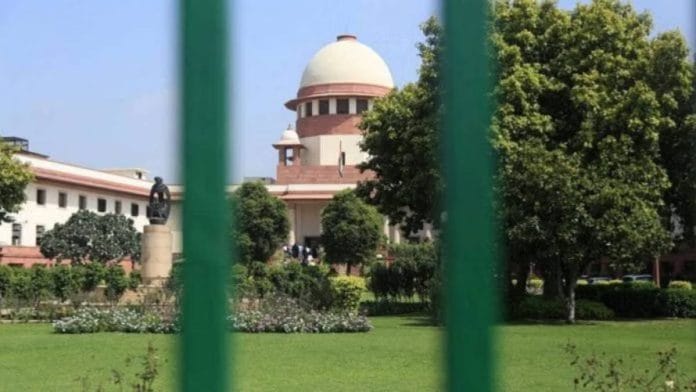
New Delhi: A recovery suit would not be time-barred if the debtor continues to make entries in their balance sheets, the Supreme Court has held. The top court said that such entries would be treated as acknowledgement of the liability, and under Section 18 of The Limitation Act, 1963, a fresh period of limitation shall be computed from the time such an acknowledgement is signed by the debtor or the person against whom the claim is made.
This means repeated entries in balance sheets acknowledging outstanding liabilities can extend limitation periods under Section 18.
The decision serves as a reminder to lower courts not to act prematurely and dismiss suits where documentary material raises a genuine question requiring trial.
With this ruling, a bench of the apex court set aside a November 2024 Delhi High Court judgment which had stayed proceedings in a recovery suit between a builder and a housing society, holding it was time-barred under the Limitation Act. The dispute allegedly arose between 2000 and 2003, but the recovery suit was filed in 2014.
The Supreme Court judgment revived the civil contractor’s recovery suit, restoring it for trial while clarifying that it was not deciding whether the contractor was ultimately entitled to the money, an issue to be decided during the trial. The contractor had presented sufficient material to keep the case alive, the top court said.
Background of the dispute
The case dates back to February 2000, when a housing society—Vigyapan Loke Delhi Advertising Cooperative Group Housing Society Ltd—entered into a contract for civil works with Wazir Hussain (now deceased). The deceased is represented by his legal heir.
Claiming unpaid dues for his construction work, Hussain filed a recovery suit in 2014 seeking over Rs 11 lakh in principal plus interest.
The primary dispute was whether the 2014 suit was barred by the law of limitation, given that the core transactions took place between 2000 and 2003. The trial court allowed the suit to proceed in January 2020, but the Delhi High Court later accepted the housing society’s revision petition and dismissed the contractor’s claim as time-barred.
Also Read: SC refuses to revisit OBC creamy layer ruling, says order applicable to CSE-2025 candidates
Barred by limitation?
The contractor argued that the housing society had consistently reflected the outstanding liability in its balance sheets from 2004-05 through 2012-13. The housing society argued that the suit was filed many years after the transactions of 2000-2003 and was therefore barred by limitation.
The Supreme Court had to decide whether the balance-sheet entries constituted acknowledgments of debt sufficient to extend the limitation period under Section 18 of the Limitation Act.
Continuing legal liability
The Supreme Court allowed the appeal and set aside the Delhi High Court judgment. It revived the suit, and directed that it proceed before the trial court. All issues on the merits were left open for determination during trial.
The court relied on its earlier decisions in Asset Reconstruction Company (India) Ltd. v. Bishal Jaiswal and Axis Bank Ltd. v. Naren Sheth, which recognised that entries in balance sheets can constitute acknowledgments of liability under Section 18 of the Limitation Act.
The court clarified that Section 18 does not require an acknowledgment to specifically name the creditor. What matters is whether the document, read along with surrounding circumstances, shows the existence of continuing legal liability.
The bank reconciliation statements referred to cheques issued to ‘Wazir Hussain Contractor’, while subsequent balance sheets continued carrying forward amounts relating to 2004-05. Together, these materials provided support for the contractor’s case that the liability continued to exist.
The court emphasised that the balance-sheet entries did not conclusively prove that the entire claimed sum was due. However, determining the exact liability would require evidence and trial. At the Order VII Rule 11 stage, the court only needs to examine whether a prima-facie case exists; it should not conduct a detailed evaluation of evidence.
Order VII Rule 11 of the Civil Procedure Code (CPC) is a provision that allows a court to reject a lawsuit at the very beginning, without conducting a trial, if the case suffers from certain basic legal defects. In other words, before spending years recording evidence and hearing witnesses, the court first checks whether the suit is legally maintainable. If it is clearly defective, the court can dismiss it at the onset itself.
Giridharan Velamore is an alum of ThePrint School of Journalism, currently interning with ThePrint.
(Edited by Nardeep Singh Dahiya)
Also Read: 24-hr deadline to produce accused before a magistrate starts from detention, not formal arrest—SC