







Gurugram: Haryana resident Saksham Rathore’s father, Brigadier Abhimanyu Singh Rathore was a serving officer in the Indian Army, when he died on 30 July 2023, while undergoing treatment at Command Hospital, Chandigarh for Cerebral Venous Thrombosis—a blood clot in the brain.
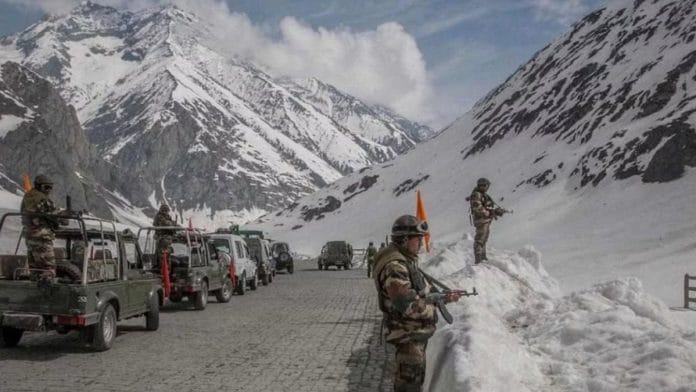
The onset of his condition had occurred in Leh, where he was serving during the Army’s Operation Snow Leopard in response to Chinese incursions along the Line of Actual Control in eastern Ladakh. The Army had formally declared him a Battle Casualty in January 2024.
But when Saksham, a B.Com and MBA graduate, sought a government job appointment on compassionate grounds under Haryana’s policy for dependents of battle casualties, the Nayab Singh Saini government said that his father had died of “disease”, not on the battlefield, and that he was not a “martyr”. His request was denied thrice—twice in 2024 and once in 2025.
Now, the Punjab and Haryana High Court has stepped in.
Quashing the three rejection orders by the state, the high court, earlier this month, allowed Saksham’s writ petition. In the 16 July order, Justice Nidhi Gupta directed the Haryana government to consider him eligible as the son of a Battle Casualty Class I officer under its 2018 and 2023 policies, and grant him compassionate appointment.
Pulling up the government and describing the rejections as non-speaking orders that offered shifting and contradictory reasons, the court has given it four months to comply.
Also Read: ‘One man’s trash is another’s treasure’: SC restores 23-year-old eviction order, pulls up high court
Haryana govt’s arguments & what court said
Before the high court, the state’s counsel made two arguments—first, that Haryana’s compassionate appointment policies apply only to dependents of “martyrs”, not “battle casualties”; and second, that Brigadier Rathore had died not in action but “due to disease”.
Justice Gupta rejected both.
With regards to the first argument, the court looked at the history of the state’s policy itself. Haryana’s original 2014 scheme used the term “martyr”, which, the court noted, the armed forces do not officially recognise as it carries “political and religious connotations”, and isn’t used for defence personnel who die in the line of duty. The Army’s own terminology is “battle casualty”.
Recognising this, Haryana government had amended its policy in 2018 to explicitly extend benefits to dependents of “battle casualties”. This was reaffirmed in a fresh policy in 2023 with a specific definition covering personnel “killed in harness” in the performance of duty—a definition which, the court found, squarely covered Brigadier Rathore’s case.
On the other argument that the Brigadier had died of disease and not in action, the court’s view was considerably sharp. Calling the state’s claim “preposterous”, Justice Gupta noted that Brigadier Rathore had developed the fatal blood clot while serving at high altitude, where reduced oxygen availability is medically known to trigger hypoxia, dehydration and hyper-coagulation of the blood. “If anything,” the court said, “it was a ‘disease’ suffered by a soldier while in service at an active battlefront.”
The court added that it was “deeply anguished and appalled” at what it called the state’s “unsympathetic and uncooperative stance” in complicating a straightforward policy through “semantics and legalese”.
‘Not the first time’
Justice Gupta pointed to a string of the high court’s own precedents—Jai Dev vs State of Haryana (2025) which was later upheld by a Division Bench, along with Rita Saikia (2017), Major Arvind Kumar Suhag (2010) and Pushplata (2024)—all holding the same principle: once the Army certifies a death as a battle casualty, the state cannot dispute the classification to deny benefits, and that welfare policies must be interpreted liberally rather than narrowly.
“It does not lie in the mouth of the State to contend otherwise,” the court said, reiterating that a battle casualty “need not be a death arising out of active hostilities or bomb-blasts”.
(Edited by Mannat Chugh)