





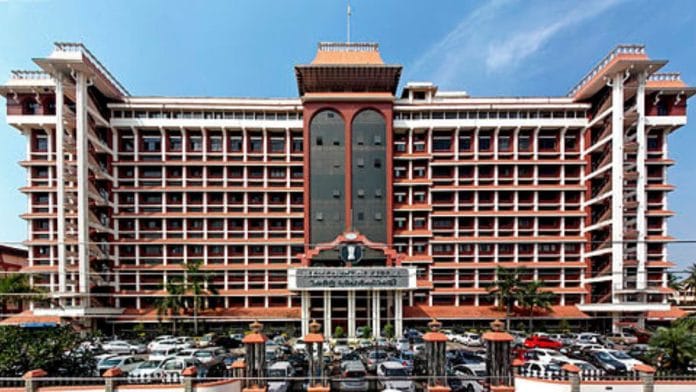


New Delhi: A 62-minute delay in the online filing of a charge sheet has turned out to be life-changing for two Kerala men accused in a narcotics case; for the prosecution, it was a big lapse. Granting the two accused bail, the Kerala High Court has ruled that a chargesheet uploaded after 5 pm cannot be treated as being filed on the same day.
The verdict not only secured default bail for the two, but also clarified that offences carrying a maximum sentence of 10 years—without a minimum term—fall under the 60-day investigation limit under the BNSS.
The charge sheet in this case was filed at 6.02 pm on the 60th day of the pair’s arrest and was forwarded to the court concerned only on 3 March, which was the 63rd day after arrest. The HC bench of Justice Edappagath held that since the charge sheet was filed beyond the stiputlated deadline, the two were entitled to default bail.
Aboobacker Siddique and Abdhul Rouf were arrested on 30 December 2025 by the Kasargod district police, along with another accused, Muhammed Mubthasim. They were allegedly found in possession of 4.22 grams of MDMA, for personal use and sale, at a homestay at Koppala sub-division of the district.
The Kasargod district police filed a charge sheet against them and two other accused on 28 February this year, but the trial court took it on record only on 3 March. Counsel for both Siddique and Rouf argued before the court that the charge sheet was forwarded to the court only on 3 March—three days after the 60th day of their being taken into custody in the NDPS case, thereby making them eligible for default bail.
On the other hand, the public prosecutor argued that the charge sheet was filed on the 60th day of their custody and hence their pleas should be rejected.
“As already noted, the final report in the present case was e-filed on 28/02/2026 at 6.02 pm. In terms of the applicable rules, such a filing, having been made after 5 pm, must be reckoned as instituted only on 01/03/2026,” Justice Edappagath observed in the order passed Monday on the bail matter of two narcotics case accused.
“Consequently, for the purpose of computing limitation, the filing falls beyond the statutory period of sixty days from the date of remand of the applicants. The applicants are, therefore, entitled to statutory bail.”
‘Minor changes in phraseology’
In addition to the argument that the charge sheet was filed after the 60th day, the public prosecutor also raised a legal point drawing more observations by the high court on the principle of default bail.
Default bail is governed by section 187(3) of the BNSS, which is similar to the provisions of section 167(2) of the CrPC. Enacted and implemented across the country since 2023, the particular section of the BNSS allows investigating officers a 90-day period to file a charge sheet in an offence punishable with death, life imprisonment, or “for a term of ten years or more”.
The focal point of the legal arguments, however, revolved around the reading of the phrases used in Section 187(3)(i) of the BNSS and Section 167(2) of the CrPC, with reference to the prison term.
Counsels for the narcotics case accused argued that since the alleged offence fell under the provisions of section 22(b) of the NDPS Act, which carries a maximum punishment of ten years with fine, but with no minimum punishment, the investigation should have been completed and the final report should have been filed within a period of sixty days.
On the other hand, the public prosecutor argued in HC that since the NDPS Act provides for a maximum punishment of 10 years’ imprisonment, the set timeline would be 90 days.
Justice Edappagath observed that the distinction has been carved out in the law to allow investigative agencies more time to carry out a comprehensive probe into offences punishable by a greater quantum of sentence. On the other hand, he said, the 60-day timeline was decided for offences punishable with imprisonment up to ten years, which presumably require a comparatively simpler probe and hence a shorter period for filing the charge sheet.
“This classification seeks to balance the liberty of the accused with the state’s interest in effective law enforcement—ensuring that detention is not prolonged unnecessarily, while allowing sufficient time for investigation in serious cases,” he observed.
He observed that a simple reading of the BNS provision on default bail makes it clear that the rationale has been maintained, but with a higher threshold: For the ninety-day period to apply, the offence must be punishable with imprisonment of ten years or more.
“In substance, therefore, proviso (a)(i) to Section 167(2) Cr.P.C and Section 187(3)(i) BNSS are aligned, with only minor changes in phraseology,” the HC judge further observed.
“The conclusion that emerges is that the 90-day benchmark for default bail applies only where the offence carries: (a) the death penalty, (b) imprisonment for life, or (c) a minimum sentence of ten years,” he further observed. He documented that offences punishable with imprisonment of up to ten years, without a minimum threshold, as was the particular case under section 22(b) of the NDPS Act, fall within the 60-day category.
“Inasmuch as the offence under Section 22(b) of the NDPS Act provides for a maximum punishment of ten years with fine, but stipulates no minimum term, the statutory right to bail accrues if the final report is not filed within 60 days from the date of custody,” the HC observed, granting bail to the narcotics case accused.
The HC warned the narcotics case accused against contacting any prosecution witnesses and leaving the state without the permission of the trial court.
(Edited by Viny Mishra)
Also read: Bail jurisprudence in India slow, not short on principle. SC & its latest push for solving pendency