


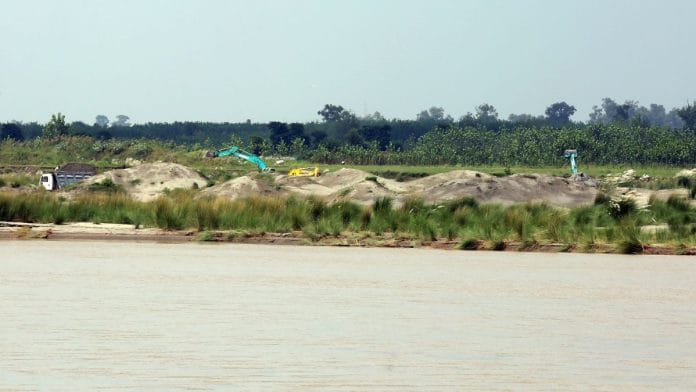
New Delhi: Despite significant spending on cleaning the Yamuna, pollution in the river has only increased, the Supreme Court observed earlier this month, warning that states and Union Territories could face financial penalties if water quality deteriorates within their jurisdictions.
In an order dated 4 November, a bench of Justices Manoj Misra and Manmohan said the poor condition of the Yamuna reflected the failure of civic administration across towns, cities and villages along its banks. It directed the Central Pollution Control Board (CPCB) to monitor water quality at the points where the Yamuna and major drains enter and exit every state, Union Territory and district.
The court said the concerned jurisdiction would be held accountable and penalised if water quality deteriorated while passing through it. The CPCB has been asked to suggest a formula for calculating the compensation.
The directions form part of the court’s continuing efforts to oversee the rejuvenation of the Yamuna. In doing so, the bench has also invoked the principle of Common But Differentiated Responsibilities (CBDR), an established concept in international environmental law, to clarify that states sharing a river have a common responsibility to protect it and the extent of each state’s liability depends on its contribution to pollution and its ability to address it.
How the Yamuna Action Plan came under scrutiny
The latest directions follow orders passed on 21 May and 22 September this year, when the court examined the absence of a coordinated plan to address pollution in the river.
In May, the bench observed that encroachments on the riverbed, particularly in Delhi’s Zone ‘O’ (designated river and floodplain zone along the Yamuna in Delhi under the Delhi Master Plan), industrial effluents and untreated sewage had reduced the Yamuna to little more than a sewage channel. It also flagged the failure of agencies responsible for drainage, sewage, stormwater and effluent treatment to work together.
The court subsequently constituted a committee headed by the Union Home Secretary, with Chief Secretaries of the states and Union Territories through which the river flows, representatives of pollution control boards as members and senior advocate K. Parameshwar, appointed as amicus curiae. The committee was tasked with preparing a comprehensive Yamuna Action Plan.
The plan was placed before the court in September; the bench found that it did not propose discarding or relocation of encroachments and unauthorised structures on riverbeds, floodplains and drains in Delhi.
The court also sought details of the 1,799 unauthorised colonies identified in Delhi and questioned how many were situated on floodplains. It also asked for the distinction between active and other floodplains in the Master Plan for Delhi 2047 and whether the city’s planning framework was consistent with the proposed action plan.
During a presentation by the Ministry of Home Affairs on 7 October, the court was told about proposals to upgrade 20 existing sewage treatment plants (STPs) and build 125 new ones across the Yamuna basin. The plan also envisaged tapping 520 drains that discharged approximately 9,666.81 million litres of wastewater per day into the river and its tributaries.
However, the bench found discrepancies in the government’s own assessment. While the action plan claimed that water bodies and wetlands in Zone ‘O’ were free of encroachments, an annexure prepared by the Delhi government marked all 35 such water bodies and wetlands as encroached.
Similarly, although the plan stated that 28 of Delhi’s 37 existing STPs met prescribed standards, the CPCB report indicated that none met all the stipulated standards. Only five met the bacteriological limit.
The court said additional treatment plants alone would not address pollution unless untreated sewage and industrial effluents were stopped at the source.
Also Read: How Yamuna changed in 200 years—river is now 68% narrower, with 89% lower discharge
Why states cannot treat the Yamuna as separate stretches
Explaining the principle of Common But Differentiated Responsibilities, the bench said a river shared by several states must be treated as one continuous ecosystem rather than a collection of separate state-wise stretches.
The principle was articulated in Principle 7 of the 1992 Rio Declaration on Environment and Development and subsequently reflected in international climate agreements, including the Kyoto Protocol and Paris Agreement.
The underlying idea is that environmental protection is a collective responsibility, but the extent of obligations can differ depending on the contribution of individual parties to environmental damage and their capacity to address it.
Applying this reasoning to the Yamuna, the court said, “This balance, which is a joint responsibility for the river as a whole, combined with individual obligations calibrated to each State’s own contribution and capacity”.
The bench said the responsibility operates at three levels: preventing pollution before it occurs, bearing the cost of cleaning it up once it does, and restoring the river ecologically where damage has already taken place.
It also referred to the River Ganga (Rejuvenation, Protection and Management) Authorities Order, 2016, which provides that the Ganga must be managed as a single system. Since the Yamuna is one of its principal tributaries, the court said the same integrated approach should apply to it.
The bench illustrated this by saying that the quality of water leaving a state should not be worse than the quality at which it entered. However, a state cannot claim that its responsibility ends merely because the river has crossed its geographical boundary.
The court also addressed the ecological consequences of encroachments. It said Zone ‘O’ should be protected as a green zone and, if feasible, extended upstream and downstream. Permanent structures should not be permitted, except green parks and essential public infrastructure. Existing structures should be removed in accordance with law, with alternative accommodation provided to occupants wherever they are entitled to rehabilitation.
Smart meters, surprise inspections and financial penalties
Beyond holding states accountable, the court has sought to establish a monitoring mechanism to ensure that existing treatment infrastructure actually works.
It directed every STP, Common Effluent Treatment Plant (CETP) and government-commissioned biogas plant to install tamper-proof smart energy meters within one month. STPs and CETPs must also install inflow and outflow meters, along with continuous sensors to record the volume of discharge and parameters such as pH, BOD, COD, suspended solids and ammoniacal nitrogen.
The readings must be uploaded live on CPCB and state pollution control board websites. A break in the data feed exceeding 24 hours will be presumed to indicate that the plant is non-operational, unless the operator establishes otherwise.
The CPCB has also been directed to conduct unannounced quarterly sampling of STPs with a capacity of at least 5 million litres per day and all CETPs through IITs, NITs or accredited laboratories. Results must be published within 30 days. Environmental compensation is to be recovered from operators for each day of non-compliance.
The court has further directed urban local bodies to register septage tankers, install GPS tracking systems and develop a portal to monitor sewage collected from households and its subsequent disposal.
To ensure enforcement, public and private operators of treatment infrastructure must provide CPCB inspection teams unrestricted access to their premises and records. Police commissioners, district magistrates and superintendents of police must provide magisterial and police assistance when requisitioned.
The Chief Secretaries of the basin states and Union Territories, along with concerned Central Ministries, have been directed to appoint nodal officers not below the rank of Special Secretary within two weeks. Officers in charge of every treatment plant and major drain must be named on the portal and submit monthly compliance affidavits before the court.
The matter will next be heard on 13 January 2027
The Court concluded by commenting, “The Supreme Court is neither a city planner nor an expert body. It is for the civic administrators to prepare a plan to clean the river Yamuna. This Court considers it appropriate to give the administrators the power and flexibility to do their jobs, while holding them accountable if they fail to achieve results”.
(Edited by Anupama Yadav)
Also Read: The Yamuna River deserves more than a Sunday clean-up