




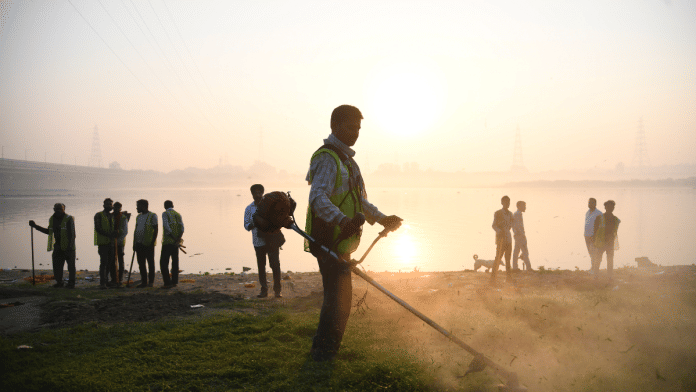

I have spent the past two days preparing for 18 October’s Chalo Yamuna Mega Cleanliness Drive. I woke at the crack of dawn and headed to the Yamuna River to join thousands of volunteers, students, activists, social workers, and city resident as the words of the famous Mata ki Bhent rang in my ears. “Chalo bulawa aaya hai, Mata ne bulaya hai”. Come, the call has come, Mother has called.
In India, rivers are not merely water bodies. Ganga, Yamuna, Narmada, Godavari, Kaveri and countless others have been worshipped for centuries, sustaining civilisations, nourishing our lands and flowing through our sacred stories. The mighty Mother Yamuna is the personification of the River Yamuna and also is the second most sacred river in India after the Ganga. In Hinduism, Yamuna is the daughter of Surya, the Sun deity, and also the twin sister of Yamraj, the God of Death. She is also one of the Ashtabharyas, or eight principal consorts of Krishna.
This Sunday morning, thousands of volunteers and BJP karyakartas reached the 70 or so ghats in the city as part of a massive Yamuna clean-up campaign by the Delhi Government.
Seeing these motivated youth with their effervescent energy, in stark contrast to the strident, accusatory and almost anarchic mob that had overtaken New Delhi and held the residents to ransom a few days ago, I was compelled to ruminate over a few points, or rather ideologies.
Service before self
According to Sanatan Dharm, everything in the universe is seen as a manifestation of the Divine. This gives rise to the famous maxim “Nar Sewa, Narayan Sewa”, or service to humanity is a service to God.
Sikhism, too, is strongly rooted in sewa or service; in fact, at any time of a calamity or catastrophe anywhere in the world, you will see Sikhs serving langar to feed the hungry. They also take sewa a step further by doing cleanliness drives in gurudwaras, where the rich and the poor come together to look after their shared space.
So when Prime Minister Narendra Modi calls for Swacch Sewa, it is part of our very own culture, prevalent in the subcontinent.
“समानी व आकूतिः समाना हृदयानि वः। समानमस्तु वो मनो यथा वः सुसहासति॥“
Let your aims be common, and your hearts be united. May your minds be of one accord, so that you may live together in harmony and effectively serve one another.
— Rigveda 10.191.4
Ancient civilisation, modern conundrum
We are descendants of theSindhu Saraswati civilisation. It was a highly sophisticated and advanced culture of the Saraswati Sindhu belt. Well-laid-out cities with proper drainage systems and dedicated toilets and bathing areas were all part of its civic life, as can be seen from the ruins thus far excavated. From the remains, it is apparent that urban waste was well managed. Subsequent generations migrated, but were unable to manage the waste. What happened?
Obviously, it has a lot to do with the breakdown of the civil structure and civic responsibility; then, post-Independence, with rapid development came an utter disregard for the ancient ecosystems rooted in nature and biodegradation.
Increased household waste and the creation of plastic destroyed the recycling and reusing systems we had in place. Soon, we imbibed the single-use culture of the West. Over centuries, invasions, and changing dynasties, we slowly lost the ability to process our waste, and the rivers became a dumping ground.
In 1890, the British began dumping the sewage from the city into the Yamuna River, downstream of the Chandrawal waterworks where drinking water was processed, turning the holy river deadly.
Only 22 kms, hardly 2 per cent, of the river flows through Delhi, but this is where it picks up 80 per cent of its pollution. Who can forget the images of Chhath Puja being performed in the centre of cloud-like foam caused by toxic effluents?
Also Read: How Yamuna changed in 200 years—river is now 68% narrower, with 89% lower discharge
Practicalities of implementation
When the BJP government came to power in 2025, one of the promises was the cleanup of the Yamuna River, a monumental task. Scientific efforts to revive the river include modernising the sewage treatment plants, intercepting the polluted sewage before it is discharged into the river, and also building Delhi’s sewage network.
The Delhi Government allocated Rs 6,485 crore through the Jal Board for the 2026-27 fiscal year specifically for the set-up of sewage treatment plants in a bid to clean up the holy water body. This is also one of the largest single shares of the Green Budget.
Additionally, the Delhi Jal Board has a separate allocation for a comprehensive Yamuna rejuvenation projects worth nearly Rs 4,500 crore, which includes setting up 15 new decentralised sewage treatment plants (DSTPs) and expanding sewer networks to push total treatment capacity toward 1,041 MGD.
It is apparent that Chief Minister Rekha Gupta is serious about cleaning up the holy river. She is leading by example, and this was not the first time she had motivated the public to participate in a cleanup drive for the waterbody.
What can we do?
But the onus of keeping the city clean rests not just with the politicians but also with its ordinary citizens. It is the duty of every Delhite to need to ensure the city is pollution free and we are collectively responsible for waste management and disposal.
We condemn plastic waste, and yet we purchase single-use plastic water bottles. When I was a kid, my mother always gave me a thermos or stainless steel bottle to carry. Till early decade of 2000 or late 90’s definitely, all the aerated drinks were brought home in glass bottles and a crate would be exchanged every week. This remains a practical solution to the problem of plastic bottles even today.
Despite a push for the banning of single-use plastic we rarely, if ever, carry our cloth bags to buy vegetables. I remember my grandmother stitching together bright cotton thailas from leftover scraps of fabric in which we packed our tiffins and took along to college. As ordinary citizens, we have a responsibility to manage our waste.
The Municipal Corporation of Delhi introduced waste management as per the National Solid Waste Management Rules, which were updated in 2026. Per it, residents, households and establishments need to sort waste into four different streams: wet waste, dry waste, sanitary waste and special care waste. Wet waste consists of kitchen waste such as fruit or vegetable peels, which can be composted; dry waste such as plastic and glass bottles can be recycled; sanitary waste, including diapers and sanitary napkins is to be packed separately; and special care waste includes batteries and bulbs, which contain toxic waste and mustn’t end up in landfills. The MCD is trying very hard to implement this policy, but honestly, how many of us urbanites are actually doing this?
If it is the government’s duty to provide safe and clean drinking water, we also need to be proactively ensuring that our waste and plastic do not end up in the rivers and soils of our country.
It reminds me of a popular Woody Guthrie song: “This land is your land, this land is my land, this land is made for you and me.”
Following the Cockroach Janta Party protest earlier this month at Jantar Mantar, the New Delhi Municipal Council removed 60 metric tonnes(60,000 kg) of waste from the site. Peak daily waste accumulated was 15,000 kg, which included plastic bottles, food containers, disposable plates, banners, etc. The waste had been dumped along Jantar Mantar, Tolstoy Marg, Jai Singh Road, Janpath and adjoining areas of Connaught Place. Not once did I hear CJP leaders or even the so-called “youth icon”, Rahul Gandhi, requesting protesters to clear their own trash.
Leadership is not always about a call to anarchy; it is also a call to instil civic sense in the masses. PM Modi has sought to lead by example.
Also Read: Thousands of dead fish found on the banks of the Yamuna in Delhi’s Burari
Swach conversations
Conversations of a cleaner Bharat and talks on building toilets have come up in the years since PM Modi came to power. After Mahatma Gandhi, no political leader from the Congress, which remained almost uninterrupted in power until 2014, spoke about toilets or cleaning up after oneself. Gandhiji once said, “Sanitation is more important than independence”.
He walked his own talk. He saw the terrible living conditions of the people living in the slums as a collective failure of society. He even picked up human excreta and waste with his own hands. His Valmiki Basti today houses the most wonderful community, who continue to live by the inspirational values of Gandhism.
In my tenure as MP, I joined cleanliness drives at the Mohan Singh place where people would defecate in the open. I used Google Maps and geofencing technology to mark out the area. It was only post-2014 that numerous schemes were run in a targeted fashion, introduced by PM Modi, who worked toward a Swachh Bharat and built thousands of toilets, bringing about a Swachh Revolution in this country.
This is the kind of campaigning we need from our Gen Z, who are the hope of our country, not the kind of anarchy that took over Bangladesh and Nepal. Had PM Modi been an actual dictator, like some claim, he would have introduced capital punishment for littering, defecation, and urinating in public. Instead, he inspired an entire generation through the Swachh Bharat campaign. Merely eating Khan Chacha rolls in front of a camera is not an inspiration for a generation.
Lessons to remember
The Yamuna riverfront can take valuable lessons from Ahmedabad’s Sabarmati Riverfront Development Project to transform Delhi’s neglected riverbanks into vibrant public spaces while prioritising ecological restoration.
The Sabarmati project created an 11.25 km riverfront and reclaimed about 205 hectares, with an estimated project cost of Rs 1,152 crores. Its promenade, parks, cycle tracks and cultural spaces demonstrate how rivers can reconnect cities with their natural heritage.
Architect Pankaj Gupta’s book The Yamuna River Project (2018) serves as a blueprint on how the Yamuna waterfront can be transformed by involving the residents of the city who share a deep-rooted passion for the Yamuna River, “with people who are integral to its design”. Delhi has an opportunity to adopt this people-centric approach for the river. However, the Yamuna River demands an ecologically sensitive approach to sewage treatment, clean water flow, wetland restoration, biodiversity parks and floodplain protection.
We all need to take inspiration from Gandhi.
“Sabarmati ke sant tune kardiya kamal (Saint of Sabarmati, you have performed a miracle)”, the Yamuna River can also become the Sabarmati River through the collective efforts of its residents.
Meenakshi Lekhi is a BJP leader and lawyer. Her X handle is @M_Lekhi. Views are personal.
(Edited by Insha Jalil Waziri)