





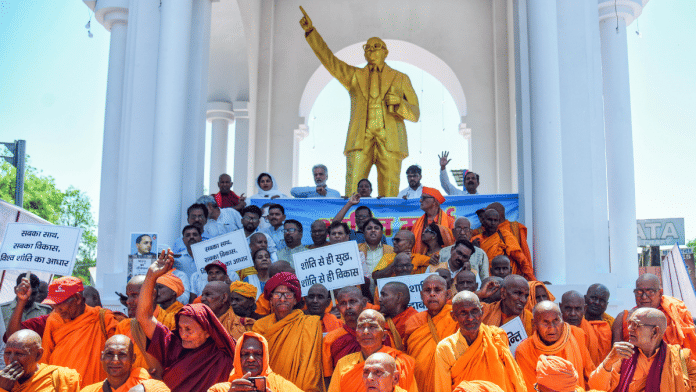


Mumbai: As preparations for Census 2027 are underway in Maharashtra, Buddhist leaders have urged neo-Buddhists to mention their Scheduled Caste identities, arguing that any drop in population or unchanged status will lead to loss of funds, reservation and other benefits linked to the community.
On 4 March, the Buddhist Society of India, also called the Bharatiya Bauddha Mahasabha, issued an appeal urging neo-Buddhists to write ‘Buddhist’ in the religion column, and mention the caste of their ancestors such as—Mahar, Mang, Chambhar and other Scheduled Castes—in the caste column of census forms.
Neo-Buddhists are primarily Dalit followers of social reformer Dr B.R. Ambedkar, who converted to Buddhism on 14 October, 1956, in Nagpur to break away from the caste system.
Buddhism fundamentally rejects the caste system because its core philosophy emphasises on universal equality, individual merit, and the reduction of suffering, which directly conflicts with the birth-based hierarchy of the Indian ‘varna’ or caste system.
“It is unanimously agreed that it is necessary for the true population of Buddhists to be reflected in the Indian Census,” the Mahasabha said in its appeal. This, it said, has implications for the allocation of welfare funds, reservations and representation linked to SC population figures.
Founded by Ambedkar on 4 May 1956, the Mahasabha is a religious public trust that propagates the teachings of Buddha as well as organises the newly converted Buddhists into a cohesive community.
Currently led by Meera Ambedkar, daughter-in-law of Dr Ambedkar, the Mahasabha works towards social reform, education and community empowerment across India. Meera’s son Bhimrao Ambedkar is the trustee and national working president of the Sabha.
The Census exercise formally began 1 May in Maharashtra, with the launch of the self-enumeration phase. The state opened the self-enumeration portal 1 May and will accept entries till 15 May. This will be followed by the house-listing and housing census phase from 16 May to 14 June, during which enumerators will conduct door-to-door verification.
The Mahasabha argued that while the neo-Buddhist population has steadily increased following conversion movements inspired by Ambedkar, the recorded SC population has comparatively declined because many converted Buddhists no longer identify with caste.
It has also advised Buddhists to mention Pali as their mother tongue instead of Marathi or other languages, stating that the language holds religious and cultural significance for the community.
“The Pali language given recognition by the Central Government is our mother tongue. We perform Vandana, remembrance and all rituals in the Pali language. This means Pali is our language. Therefore, for the preservation of Pali, in the mother tongue column, instead of Marathi or any other language, write Pali language as your mother tongue,” the appeal said.
The issue, Bhimrao told ThePrint, is not about accepting caste socially or spiritually.
“It is about constitutional participation and safeguarding rights that are linked to census data. The Pali language is part of the Buddhist heritage and when we accept the religion, we must also accept the language which we use as our official language,” he said.
If people stop mentioning their caste identities entirely, the recorded Scheduled Caste population reduces, he explained. “That affects funds allocated through the Social Welfare Department, educational schemes and political reservation.”
Also Read: A global Buddhist monastery thrived in Mumbai for 1,400 years. ‘Messages from the past’
Mahasabha’s appeal
The appeal cited the Constitution (Scheduled Castes) Order and subsequent amendments that extended SC benefits to the Buddhists converted from Scheduled Castes. It argues that census figures directly influence allocations for welfare schemes and reservations in local bodies, assemblies and Parliament.
It noted that Dr. Ambedkar, under Article 341 of the Constitution, gave the President the authority to determine the Scheduled Castes. Accordingly, Parliament and the President approved the Constitution (Scheduled Castes) Order, 1950.
The appeal also stated that after former Prime Minister V.P. Singh left the Congress party, Ambedkar’s grandson Prakash Ambedkar extended political support to aide him with re-elections in Uttar Pradesh. In return, a condition was placed that Buddhists should receive Central Government concessions/benefits, after the formation of his government.
“To fulfill that commitment, the V. P. Singh Government, through the Constitution (Scheduled Castes) Order, 1950 (Amendment), 1990, dated 04/06/1990, made a constitutional amendment and applied the Scheduled Caste list to Buddhists as well. That means Buddhists were granted Scheduled Caste benefits,” it said.
It also highlighted that a decrease in the SC population affects the funds allocated through the social welfare department, various beneficial schemes for Scheduled Castes, and social, educational and cultural development, as well as political reservation.
“Since the government, administration and social system are against us, if the census form is not filled properly, the above-mentioned adverse effects may arise,” the appeal states.
The 2011 Census, according to Bhimrao, was not conducted properly.
“There are doubts about the number of SCs because the 2011 Census was not done properly,” the Mahasabha working president said, adding that the majority of SCs in Maharashtra belong to the Mahar community. “It is important for them and others to mention that specifically.”
“Caste is a mandatory representation for political reservation in India. Additionally, a caste certificate is also important for educational welfare, like for students aspiring to be doctors, or IAS, IPS officers.”
Not filling the caste section in the Census form renders the form incomplete, he asserted.
Bhimrao is also national president of the Samata Sainik Dal (SSD) or ‘Army of Soldiers for Equality’ established by Ambedkar in 1927. It was formed to protect the rights of the marginalized and oppressed communities in India.
The Mahasabha’s appeal stated that reservations were also provided during elections such as Lok Sabha, Legislative Assembly, Municipal Corporation, Municipality and Gram Panchayat.
“Today, we get 13 percent reservation (for SCs in Maharashtra). Once our numbers increase, we will get more reservations. We may even go up to 18 or 19 percent,” Bhimrao said. “After the Supreme Court judgement of 1 August 2024 sub-classification (of the Scheduled Castes and Scheduled Tribes), we are making such efforts to increase the number and the reservation percent based on real evidence from the Census data.”
On 1 August 2024, a seven-judge Constitution Bench of the Supreme Court ruled that states can sub-classify SCs and STs, to ensure that the most disadvantaged, rather than the relatively well-off members within these communities receive reservation benefits.
Development economist Bhalchandra Mungekar told ThePrint that he supports the stand of the Mahasabha.
“There are 59 communities or sub-castes recognised as Scheduled Castes (SCs) in Maharashtra. The appeal to write both ‘Buddhist’ under the religion column and the specific Scheduled Caste under the caste column is important because that will give the exact number of people in each of these sub-castes as well,” the Ambedkarite said.
“This information along with their economic background will help to classify which of these communities are still in desperate need for reservations and which ones need more and less focus,” he added.
(Edited by Tony Rai)
Also Read: Global summit in Delhi, now Devnimori relics to Sri Lanka–why India is pushing Buddhist diplomacy