





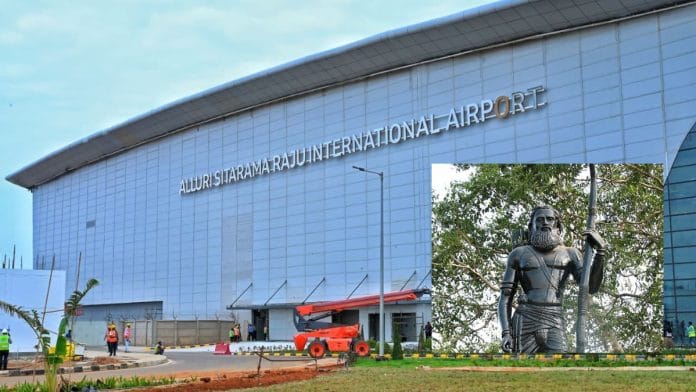


Hyderabad: When Andhra Pradesh’s largest airport at Bhogapuram in Vizianagaram district begins operations on 1 August, it will be a significant milestone both for the state and GMR Airports Ltd (GAL).
For Andhra Pradesh, the new airport, built at a cost of nearly Rs 4,727 crore, is the largest public-private partnership (PPP) airport after the existing Visakhapatnam airport was returned to the Indian Navy. It is also expected to play a pivotal role in boosting economic growth and tourism across six north-coastal districts in the state.
For GMR, it is the second project in the state, following its achievement as the first Indian private company to build the Hyderabad airport in March 2008.
But in addition to the state and GMR, the new airport also holds significance for the people of the Uttara Andhra region because it is named after Alluri Sitarama Raju, celebrated as a leading freedom fighter who stood against the British.
Naming the new Bhogapuram airport after Alluri Sitarama Raju demonstrates a rare instance of political convergence, as leaders across the political spectrum—from the Telugu Desam Party, YSR Congress Party and the Bharatiya Janata Party to the Communist parties and the Congress in Andhra Pradesh—celebrated the naming of the airport after the revolutionary freedom fighter.
“The contribution of Sri Alluri Sitarama Raju is so immense that to the people of Andhra he transcends caste and region. He is revered all across Andhra and Southern India for fearlessly standing up to the British just as Bhagat Singh did in Punjab,” TDP leader K. Pattabhi Ram told ThePrint,
“So, naming the airport in the Manyam region after him is a small tribute we can pay for his contribution to India,” he added.

Also Read: How Kia turned Andhra Pradesh’s historic Penukonda town into India’s own ‘Little Korea’
‘Hero of the jungle’
Born in July 1897 to an advocate in Andhra Pradesh, Alluri Rama Raju renounced worldly life at the age of 18 after the young woman named Sita, whom he loved, died prematurely following an illness.
He then prefixed ‘Sita’ to his name and people began calling him Alluri Sitarama Raju.
Although he lived as an ascetic among tribal communities, he noticed growing discontent with British rule among the local people. He then emerged from the Eastern Ghats of Andhra Pradesh to launch a full-fledged guerrilla war against colonial forces against the backdrop of the Non-Cooperation Movement.
Between 1922 and 1924, he led the historic Rampa Rebellion in Rampa Chodavaram, then a small village in north-coastal Andhra Pradesh.
Recognising his knowledge of traditional medicine and strategic brilliance, the local Adivasi populations quickly embraced him as a mystical leader.
He also came to be known as Manyam Veerudu, or Hero of the Jungle. In the malaria-ridden terrains and dense jungles of the Eastern Ghats, he used to cure people from tribal communities using native herbs and Ayurvedic medicine.
Raju’s legendary status emerged from his hard-fought battle for the tribals when the British imposed the Madras Forest Act of 1882. Andhra, which was under the Madras Presidency at the time, was also under colonial rule.
The British legislation severely restricted indigenous communities from practicing ‘podu’, or shifting cultivation, and stripped them of their traditional livelihoods, subjecting them to brutal exploitation by British contractors.
The denial of access to forest produce and traditional ways of cultivation infuriated Raju, and he mobilised the Rampa tribal warriors to attack police stations, confiscate weapons, and use them to fight the British Army, which deployed a separate unit to nab Raju.
Historical accounts of the Indian freedom struggle recount how the British feared him for his lightning-fast movements, his strong intelligence network, and his guerrilla tactics to raid police stations for firearms and ammunition.
A psychological tactic that angered the British was the defiant signature he used to leave on a piece of paper at the police stations, listing the number of firearms he stole.
The fact that the Rampa Rebellion spread across Andhra made the British fear and despise him equally for his mastery over asymmetric warfare, a tactic later followed by the People’s War Group (PWG).
Though Raju initially aligned with Mahatma Gandhi’s Non-Cooperation Movement—persuading the tribals to wear Khadi and give up drinking—he firmly believed that independence could only be won through the use of force.
His fiery spirit drew deep inspiration from the armed revolutionaries of Bengal, whose radical anti-colonial tactics shaped his own combat strategy.
Raju’s fight was fused with his iconic slogan of ‘Jal, Jungle, Zameen (water, forest, land)’ in his struggle for Swaraj and the ownership of indigenous land rights.
Desperate to suppress his rising influence, the British deployed the elite Assam Rifles and placed a massive bounty on his head. Raju was finally nabbed in the jungles of the Ghats and was executed at the age of 27 in 1924.
A century later, Raju’s contributions are recounted and replayed in movies and popular literature.
The film RRR, which won an Oscar for its famous Naatu Naatu song, is a tribute to two heroes: Alluri Sitarama Raju and Telangana’s Komaram Bheem, a tribal warrior, who was inspired by Raju’s contribution to India’s freedom struggle.
Bhogapuram airport
The Bhogapuram airport is among the fastest-completed greenfield international airports in India, completed in just 31 months. It has been designed to handle 6 million passengers annually in the first phase, with a master plan to expand capacity to 40 million in the future.
The project is expected to play a pivotal role in boosting economic growth, tourism, industrial investments, exports, logistics, aerospace and defence sectors across the erstwhile Visakhapatnam, Vizianagaram and Srikakulam districts, according to a release issued by the ruling Telugu Desam Party (TDP).

Developed under the Design, Build, Finance, Operate and Transfer (DBFOT) framework, the integrated project spans 2,700 acres, including a 500-acre aviation hub and a 137-acre aviation university.
The Bhogapuram airport is expected to significantly strengthen North Andhra’s export ecosystem through a cargo terminal with an annual capacity of 25,000 metric tonnes.
It includes temperature-controlled cold-chain facilities for transporting pharmaceuticals, marine products and other high-value perishable goods. Integration with Visakhapatnam Port, industrial corridors and logistics networks is expected to establish Bhogapuram as a major air cargo and logistics hub on India’s east coast.

Architecturally, the terminal reflects Andhra Pradesh’s cultural identity. It is inspired by the ‘Flying Fish’, symbolising the Bay of Bengal and North Andhra’s maritime heritage.
“The project aims to attract around Rs 20,000 crore in investments and generate over 60,000 direct and 1.2 lakh indirect employment opportunities,” the release said.
(Edited by Sugita Katyal)
Also Read: How Andhra Pradesh plans to use Rs 1,010-crore pooled municipal bond to fund urban growth