





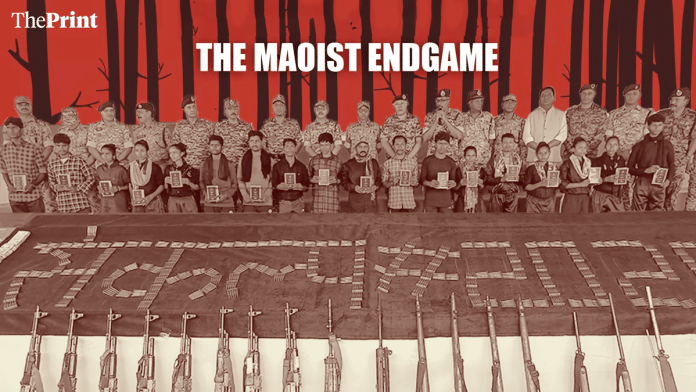



New Delhi: Mass surrenders, a leadership vacuum, no new recruits and government schemes reaching forests that were once no-go zones—this is the government’s account of how it dismantled Maoist insurgency after six decades.
Union Home Minister Amit Shah told Parliament a day before the government’s self-imposed 31 March deadline to end ‘left-wing extremism’ that of the 21 members of CPI (Maoist)’s Central Committee and Politburo, one had been arrested, seven had surrendered, 12 had been killed, and the one remaining was absconding.
“The talks are going on with the absconding one, and I believe he too will surrender very soon,” Shah said, adding: “All main armed Maoist cadres have been finished.”
The Red Corridor—born from a peasant uprising in West Bengal’s Naxalbari in 1967, which spread from there to Chhattisgarh, Jharkhand, Odisha, Maharashtra, Kerala, West Bengal, Madhya Pradesh, and parts of Andhra Pradesh and Telangana—is, by New Delhi’s reckoning, a corridor no longer.
Also Read: Maoists had plans to expand beyond Abujmarh. MP’s Hawk Force stood in their way
The crackdown
The collapse of the movement, government officials said, was driven by a security-centric strategy that systematically decapitated veteran leadership. The watershed came in 2025, with the elimination of CPI-Maoist General Secretary Nambala Keshav Rao and Central Committee members Sahdev Soren, Kadari, Satyanarayana Reddy and Katta Ramchandra Reddy.
That leadership vacuum triggered what the Ministry of Home Affairs describes as a record exodus.
Surrenders in Chhattisgarh doubled in a year—from 736 in 2024 to 1,573 in 2025. The number of ‘most affected’ districts nationwide fell from 86 in 2004, 68 in 2016, to just 11 by 2026. These are largely in Chhattisgarh, Jharkhand and Odisha.
Another turning point came in April last year with Operation Black Forest, which targeted commanders who had evaded capture for three decades.
Security forces cleared Karregutta Hills on the Chhattisgarh-Telangana border and the Abujmarh region (covering Chhattisgarh’s Narayanpur, Bijapur and Dantewada districts)—once considered impenetrable Maoist territory.
The largest single engagement, at Karregutta Hills, killed 31 Maoists without a single security force casualty, Shah told a felicitation ceremony for CRPF and DRG personnel in September 2025. The operation, though, has been marred by allegations of excessive force and encounter killings.
Forces deployed across these operations included the Central Reserve Police Force’s elite CoBRA battalions, District Reserve Guard and state police.
The broader toll speaks to the scale of the conflict. From 2004 until 24 March 2026, the Red Corridor recorded 25,513 violent incidents, killing 6,568 civilians and 2,453 security personnel. On the other side, approximately 5,000 security operations neutralised 3,514 Maoists, and 14,496 cadres laid down arms since then.
In January 2025, security forces killed Ramachandra Reddy Gari Pratap Reddy, better known as Chalapathi, a Central Committee member carrying a Rs 1-crore bounty. Chalapathy–the alleged mastermind behind the 2008 Nayagarh armoury loot and the 2003 assassination attempt on Andhra Pradesh Chief Minister N Chandrababu Naidu—was eliminated in Gariaband, Chhattisgarh.
(In Odisha’s Nayagarh, hundreds of armed rebels attacked a police station in 2008, looting ammunition and injuring policemen; Naidu was injured in a mine blast in Andhra Pradesh’s Tirupati in 2003)
Together with the killing of General Secretary Nambala Keshava Rao, these losses, government officials said, stripped the movement of its operational backbone.
Among 10 high-value desertions in 2025 was Satish, alias T Vasudeo Rao, who also carried a Rs 1-crore bounty. Veteran leaders Mallojula Venugopal and Misir Besra remain at large; and former secretary general of CPI(M) Ganapathy, officials said, is now largely a symbolic figure.
“What once functioned as a structured insurgent movement has now fragmented into isolated groups struggling to survive under constant pressure,” a government official said.
Operation Kagaar, launched in 2024, provided the framework under which all these operations were consolidated. Without central coordination, the insurgency has lost its ability to plan large-scale attacks, sustain communication networks, or maintain ideological cohesion, officials said, adding that the absence of fresh recruitment further hollowed out its appeal among local populations.
Shah, in his address to Parliament Monday, rejected the premise that poverty gave rise to the insurgency. “Maoism did not spread because of poverty, but Maoism led to poverty in regions such as Bastar,” he said.
Surrenders, development push
Along with operations, the government’s surrender and rehabilitation programme accelerated the movement’s decline.
Financial assistance, housing, skill development and employment opportunities, officials said, made surrender a viable alternative for cadres facing relentless pressure in the forest.
“This triggered a cycle of declining morale within insurgent ranks, leading to further desertions. Notably, former Maoist leaders have publicly acknowledged that working within the framework of the Indian Constitution offers a more sustainable path forward—reflecting a broader ideological shift,” the official said.
To encourage surrenders, the central government also rolled out rehabilitation packages ranging from Rs 10,000 to Rs 5 lakh depending on the rank of those who laid down their arms.
The government simultaneously pursued a development drive.
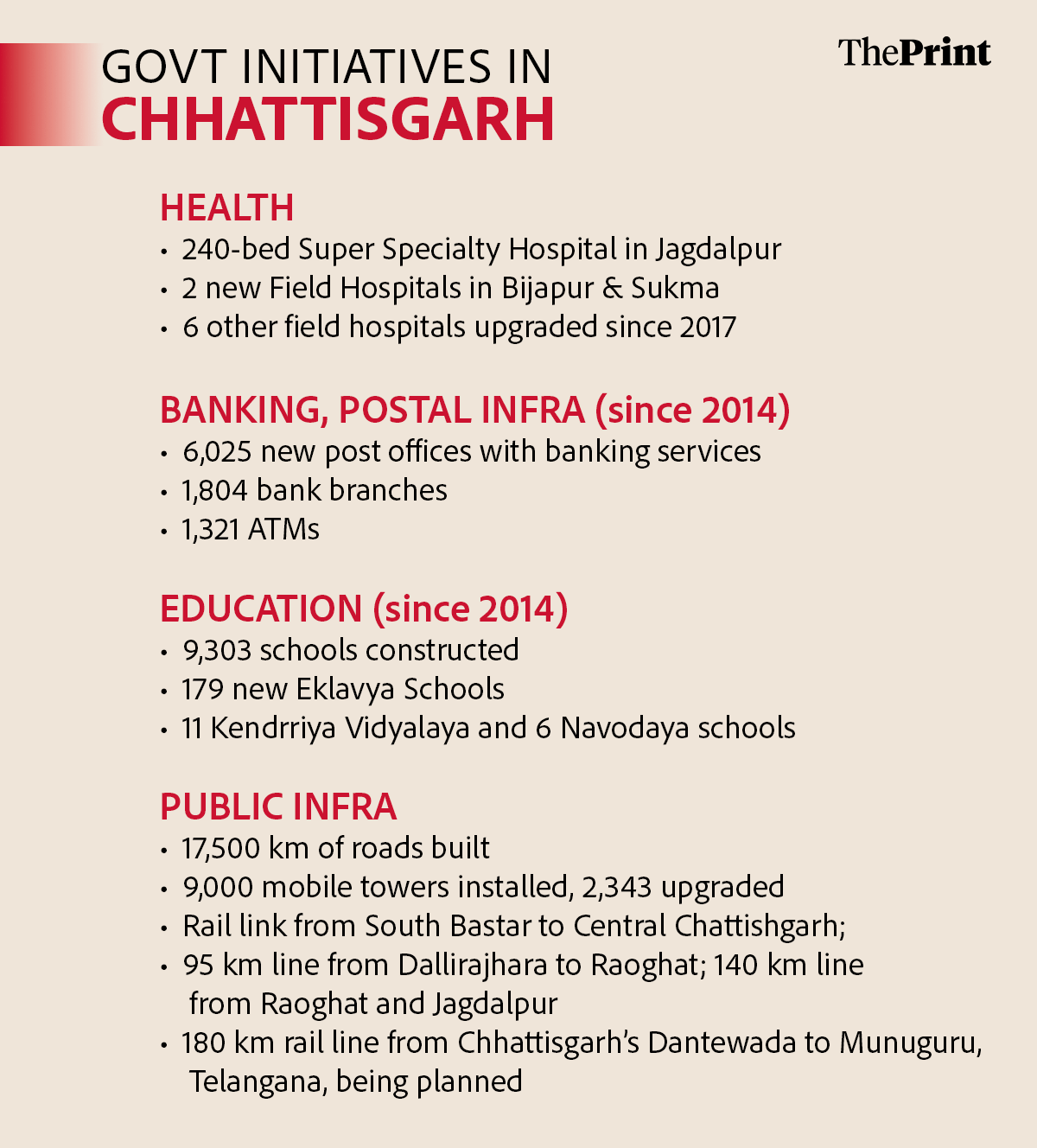
Since 2014, 17,500 kilometres of roads and 9,000 mobile towers were laid into previously isolated areas of Chhattisgarh and Jharkhand. This connectivity enabled setting up of 6,025 new post offices, 1,804 bank branches and 1,321 ATMs in what were once conflict zones.
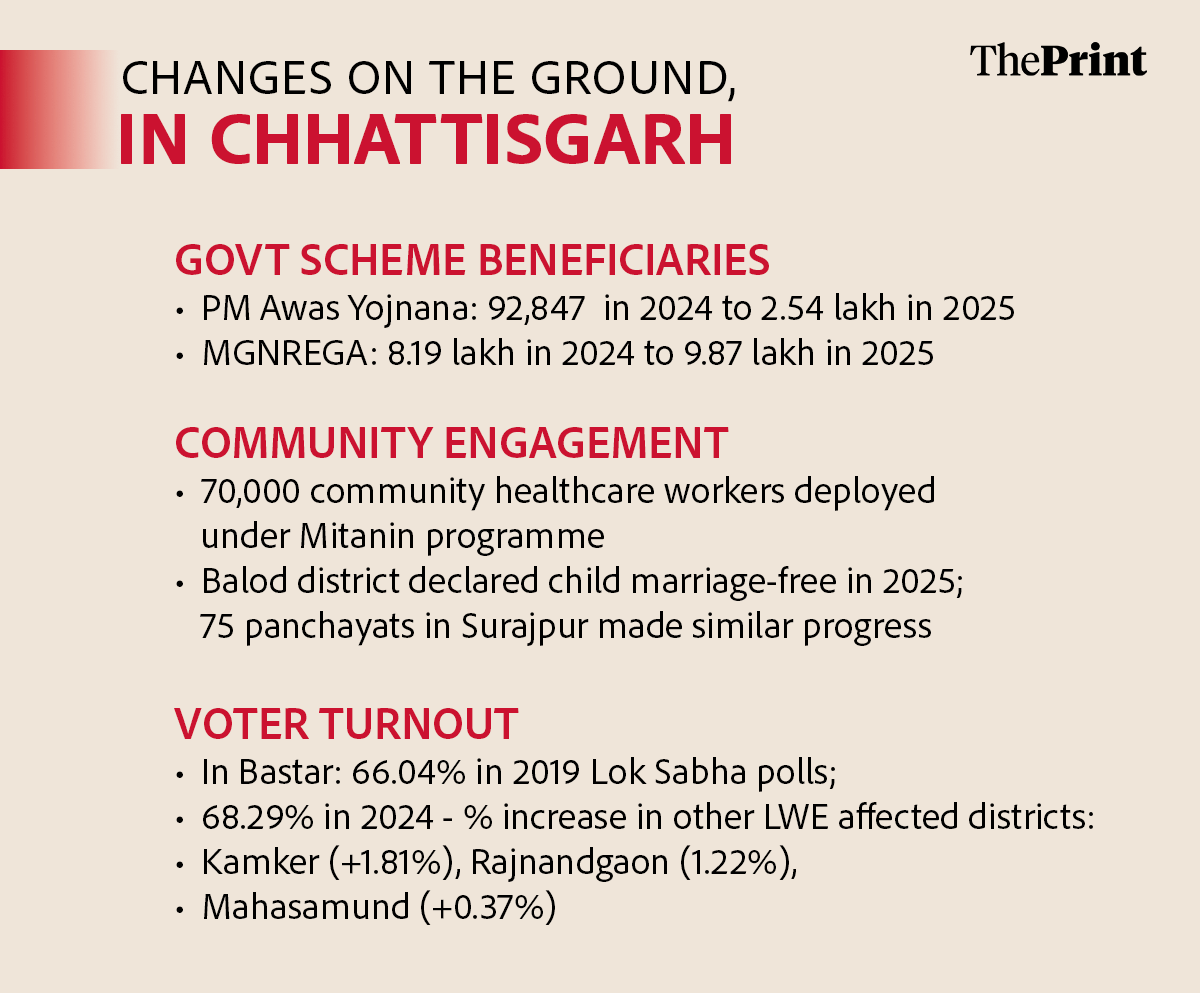
The PM Awas Yojana, which aims to provide housing, reached over 2.5 lakh beneficiaries in Chhattisgarh by 2025, replacing informal governance with state-administered direct benefit transfers.
Healthcare followed after. Field hospitals in Chhattisgarh’s Sukma and Bijapur, and a 240-bed Super Speciality Hospital in Jagdalpur were set up in recent years.
Under Centre’s Mitanin Programme, 70,000 community health workers, most of them from marginalised or tribal backgrounds, were deployed across Chhattisgarh. And women-led health collectives, Mahila Arogya Samitis, extended their reach beyond healthcare into other issues such as food security, sanitation, and gender-based violence, officials said.
In education, 9,303 schools and 179 Eklavya (residential model schools) schools were established since 2014, specifically to sever the Maoist recruitment pipeline among tribal youth, in Chhattisgarh. And other schemes, such as Niyad Nellanar for housing and water in Chhattisgarh, the aspirational districts programme, skill development missions and Ayushman Bharat (healthcare) brought formal governance directly to communities.
A region reclaiming itself
Data indicates improvements in Chhattisgarh.
Voter turnout in Bastar rose from 66.04 percent in 2019 Lok Sabha election to 68.29 percent in 2024 polls. Balod became India’s first child-marriage-free district in 2025; in September that year, Surajpur declared 75 village panchayats free from child marriage.
The Bastar Olympics, a sporting drive, drew 3.9 lakh participants last year. At its closing ceremony, Shah noted that over 700 former Maoists had competed—having, in his phrase, chosen “hope over fear”.
“Today, the Maoist movement stands weakened on all fronts—militarily, organisationally, and ideologically. Its leadership has been dismantled, its recruitment pipeline has dried up, and its influence over local populations continues to erode,” the official quoted above said.
Is Maoist insurgency over?
Local Sushil Kumar Pandey, who started Bastar Samajik Jan Vikas Samiti in Maoist-affected areas of the district, said there has been development in basic healthcare and education facilities in the region.
“There was a time when we weren’t allowed to enter villages. Locals wouldn’t meet us, because they would either be labelled as a Naxalite, or those working for the police. There were no phones, no roads, and nobody to hear grievances,” Pandey said.
A lot has changed. “Many people from Maoist hotbeds migrated to different areas due to fear. But now, locals can go into the forests without fear of getting killed. Now, if a policeman is killed, there are people who show up for condolences,” he said.
Aloka Kujur, a tribal rights activist based in Ranchi, said governments have claimed to put an end to left wing extremism multiple times.
“People have lived in fear, under heavy deployment and suspicion for long. They are fearful that their lands will be taken away in the name of development. They are scared that their jungles will be wiped out,” Kujur said.
Also read: Odisha’s top Maoist Sukru surrenders weeks after hacking deputy to death over laying down arms