



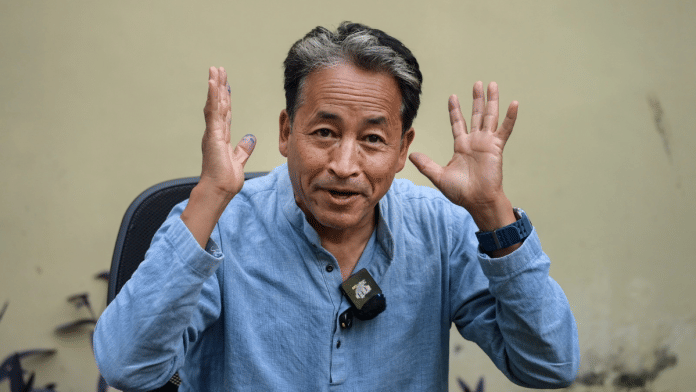
New Delhi: Climate activist Sonam Wangchuk has accused the Centre of going back on the understanding reached with the agitating Ladakh groups in May, saying the failure to hold a proposed meeting on Thursday had once again dashed hopes in the region.
At a press conference in Delhi, Wangchuk said the representatives of Leh Apex Body (LAB) and Kargil Democratic Alliance (KDA) had prepared for the next round of discussions on October 22 after the October 15 meeting in Leh, where they submitted their draft to the Union Home Ministry and received the ministry’s proposal in return.
The two drafts were compared point by point, with the expectation that differences would be discussed at the next meeting, he said.
“I had already booked my tickets. We made our plans accordingly, but now they are saying the meeting is not happening,” Wangchuk said, describing the development as another betrayal of trust.
The May 22 meeting had raised hopes of a democratic framework for Ladakh, he said. The representatives had initially sought statehood but, after being told that the region lacked the resources for it, proposed a Union Territory with a legislature and constitutional safeguards, Wangchuk said.
“We are saying again that nothing less than a Union Territory with a legislature and safeguards will be acceptable,” he said.
Wangchuk said Ladakh’s strategic position on the border with China made its democratic rights particularly important.
“China is claiming Ladakh as its territory. We condemn that. But do not crush Ladakh under your feet,” he said, warning the government against weakening the border region through its own decisions.
“Do not weaken the borders because of your stubbornness,” he added.
The May 22 meeting between representatives of LAB and KDA, and the MHA sub-committee had focused on constitutional protection for Ladakh, democratic representation and the long-pending demand for statehood.
Wangchuk had then said the government had proposed safeguards for Ladakh on the lines of Articles 371A and 371G and had agreed in principle to a governance structure for the entire region rather than limiting powers to district councils.
Wangchuk asserted on Thursday that the demand for a legislature was rooted in the need to give Ladakh’s people a say in how the region was governed.
At present, decisions were being taken unilaterally by the administration. The district councils, too, had seen their powers curtailed, he claimed.
“An LG has been appointed like a British Viceroy, who makes unilateral decisions. This is a blot on Indian democracy,” Wangchuk alleged.
He also raised concerns about the protection of Ladakh’s land, resources and identity, noting that around 90 per cent of its population belonged to tribal communities. He said local people risked being marginalised in decisions involving corporate interests and questioned policies that, he alleged, were being pursued without adequate public consent.
Wangchuk cited protests by women against the expansion of liquor sales, saying many people wanted Ladakh to remain a dry region.
The climate activists also acknowledged some positive developments in Ladakh, including a High Court bench and improvements related to roads and airport, but said these could not substitute for democratic rights.
“Whatever good has happened, we salute it. But nobody wants a cage, even if it is made of gold,” he said.
Citing the example of Arunachal Pradesh, which was granted statehood in 1987 despite its sensitive border location, he argued that strategic considerations should not be used to deny Ladakh an elected legislature.
Wangchuk condemned China’s claims over Ladakh, saying the region should be strengthened by giving its people the same democratic rights as citizens elsewhere in India, rather than leaving them without a say in their own governance.
Referring to the September 24, 2025 violence in Leh, Wangchuk said the protest had been peaceful with people sitting on a hunger strike, yet people had been killed.
Asked about the ongoing protests against the Chief Election Commissioner Gyanesh Kumar over the Special Intensive Revision (SIR), Wangchuk said the debate on electoral reforms should also cover places such as Ladakh, where people did not have the right to elect representatives to a legislative assembly.
“The Special Intensive Revision of electoral rolls was one aspect of a broader question about democratic rights… elections alone are not enough if promises made to people were not fulfilled,” he said, calling for larger electoral reforms.
Disclaimer: This report is auto generated from the PTI news service. ThePrint holds no responsibility for its content.