





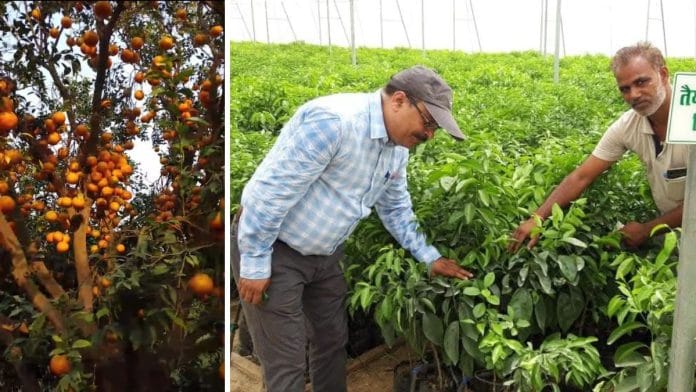


Gurugram: Sirsa’s kinnow has formally received its Geographical Indication (GI) tag, with the Registry in Chennai sealing the certificate of registration, a recognition officials are calling a first for Haryana in terms of an agricultural product carrying an exclusively Haryana-origin tag.
The Chief Minister’s Office, in a post on X, said the GI tag for Sirsa’s kinnows gives the state’s horticulture sector a new identity and credited it to years of hard work by farmers in building quality and a strong horticultural tradition in the region. The post said the recognition would give Haryana’s kinnow fresh visibility at both the national and international levels.
According to the certificate issued by the Geographical Indication Registry, ‘Sirsa Kinnow’ has been registered as GI No. 1101, Certificate No. 767, under Class 31, the category covering horticulture.
The registered proprietor is the Kharisureran Farmer Producer Company Limited, based at House No. 317, VPO Khari Sureran, Ellenabad, in Sirsa district, with the District Horticulture Officer, Sirsa, named as the facilitating agency.
The company had filed the application on 16 June 2023, and the certificate was sealed in Chennai on 28 March this year under the signature of the Registrar of Geographical Indications.
The registration comes with a logo, an orange kinnow with a green leaf inside a circular ‘Sirsa Kinnow’ emblem, that registered users will now be entitled to use on their produce. The GI area covers the whole of Sirsa district, as marked out on the map annexed to the certificate.
Also Read: Bihar’s superfood makhana industry isn’t growing. Where is the land?
What a GI tag protects
A Geographical Indication tag is a form of intellectual property protection given to products whose quality, reputation or characteristics are essentially linked to a specific place of origin.
It is granted under the Geographical Indications of Goods (Registration and Protection) Act, 1999, and administered by the GI Registry in Chennai, under the Controller General of Patents, Designs and Trade Marks.
Once registered, it stops anyone outside the defined geographical area, or anyone who is not an authorised user, from selling a product under that name.
Haryana Horticulture Department Director Dr Arjun Singh Saini told The Print that the tag belongs collectively to the community of producers rather than any single company, and runs for ten years, renewable thereafter. Darjeeling Tea was the first product in India to receive a GI tag, in 2004-05.
An important legal nuance applies here, and it is often misunderstood.
Asked how Sirsa Kinnow could get GI tag when the fruit is not native to India, Saini clarified that a GI tag does not certify where a plant variety originally came from—it certifies that the product, as grown in that specific place, has developed a distinct quality or reputation because of local conditions.
Kinnow is not native to Haryana, or even to India. It was developed in California in the early 20th century by horticulturist Howard B. Frost, a cross between the King mandarin and the Willow Leaf mandarin, and was introduced to India’s northwestern states decades later.
In the Sirsa region, kinnow has been grown for over four decades.
Saini also clarified that the GI tag is not for the kinnow variety as such—it is for “Sirsa Kinnow” specifically, recognising that the fruit grown in Sirsa’s particular soil, climate and irrigation conditions has acquired a distinct identity of its own.
The principle is the same one that lets Champagne be legally labelled as such only when made in that French region, even though the grape variety used did not originate there, or that lets Darjeeling Tea carry its name despite the tea plant itself being native to China.
Is this Haryana’s first GI tag?
Nayab Singh Saini government’s framing of this as a landmark needs a note of context.
Haryana already figures on India’s GI map through two products, Basmati rice, tagged in 2016, and Phulkari embroidery in 2010, but both are shared tags.
Basmati’s GI covers seven states together, including Punjab, Himachal Pradesh, Delhi, Uttarakhand, Uttar Pradesh and Jammu and Kashmir, besides Haryana. Phulkari’s GI is shared with Punjab and covers only parts of Haryana such as Ambala and Hisar.
Sirsa Kinnow, now registered as a tag exclusive to Haryana, is the state’s first standalone GI, distinct from these joint registrations.
Why Sirsa
Sirsa is Haryana’s leading kinnow-producing district by a wide margin. Government data shows the state produces roughly 4.40 lakh metric tonnes of kinnow every year, with Sirsa alone accounting for more than half of that output, cultivated over more than 20,000 hectares in the district, according to figures of the state’s Horticulture Department.
Citrus, and kinnow in particular, has for years been the backbone of horticulture in the region, with orchards expanding steadily as farmers moved away from lower-return traditional crops.
The fruit specification submitted with the application describes Sirsa Kinnow as a mid-season variety, oblate in shape with a flattened apex and base, and a smooth peel that turns deep orange on ripening, developing around 9 to 10 segments with few seeds.
It reaches full maturity between December and January, the peak harvesting season in Haryana.
The uniqueness claimed in the application rests on Sirsa’s semi-arid climate, sandy-loam soils, canal and groundwater irrigation, and long-established local cultivation practices, along with the reputation the fruit has built in domestic and export markets over decades.
The filing also describes Sirsa Kinnow as juicier and more sour-tasting than kinnow grown elsewhere, with a darker colour and thicker skin, and cites higher calcium content compared with other citrus fruits.
These are characterisations made in the applicant’s own filing, and broader health claims circulating around kinnow more generally should be treated as promotional rather than clinically established.
Political families among the growers
The belt’s reputation extends well beyond Sirsa district’s own boundaries. Dr Kamal Veer Singh, a kinnow grower with a 200-acre orchard at Teja Khera in Sirsa, said the quality zone actually runs in a continuous stretch from the Dabwali subdivision of Sirsa across the border into Abohar and Fazilka in Punjab.
Singh, a nephew of former deputy prime minister Devi Lal, his grandfather Tara Chand was Devi Lal’s father Lekh Ram’s real brother, served as Officer on Special Duty during both Devi Lal’s tenure and Bhupinder Singh Hooda’s government.
“The area starting from Dabwali subdivision of Sirsa to Abohar and Fazilka in Punjab is known for its high quality kinnows. The kinnows here are very nice in ambience with no scratches on the surface, and are very juicy. It is largely because of the climatic condition, soil and water,” Singh told The Print.
He said this quality reputation was precisely why several political families, alongside thousands of ordinary farmers, have built kinnow orchards in the belt. He pointed to Abhay Singh Chautala’s large orchard also at Teja Khera, a 200-acre orchard belonging to the family of former Punjab chief minister the late Parkash Singh Badal at Balasar in Sirsa, and orchards in Abohar owned by former Lok Sabha Speaker Balram Jakhar, whose son Sunil Jakhar is a former Punjab BJP chief.
Singh said the crop has delivered strong returns for growers, with last year particularly good on account of high yield and remunerative prices, giving him a return of close to Rs 6 lakh per acre. He also said it was on his suggestion that Hooda’s government set up the Centre of Excellence for Tropical Fruits at Mangeana near Dabwali in 2007-08, in collaboration with Israel.
“I suggested at that time that the government should set up a centre for quality seeds for kinnows. Somehow, that didn’t happen, and now my son Amit has set up one such centre at the family farm,” he said, referring to Amit Sihag, a Congress leader and Dabwali’s MLA from 2019 to 2024.
The infrastructure building around the fruit
The state has also been investing in processing capacity for the crop. A kinnow juice processing plant is coming up on the Vita Milk Plant premises in Sirsa under a public-private partnership, with an outlay of over Rs 26 crore, meant to process 9000 metric tonnes of kinnow annually, including lower-grade fruit that earlier fetched poor prices in the open market.
Waxing and grading facilities have also been set up in the district, at Abubshahar and elsewhere, to improve shelf life and cut down on wastage before the fruit reaches the market.
What the tag is expected to do
A GI tag typically allows a product to command a price premium, since it certifies authenticity and origin to buyers. It also opens the door to structured export support through agencies such as APEDA, and gives registered growers legal ground to act against traders elsewhere who might market ordinary citrus fruit as “Sirsa kinnow” to cash in on its reputation, according to an officer in the State’s Horticulture Department.
For a fruit economy that has long struggled with seasonal gluts and distress sales, the tag is being pitched by the state government as a tool to strengthen bargaining power for growers and build a distinct market identity for the produce beyond the region.
With the certificate now formally issued, the Kharisureran Farmer Producer Company and other Sirsa growers will be entitled to use the “Sirsa Kinnow” name and logo on their produce and packaging.
(Edited by Gitanjali Das)
Also Read: The GI tag man of India lives in Varanasi. He is blending culture and commerce