


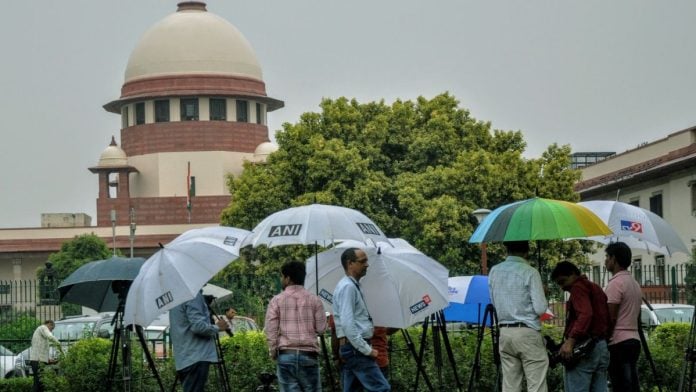
New Delhi: The Supreme Court Thursday posed four questions while hearing a petition regarding the alleged detention and forced removal of journalists while covering protests demanding the resignation of Chief Election Commissioner (CEC) Gyanesh Kumar.
– Who qualifies as a journalist?
– Should professional accreditation or institutional affiliation determine the protection available to journalists?
– Do journalists enjoy any special privilege vis-à-vis law enforcement agencies while covering protests?
– Does forcible removal of a journalist from a protest site amount to custody? What are its constitutional consequences?
A bench led by Chief Justice Suryakant and comprising Justices Joymalya Bagchi and V Mohana disposed of the petition, asking the petitioner to approach the court-monitored enquiry panel, looking into the allegations of violence and police atrocities during the protests.
The bench did not express any opinion on merits, but said it would examine larger constitutional questions to maintain a balance between journalistic freedom and maintenance of public order. The committee, it clarified, will examine individual allegations of police excesses.
However, Justice Bagchi said there were gaps in the existing framework governing police interaction with journalists.
He pointed out that self-proclaimed journalists might not necessarily enjoy the same level of protection as accredited ones.
To elaborate his point, he said: “Status (as a journalist) is not self-conferred. If you are a journalist from a newspaper/print media, you’re under [Press Council] accredited journalist. If you are a TV channel of that newspaper, you are accredited accordingly. You can also be an online journalist, and you can also have registration. These things we have to…we are in the realm of atomised individuals claiming to be journalists. Self-proclaimed journalists may not have the same protection as accredited journalists.”
The petition was filed by Kerala Union of Working Journalists (KUWJ).
A fortnight ago, the Delhi Police made a similar submission before the court in their affidavit, filed in response to a batch of petitions, accusing the force of atrocities. The police claimed social media influencers, content creators and reel makers would not get the same protection as accredited journalists.
It was maintained that the police did not knowingly obstruct any journalist from carrying out their duties.
“The Delhi Police has, at no point, sought to obstruct, impede or interfere with the bona fide discharge of journalistic duties, whether during the protests in question or otherwise,” the affidavit said.
It denied breach of the top court order that directed the police from exempting the media from restrictions imposed by the Delhi Police to regulate the movement of those present at the protest sites. It said content creators cannot seek benefit of this directive.
During the hearing Thursday, the top court said it would lay down a Standard Operating Procedure (SOPs) on how to deal with journalists during public demonstrations, if it found grey areas or a vacuum.
Justice Bagchi said: “First we have to define a journalist. Is it a journalist in the category where someone is registered under the Press Council? Or is employed with a registered newspaper/TV channel? Or a person who seeks to be a (spokesman) to the citizens, like on social media, who are making reels.”
Responding to a lawyer’s claim that categorisation of persons into “journalists” and “reel-makers” was an after thought cannot be done on the spot during a demonstration, the judge said: “Even if we lay down an SOP, the SOP’s graded stance of law enforcement agencies would also depend upon the status and character of the person claiming to be a journalist.”
He said the court would first address the issues on principle of how far a journalist in a situation where there is an assemblage or demonstration can go; whether a journalist has a special privilege in such a situation with respect to law enforcement agencies.
He also said that a crucial question that needs a determination is do “journalists have a superior or a different species of treatment in a situation where a demonstration is going.” This, he explained, has to be decided based on their right to pursue their profession, while making sure that law and order is maintained.
(Edited by Anupama Yadav)