





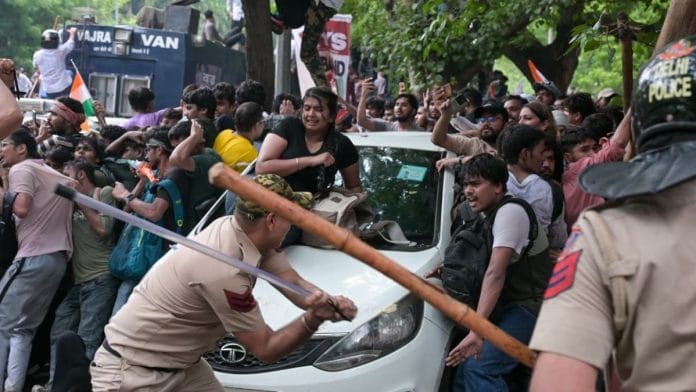


New Delhi: The security establishment is reviewing the conduct of security forces, including the Delhi Police and the Rapid Action Force (RAF), during last week’s crackdown on the CJP-led march towards Parliament, while also investigating how “disruptive elements” entered the protest and triggered the violence.
Sources in the security establishment told ThePrint that a preliminary assessment has flagged certain lapses in the handling of the situation.
Senior security officials are examining whether the infiltration of disruptive elements into the crowd marked the turning point that escalated an otherwise controlled protest into a violent confrontation.
The review is also examining allegations of indiscriminate use of force by some personnel, including the firing of a pellet gun by an RAF jawan.
According to sources, pellet guns are standard-issue weapons carried by selected RAF personnel in a company deployment. However, they said the decision to sign out such a weapon from the armoury for deployment at the Jantar Mantar protest is itself under scrutiny, given that the protest did not initially fit the kind of riot-control situations in which pellet guns are typically employed.
Officials maintained that permission had been granted only for a sit-in demonstration at Jantar Mantar and not for a march towards Parliament or beyond the designated protest area.
“The police facilitated the protest for weeks. There was sloganeering, hooting and repeated provocation, but the protest was allowed to continue. The flashpoint came only when protesters attempted to march towards a high-security zone while Parliament was in session,” said a source.
According to the reconstruction of events by the security establishment, multiple layers of barricades were initially maintained without the use of force. Police resorted to limited use of force including water cannons after protesters began pushing forward and dismantling barricades.
“The situation changed when one group managed to breach the barricades at a particular location. Standard operating procedure in such circumstances is a lathi charge to disperse the crowd,” a source said.
Officials acknowledged that the situation deteriorated further after stone-pelting began.
“Once stones were thrown by disruptive elements within the crowd, tear gas became the next step. Tear gas is standard operating procedure for riot-like situations anywhere in the world. When barricades are breached, the minimum response one should expect is water cannons and, if necessary, tear gas,” a source said.
Sources further said that several Delhi Police and RAF personnel were injured in the stone-pelting that followed. “There was clear mob psychology at play. Additional lathicharge followed and, based on videos that have emerged, it appears excessive force may have been used in certain instances. That is precisely what is being examined,” another source said.
Officials said all available video footage is being scrutinised to identify personnel involved and establish whether any action violated established procedures.
The RAF jawan who fired the pellet gun has also been questioned, sources said. According to officials, he said that he believed he was surrounded by a violent mob and the pellet gun was the only weapon available to protect himself.
Asked about videos showing alleged excessive force, including against some women protesters, sources said the inquiry would cover every such incident.
“Every action is being reviewed. Anyone found to have violated rules and standard operating procedures will face appropriate action,” a source said.
Officials stressed that while the use of force became necessary after multiple security barricades were breached, the review is examining whether individual personnel exceeded permissible limits.
“The issue is two-fold. First, whether excessive force was used by some security personnel. Second, the role played by violent elements among the protesters whose actions triggered the police response,” a senior security source said.
Sources said several police personnel were injured in violence by certain elements among the protesters, leading to head injuries and fractures.
(Edited by Gitanjali Das)