



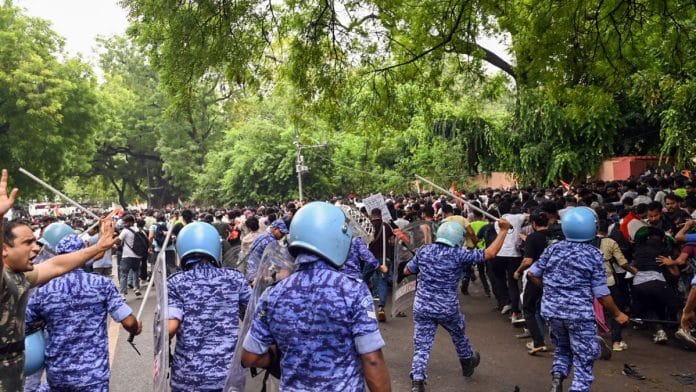
New Delhi: Taking cognisance of social media videos of personnel “deliberately knocking down” protesters at the Jantar Mantar, and even assaulting people disengaged from the agitation, the force’s chief has pulled up the personnel and their commanders on the ground, ThePrint has learnt.
RAF Inspector General Seema Dhundhia told the personnel and officers that such “excessive use of force” is not justified and that use of any force should be done in a graded manner, according to sources.
Additionally, she apprised the boots on the ground that the force headquarters has prohibited the use of Projectile Attack Gun (PAG or pellet guns), electrical weapons, and electrical shields during their deployment in the national capital.
The stinging rebuke of the RAF’s on-ground personnel and the officers of the RAF, the anti-riot wing of the CRPF, came Wednesday during a virtual meet chaired by the force’s chief Seema Dhundhia. During the meeting, she also instructed all the officers to refrain from making statements before the media.
The conduct of the security forces, including the RAF, came under scrutiny and criticism, especially over their use of “disproportionate” force against the protesters, including using pellet guns against the protesters during the Sansad Chalo march on Monday.
Authorities have denied using pellet guns, but ThePrint has reported, based on hospital confirmation, that at least three people are being treated for injuries that seem to have been caused by pellet guns.
On Seema Dhundhia’s meeting, an officer said, “She made it clear that the gradation of force adopted for crowd control during the protest at Jantar Mantar, New Delhi, on July 20, 2026, did not align with prescribed standards or the RAF’s training protocols. She directed that every officer and personnel member must strictly adhere to the prescribed ‘Use of Force’ guidelines while making a proper assessment of the nature of the crowd and the prevailing circumstances.”
The officer said that all unit commanders should issue strict warnings to their field units that available measures—ranging from lathi-charges, tear gas, and other approved crowd-control techniques—should be adopted only in a graduated manner and appropriate to the circumstances, ensuring that no unnecessary or disproportionate force is used at any stage.
“The IG noted that certain videos on social media depicted RAF personnel using unnecessary force against individuals separated from the crowd, deliberately knocking people down, and striking individuals moving past barricades. Such actions, she firmly instructed, run contrary to the RAF’s established work culture and image and cannot be justified under any circumstances,” the official said.
“She clearly instructed that during the current Delhi deployment, the situation has been analysed and PAG, Anti-Riot Gun (ARG), Electric Shock Weapon and Electric Shield will not be used or issued to the personnel till further orders,” the official further said.
Meanwhile, the CRPF increased its deployment over the course of days in the wake of the march on Monday and airlifted more than a dozen companies to the national capital.
‘Delhi requires a distinct approach’
In the review meeting, IG Dhundhia also made it clear that the sector headquarters of the RAF did not receive specific information related to operational strength and deployment of each company of the force on Monday. The CRPF had deployed 14 RAF companies on the day.
Moreover, the IG also asked the on-field formation that personnel who have recently been transferred from special operations zones such as Jammu and Kashmir should not be deployed immediately in crowd control management duties in Delhi because both the approach and mandate differ in these sectors.
“The IG emphasised that personnel transferring from the special operations zone such as Jammu & Kashmir, or other operational areas, possess a different work environment and operational perspective, but sectors such as Delhi, Bihar, Assam, and Maharashtra require a distinct and balanced approach to crowd control and public order management,” the official further said.
Therefore, such personnel shall not be deployed for field duty without being fully trained and familiarised with the RAF’s operational procedures, principles of crowd control, and the concept of “Sensitive Policing”, IG Dhdundia instructed officers on the ground, according to officials privy to the details.
“She expressed serious dissatisfaction over the performance during the recent protest organised at Jantar Mantar in Delhi. She said that introspection by officers and review of all details from the day revealed serious shortcomings in many aspects of operations that need to be rectified in the future.”
(Edited by Ajeet Tiwari)
Also read: How Gen Z protests may play out in UP assembly election