





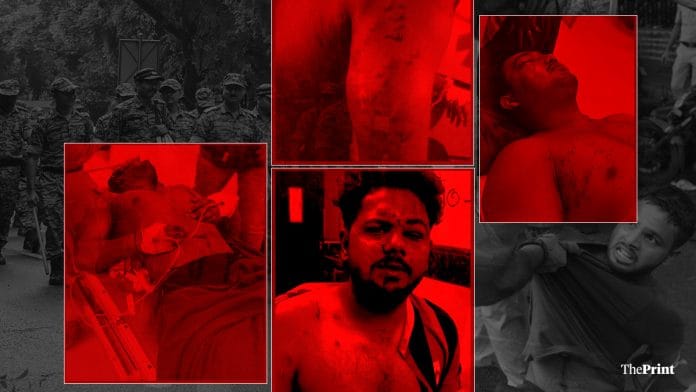


New Delhi: The 28-year-old sports reporter had gone to witness the ‘Sansad Chalo’ protest march on 20 July. It was his first time attending a student protest. Having parked his motorcycle at a spot in central Delhi, he was walking towards Connaught Place when he was caught between security forces and a “violent group of protesters pelting stones”.
While trying to safeguard himself in the middle of this chaos, the reporter was struck by what he initially thought was a tear gas shell. It was only later when he turned to ChatGPT for medical advice that the AI chatbot informed him that the wounds were caused by a pellet gun.
“Within minutes, it was chaotic. I saw an RAF personnel aiming towards me. People were running in all directions, and I just didn’t know what to do? So I ran in the opposite direction. But, I was shot at. I fell down. Everything was so loud, I thought it was tear gas,” the reporter told ThePrint.
His is now the third documented case of pellet injuries suffered on 20 July as yet. As ThePrint reported earlier, 25-year-old accounts manager Irshad Mansoori is currently under treatment for pellet injuries at Lady Hardinge Hospital. Also under treatment is 19-year-old Sahil Lohchab. Both had attended the ‘Sansad Chalo’ protest march.
More than 70 people were injured when Delhi Police and Rapid Action Force (RAF) deployed force to disperse thousands who took to the streets of central Delhi at the call of activist Sonam Wangchuk and Cockroach Janta Party (CJP) to demand the resignation of Union Education Minister Dharmendra Pradhan. More than 100 security personnel were also injured.
Some of the most intense clashes between security personnel and protesters took place near Patel Chowk metro station where Delhi Police and RAF fired multiple tear gas shells and carried out heavy lathicharge. Groups of protesters retaliated by hurling objects at security forces including glass and plastic bottles. In the middle of this, hundreds had to walk from Connaught Place to Sansad Marg through Janpath as Delhi Police had barricaded the Sansad Marg entry point at the Outer Circle.
Though Delhi Police have denied use of pellet guns during the action on 20 July, the crowd-control measure is not part of its armouries. It is, however, part of RAF’s armouries. ThePrint made multiple attempts to reach the CRPF spokesperson as well as Inspector General (RAF) Seema Dhundia for comment via calls and WhatsApp, but had not received a response till the time of publication. RAF is CRPF’s anti-riot wing.
Introduced as a crowd-control measure in Jammu and Kashmir by the state police and the CRPF around 2010, pellet guns have in many documented cases blinded those at the receiving end. The Supreme Court had in 2016 asked the Centre to ensure security forces apply their minds before firing pellet guns. The next year, the government told the apex court that the use of pellet guns was marked as the “last resort” during crowd control.
Dr Namit Gupta, a medico-legal expert and former emergency medicine doctor at AIIMS Delhi, told ThePrint that pellets, made of lead metal and very tiny in size, cause penetrating injuries too small to remove surgically.
“In practice, people often sustain injuries to vulnerable areas such as the eyes and face,” he said. Adding, “Pellets are tiny metallic projectiles that travel unpredictably, so they can also injure bystanders.”
Dr Gupta, who has experience of treating pellet injuries, added that if a pellet is lodged in a muscle, doctors often leave it in place, unless it damages a vital organ, blood vessel or nerve. But long-term follow-up is important because, in rare cases, retained pellets can lead to complications such as blood clots or even lead toxicity. He added that eye injuries are among the most severe because the small, high-speed pellets can easily penetrate delicate eye tissue, making permanent vision loss a real possibility.
Also Read: CJP protest: PM Modi announces fast-track courts for paper leak cases, says culprits won’t be spared
‘Aimed at me, I ran’
Speaking to ThePrint, the reporter quoted earlier said he had gone to the protest march to Parliament to extend his support to the protesters. Adding, “I shared similar feelings towards what they stood for.”
He recalled that he travelled to central Delhi on his motorcycle. After he parked it, he was walking towards Connaught Place, when protesters began their march from Jantar Mantar.
Between 4 PM and 4.30 PM, he saw security forces in large numbers and at least 500 protesters—groups of them, scattered—near Connaught Place. “At one end of the CP circle the crowd soon turned violent. I tried to safeguard myself. I ran for safety, but the protesters began to pelt stones, while the security forces resorted to tear gas. It escalated quickly,” he said.
After he was struck, the reporter managed to get up and walk towards safety. Helped by those at the protest site, he found potable water to clean his wound around 6 PM.
But he “could not make out what it (injury) was”.
“The minute I got on the network, I took a photo of my wound, and uploaded it to ChatGPT, to ask if these were rubber pellets, or pellet gun wounds. And, the AI platform confirmed. It told me to get a tetanus shot,” said the reporter. He then went to a private hospital and complied.
The next day, he visited Safdarjung hospital where an ultrasound and an X-ray confirmed what the AI chatbot suspected. “They did an ultrasound and an X-ray. It showed pellets visible. Doctors told me there are around 25-30 pellet wounds. I was told it would be difficult to remove them, because there were too many, and cuts were to be made. I was told the wounds are not dangerous, and can be treated with time,” the reporter said.
According to the medico-legal case (MLC) record ThePrint has seen, the reporter was brought to the hospital with a history of pellet gun injuries and complained of pain at the injury sites. The record notes that he was conscious and stable, with a blood pressure of 117/86 mmHg and oxygen saturation of 99 percent at the time of examination.
“…at around 4 PM during Jantar Mantar protest, as per the informant, the patient went to attend the protest during which the circumstances changed and situation escalated resulting in panic, to get the situation under control tear gas and pellets were used,” read the case sheet at Safdarjung.
The reporter, injured on his right elbow and back, now plans to seek a second opinion. “When I was shot, there were multiple people. I feel, when the officer shot me, there must have been more who have been injured.”
He adds that he will go back to Jantar Mantat to extend his support.
‘Was waiving national flag’
Sahil Lohchab, 19, had also gone to Jantar Mantar to attend the protest.
A resident of Najafgarh, Sahil is a final-year student at Delhi University’s School of Open Learning (SOL).
His mother told ThePrint that around 3 PM, when Sahil was “waving the national flag”, he was hit by pellets that pierced his right eye and parts of his upper body. By Tuesday morning, he was at the AIIMS Trauma Centre where he underwent surgery the next day.
His mother Jyoti, who was waiting Thursday at a park just outside AIIMS Trauma Centre, said Sahil also worked as a driver alongside his father Deepak to support the family. She said Sahil wanted to join Delhi Police and was preparing for the head constable recruitment exams.
He had also appeared for the Staff Selection Commission’s Combined Graduate Level (SSC-CGL) Group-B and Group-C exams.
“He had told me he was going to the protest. I tried to stop him, but he said that many students are going, nothing will happen,” said the mother.
In the hours that followed, repeated calls to him went unanswered. It was around 3 PM that the mother got a call informing her that Sahil had been injured.
“We rushed to Lady Hardinge, but from there he was referred to Safdarjung. We didn’t get a bed there, then we went to AIIMS, then Max. They also did not admit him because of the nature of the injury. We kept taking him from one hospital to another through the night,” she said.
Sahil was finally admitted to the AIIMS Trauma Centre around 4 AM, where he underwent surgery Wednesday, according to his family.
Doctors later confirmed to Jyoti that he had suffered a pellet injury.
His right eye has been severely damaged. “The doctors have told us there is only a one percent chance that his eyesight will return,” Jyoti said. “He is able to eat and talk, but his hand is swollen and he is in pain.”
For the Lohchab family, Sahil’s injury is also a financial crisis.
His earnings helped support the family of five, which lives in a rented house in Najafgarh. His two younger brothers, aged 15 and 12, are still in school.
“Our financial condition is such that we cannot survive on one income alone,” Jyoti said. “He is my eldest son. His whole life is ahead of him. What will he do now?”
She said the family wants both compensation and employment for Sahil. “I want him to get a job at least. He should also receive compensation. What was his fault? Why should his life be ruined?”
(Edited by Amrtansh Arora)
Also Read: CJP protest isn’t another Anna movement. It’s something Modi govt doesn’t know how to fight