





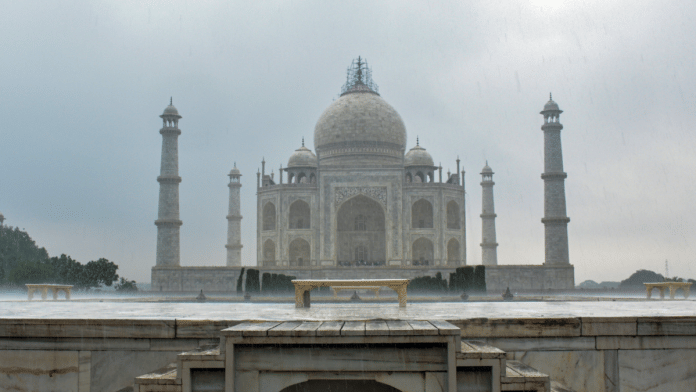


New Delhi: The Supreme Court on Thursday modified its two-year-old order, which effectively prohibited fresh industrial activity in the Taj Trapezium Zone (TTZ) without its permission, and framed a new mechanism that allows TTZ authority to process pending applications for setting up industrial establishment, expansion and relocation in the exclusive area around the Taj Mahal, a world-protected site and a heritage monument.
A bench led by Chief Justice of India Surya Kant modified the October 2024 order that restrained TTZ approving new industries in the 10,400 square kilometer trapezoid-shaped protected area around the Taj Mahal.
In 1996, the SC had earmarked this area, covering parts of Uttar Pradesh and Rajasthan, including Agra, Mathura, and Firozabad. The purpose behind creating this special zone was to shield local monuments from environmental pollution.
Initially, it banned the use of coal/coke in industries located in the TTZ, and directed them to switch cleaner fuel such as natural gas. Over a period of time, the top court took more stringent measures to free the area around the Taj Mahal from polluting units.
One such direction came in October 2024 that mandated the top court’s permission before setting up any industry—small, medium or large—in the TTZ.
However, Thursday, acting on an application filed by the Uttar Pradesh government to allow the TTZ Authority to process around 410 applications, mostly by micro, small and medium enterprises (MSMEs), the SC eased the conditions imposed in the October 2024 order.
The applications, the court was told, sought permission for industrial establishment, expansion or relocation.
While allowing the TTZ to process the application, without the SC’s permission, the CJI-led bench put in place a scrutiny mechanism that will involve experts from the Court-appointed Centrally Empowered Committee (CEC) and the National Environmental Engineering Research Institute (NEERI).
The TTZ Authority, as per the order, can decide upon an application only with the concurrence of the experts from these two bodies. The order allows one expert from each body to be present in the panel that will look into the applications.
In case of a divergence over a proposal, the matter can be referred to the Supreme Court.
“We, therefore, direct that TTZ authority may process the applications but in every such meeting, an expert representative of the CEC and another from NEERI shall be invited, and no meeting shall take place unless both subject experts are present. Similarly, in the event of 1 of the 2 experts objecting to the nature of an industry, namely classifying it not to be a ‘non-polluting industry’, such application shall not be accepted without leave of this court,” the court said.
“Those cases where both experts are unanimous alongwith TTZ authority, such applications may be taken to a logical conclusion in accordance with law without reference to this court,” the court ordered.
But the bench gave amicus curiae in the case the final authority to decide when and why judicial intervention can be sought. It said the amicus curiae can refer any proposal to the court notwithstanding the concurrence of the NEERI and CEC experts on grant of approval to an industry.
Decisions taken on each proposal shall be made public on the CEC website to enable citizens to share their views, opinions, objections or suggestions.
The SC made it compulsory for the TTZ authority to deliberate over the public comments and consult the two experts as well. It is incumbent upon the TTZ authority to apprise the amicus about every decision it would take in relation to the 410 applications, the court said.
The court’s Thursday order came even as it noted that the TTZ authority had not yet finalised a vision document nor submitted a cumulative impact assessment study of the industries proposed, and even a final report on non-polluting industries is yet to be submitted.
However, the pendency of the three initiatives cannot impede the decision-making process in connection with the 410 applications.
“While all 3 pending initiatives are required to be undoubtedly completed at the earliest and in a time-bound manner, it seems to us that pendency, therefore, should not be an impediment in processing applications received by TTZ,” the court said.
It added, “What is of utmost importance is that well-known precautionary principles must be strictly adhered to under supervision of domain experts.”
(Edited by Ajeet Tiwari)
Also Read: The Taj Mahal is wasting away, and it may soon hit the point of no return