



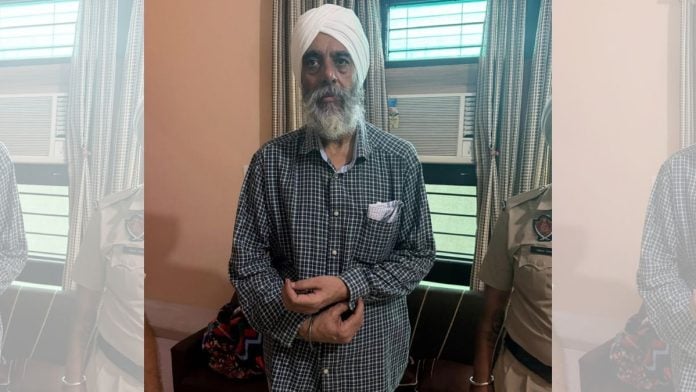
Chandigarh: The arrest of former Punjab Police Assistant Inspector General Raj Jit Singh Thursday marks a major milestone in the almost decade-long Bhola drug case that has dominated Punjab politics for the alleged nexus between drug traffickers, sections of the police and politicians. The arrest comes at a time when rampant availability of drugs is emerging as one of the key issues in the poll-bound state, with Assembly elections due early next year.
Raj Jit had been on the run from investigating agencies for more than three years after he was dismissed from service in 2023 and declared a proclaimed offender. He was arrested by the Anti-Narcotics Task Force from a house in Patiala Thursday morning, just days after he offered to surrender before the Supreme Court during the hearing of his bail plea.
The Supreme Court had on 10 September directed him to surrender. A bench comprising Justices M.M. Sundresh and Augustine George Masih recorded the statement of Raj Jit’s advocate that he was willing to surrender and gave him liberty to seek regular bail after doing so. The matter is listed for 1 October.
Raj Jit, a highly decorated officer and considered the blue-eyed boy of some of the top policemen in the state, became a controversial figure after an investigation revealed his alleged links with dismissed inspector Inderjit Singh, accused of running a drug-racket. Raj Jit’s alleged involvement also became a bone of contention between two warring sections of the top leadership of the Punjab Police, with one section seen as defending him and the other trying to ‘fix’ him.
The Bhola drug case had become deeply politicised instead of turning the focus on Punjab’s growing drug problem. The investigation has been repeatedly used to attack Shiromani Akali Dal leader Bikram Singh Majithia apart from rival factions within the police who are accused of using the drug probe to settle their own battles.
Also Read: There’s more to Punjab power crisis than a coal shortage. It’s a result of public-private failure
Enter, the Captain
While Majithia has remained the centrepiece of the Bhola drug case since Arjuna awardee wrestler and former Punjab police officer Jagdish Bhola’s arrest as the kingpin in 2013, Raj Jit entered the story in 2017 after Captain Amarinder Singh came to power in the state.
He set up a Special Task Force (STF) against drugs in Punjab, headed by then Additional Director General of Police (ADGP) Harpreet Singh Sidhu.
In June 2017, the STF arrested inspector Inderjit Singh from his official house in Jalandhar with a large quantity of heroin, illegal weapons and ammunition, as well as unaccounted Indian and foreign currency. While Inderjit was dismissed from service within a few days of his arrest, the STF shifted the focus of its investigation to Raj Jit Singh who was the then Senior Superintendent of Police (SSP), Moga, and considered to be Inderjit’s patron.
Raj Jit had been SSP of Tarn Taran in 2013, when Inderjit was posted there. Later, when Raj Jit moved to Hoshiarpur and then Moga, Inderjit continued to receive important postings under him.
Apprehending action, Raj Jit approached the Punjab and Haryana High Court in the ongoing Bhola drug case, seeking that the investigation into the Inderjit case be shifted from the STF headed by Sidhu to another officer as Sidhu, he said, had a personal bias against him. In December 2017, the court constituted a three member special investigation team (SIT) headed by a DGP-level officer Siddharth Chattopadhyaya. The other members of the SIT were ADGP Prabodh Kumar and then Inspector General Kunwar Vijay Pratap Singh.
The SIT was mandated specifically to investigate allegations concerning Raj Jit Singh’s alleged association with Inderjit Singh. The investigation, however, soon became much larger and more contentious than the original question.
The SIT subsequently submitted three reports that examined Inderjit’s conduct and the circumstances in which he had obtained several postings and promotions. The reports recorded allegations that Inderjit had been involved in manipulating drug cases, including allegations of planting narcotics, falsely implicating people, delaying forensic samples and using cases to extort money.
The SIT also examined Raj Jit’s role in Inderjit’s career. One of the reports found that Raj Jit had specifically requested Inderjit’s posting to Tarn Taran and subsequently posted him as intelligence in-charge there, despite records showing criminal cases and a previous major punishment against Inderjit.
The SIT also examined a recommendation by Raj Jit for Inderjit’s double promotion and the certification that no criminal case or departmental inquiry was pending against him. It looked at Inderjit’s subsequent postings, including his transfer to Hoshiarpur, and recommendations describing him as hardworking and sincere.
Financial questions were also examined. The SIT obtained Raj Jit’s property returns and documents relating to property purchases and noted an increase in his immovable assets from 2013 onwards. It sought explanations regarding the sources of funds.
Apart from the reports submitted by all three members of the SIT, in May 2018, a separate report was submitted by Chattopadhyaya to the court. Unlike the earlier reports, this report was not jointly signed by all three SIT members. Prabodh Kumar and Kunwar Vijay Pratap Singh did not associate themselves with it.
In his separate report, Chattopadhyaya alleged that Raj Jit was further patronised by Punjab’s seniormost officers.
The khaki rift
This was the point at which the Raj Jit-Inderjit investigation became inseparable from the bitter divisions within the police hierarchy and became the centre of a power struggle among rival factions.
In its September 2023 judgement in the Bhola drug case, a division bench headed by Justice G.S. Sandhawalia of the High Court made an important distinction between the original SIT mandate and Chattopadhyaya’s separate report. The court said the three-member SIT had been constituted to examine Raj Jit’s alleged complicity with Inderjit arising from the 2017 FIR. It noted that any possible complicity involving other officers could be investigated separately. The court also recorded objections to the May 8 report and the allegations of bias and service rivalry surrounding it.
The SIT reports were submitted to the high court in 2018 and remained in sealed cover for several years. They were finally opened by the high court on 28 March 2023 except the one submitted by Chattopadhyaya without the signatures of the other members of the SIT.
The state government subsequently acted against Raj Jit. On 17 April 2023, he was dismissed from service while the government also ordered that he be nominated as an accused in the Inderjit case. A separate vigilance case of his amassing disproportionate assets was also registered.
The court later rejected Raj Jit’s anticipatory bail plea, observing that his role required investigation after which he remained on the run till date. A lookout circular was also issued against him.
How it all began
The Bhola drug case dates back to March 2013 when Canadian national and alleged drugs smuggler Anoop Kahlon was arrested by the Punjab Police along with five others with 26 kg of heroin from Zirakpur. Olympic bronze medalist boxer Vijender Singh and his sparring partner Ram Singh’s name cropped up during Kahlon’s questioning and the case made national headlines.
A spate of arrests and more drug recoveries followed in what was projected by the police as the uncovering of a Rs 6,000-crore drug network in the country with links with druglords in Canada, Europe, Australia and New Zealand. The Punjab Police, then under Sukhbir Badal as home minister, arrested more than 75 persons across India in multiple cases registered across Mohali, Patiala and Fatehgarh Sahib.
The Punjab Police identified Bhola as the kingpin of the multi crore drug cartel. After a nine month chase, Bhola was arrested in November 2013 from Haryana.
Based on Bhola’s interrogation, police arrested two Akali leaders of the Majha region—Jagjit Singh Chahal and Manjinder Singh Bittu Aulakh—who the police alleged were supplying chemicals to Bhola to manufacture the synthetic drug called Ice.
Within days of Chahal and Aulakh’s arrest in November 2013, while being taken for a court appearance Bhola named Majithia as involved in the drug network he was arrested for. Political hell broke loose for Majithia who was then a minister in the SAD-BJP government led by Prakash Singh Badal. The Congress and Aam Aadmi Party, gearing up for the 2014 parliamentary polls, launched a full blown attack on Majithia.
Amid the raging controversy, a human rights advocacy group Lawyers for Human Rights International (LFHRI) moved the Punjab and Haryana High Court, demanding a thorough investigation into Bhola’s allegations. However, the court while impleading LFHRI in an ongoing Public Interest Litigation (PIL) on the alleged politician-police-drug dealers nexus in Punjab, did not shift the investigation to the Central Bureau of Investigation.
Bhola’s case was clubbed in the PIL in 2014 while Raj Jit’s case was included in 2017.
(Edited by Nardeep Singh Dahiya)
Also Read: Punjab’s most wanted list, jailbreak, now politics: Gurpreet Sekhon’s journey from gang wars to AAP