





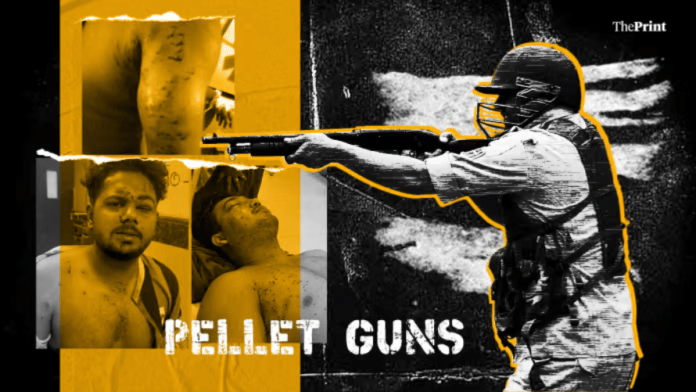

New Delhi: Even as Leader of the Opposition Rahul Gandhi’s dharna at a Delhi police station on Friday led to the registration of an FIR over the alleged use of pellet guns against Gen Z protesters at Jantar Mantar, the weapon at the centre of his protest has a history dating back to the Congress-led UPA.
Pellet guns entered India’s crowd-control arsenal around 2009-10, when Manmohan Singh was the prime minister and P. Chidambaram Union home minister.
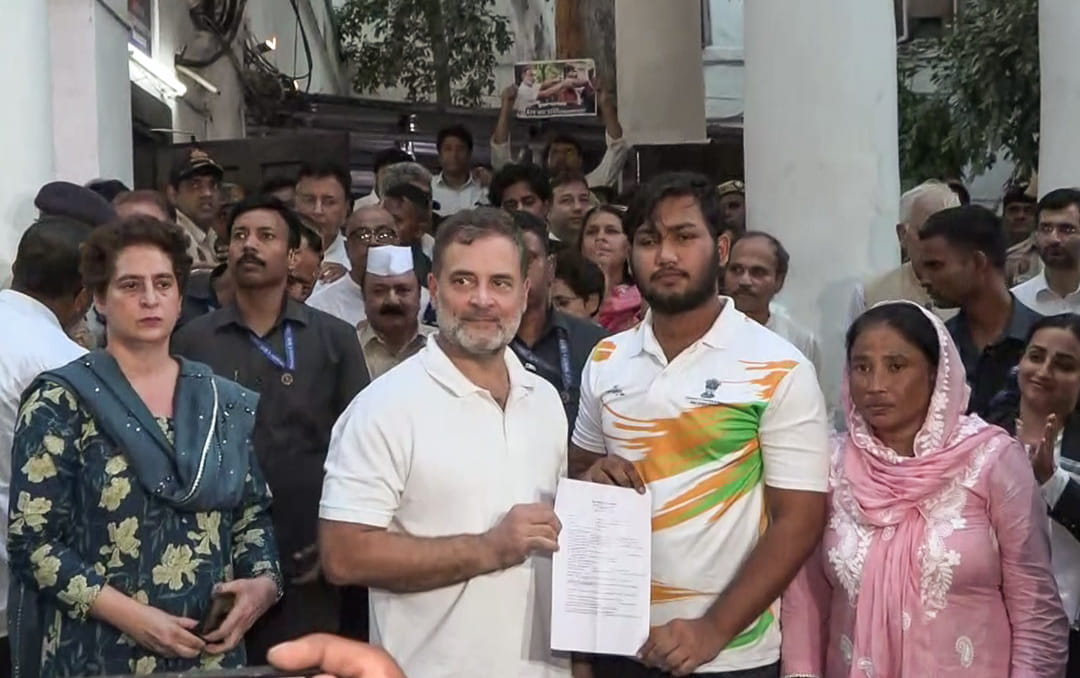
Gandhi sat on the dharna outside the police’s New Delhi district office with an alleged victim of the pellet gun. He questioned the BJP-led NDA government over why such weapons were allegedly used to disperse a student protest.
Nearly 16 years ago, however, pellet guns were introduced in Jammu and Kashmir as a “less-lethal” crowd-control option aimed at reducing reliance on live ammunition that resulted in fatalities.
According to sources in the security establishment, the intention was to bring in something between conventional crowd-control measures like the lathi and tear gas and firearms, so that the crowds could be dispersed without resorting to bullets.
Their use, however, became deeply controversial because of the severe injuries they caused.
Prior to the introduction of pellet guns, the then home minister Chidambaram told the Parliament on 4 August 2010 that since 11 June, 39 civilians had died in the state due to the use of force by the security forces when they had no other alternatives.
“In the discharge of their duty to maintain law and order, the security forces have been compelled by the situation to resort to lathicharge and, if the lathicharge failed to yield results, to tear-gassing. When all attempts to control the crowds failed and there was the danger of the crowds over-running the police station or police outpost, the security forces were compelled to resort to firing.
साहिल की FIR दर्ज न होने देने का एक ही मतलब है –
नरेंद्र मोदी और अमित शाह के राज में शांतिपूर्ण प्रदर्शन कर रहे युवाओं पर खुलेआम पैलेट गन चलाई जा सकती है, मगर उन्हें इंसाफ नहीं मिल सकता।
जब तक FIR दर्ज नहीं होती, जब तक दोषियों पर कड़ी कार्रवाई का भरोसा नहीं मिलता – हम डटे… pic.twitter.com/iJ6ojC9mmA
— Rahul Gandhi (@RahulGandhi) August 21, 2026
While the security forces have been advised to deal with the crowds in a restrained manner, the relentless stone-pelting and the danger of police stations and police outposts being overrun have compelled the security forces to use force both in self defence and in order to protect public property, he said.
“There have been 39 civilian deaths since June 11, 2010; of these 22 deaths have occurred since July 30, 2010,” he said in the Parliament. He had informed the Parliament that 872 stone pelting incidents had happened in June and July with 1266 security personnel injured.
During the unrest in 2016, when the pellet guns were in use for six years, then home minister Rajnath Singh told Parliament that one person was dead and 53 had suffered eye injuries due to the use of pellet guns.
However, Srinagar’s Sri Maharaja Hari Singh Hospital had claimed to have operated on over 100 persons with eye injuries. Singh informed Parliament that the government had constituted an Expert Committee on 26 July 2016 to explore other possible alternatives to pellet guns as non-lethal weapons.
“The Committee has submitted its report and the recommendations have been taken into account by the Government for appropriate implementation,” he said.
The home ministry then decided that the security forces would undertake various other measures such as using PAVA Chilli (Shells and Grenades), STUN LAC (Shells and Grenades) and Tear smoke shells to disperse rioters. “However, if these measures prove to be ineffective in dispersing rioters, use of pellet guns may be resorted to,” the ministry said.
The pellet gun fires a cartridge containing hundreds of small spherical projectiles, or pellets, made of a lead alloy. 12 bore is the measure of the barrel. When fired, the cartridge releases a spray of hundreds of tiny pellets that fan out and disperse with a speed of 100 to 150 meters per second, injuring multiple people in a single shot.
These pellets, manufactured at the Ordnance Factory in West Bengal’s Ishapore, are part of the Rapid Action Force’s armoury and each company, which has 100 to 120 personnel, is issued two or more of these guns.
Also read: Delhi Police to file FIR after Rahul stages dharna outside DCP office with teen hurt by pellets
Why were pellet guns introduced
Speaking to ThePrint, former Jammu and Kashmir DGP Kuldeep Khoda said that pellet guns were introduced in 2010 as the government wanted to reduce the number of deaths that happened due to the use of guns as the last resort for crowd control.
“In J&K, there were several instances where people part of the mob carried firearms, and to disperse such a crowd lathicharge and tear gas was not enough. So, the government introduced a non-lethal weapon that would cause superficial injuries and pain to disperse the crowd,” he said.
However it was strictly labelled as a “weapon of last resort”, he added.
“The forces were trained to point the gun downwards to ensure that the pellets did not hit above the torso,” he added. However, while dealing with a crowd, he said, officers were unable to always point the guns downwards despite training. “These were not spaces where officers had the options of aiming properly or taking positions.”
He said the weapon’s usage as part of the crowd control mechanism brought down the number of deaths in the Valley caused during cross firing. However, it did cause injuries to the brain, spine and eyesight, he added.
The timeline
Pellet guns were first used in India in 2010 during one of the tense phases in the state of Jammu & Kashmir. A widespread protest erupted in the state following the 29 April 2010 fake encounter in Machil sector of Kupwara district, in which Shahzad Ahmad Khan, Mohammad Shafi Ahmad Lone and Riyas Ahmad Lone were killed, and the subsequent death of teenager Tufail Mattoo.
To counter the stone-pelting by the protesting crowd, the police used firearms, leading to the deaths of several civilians The police received severe flak for the usage of firearms. They subsequently introduced the 12-bore pump-action shotgun known as pellet guns.
The next widespread usage of pellet guns was seen in 2016 after the encounter killing of Hizbul Mujahideen commander Burhan Wani. There were widespread protests in the state with violent clashes between security personnel and the civilians.
As per reports, the security personnel used the pellet gun to disperse the violent crowds. During the six-month-long violent agitation more than 100 civilians were killed and thousands injured, including those wounded by the controversial pellet guns.
Pellet guns were deployed in April 2018 as well after protests broke out in Anantnag and Shopian during the byelections for the Srinagar Lok Sabha seat. The public demonstration sought accountability for the high number of civilian deaths during anti-militancy operations.
Subsequently, to curb the protests, the security personnel used pellet guns on the protesters. The Narendra Modi government received severe flak for the usage of the pellet guns in 2018, two years after the then Home Minister Rajnath Singh had stated that the government would explore other non-lethal alternatives.
Months later, the security personnel’s use of pellet guns caused severe eye injuries to a 19-month-old infant, Hiba Jan, in Kashmir. The infant, one of the youngest pellet victims in the valley, got shot when the security personnel fired pellets to disperse a crowd in Shopian.
The incident gave rise to widespread protests and severe criticism of the government over the weapon causing life altering impact to civilians.
Recent controversies
Sixteen years since the introduction of the pellet guns as a crowd-control measure, they are in focus again after the several Gen Z protesters claimed they were hit by pellets fired by security personnel when the agitators tried to march to parliament during their protest against exam paper leaks on 20 July.
An RTI filed by TMC national spokesperson and Rajya Sabha MP Saket Gokhale revealed that Delhi’s Lady Hardinge Medical College and Ram Manohar Lohiya Hospital treated at least 10 people with “pellet, shots or projectile injuries” after the 20 July protests.
Meanwhile, several other cases of potential pellet injuries were also reported from the AIIMS and Safdarjang Hospital on the days following the 20 July Sansad Chalo March.
One of the alleged victims is Sahil Lochab, a resident of Delhi’s Najafgarh. Lochab allegedly sustained pellet injuries in his right eye, causing corneal perforation with high chances of permanent loss of vision. He was treated at AIIMS.
Rahul Gandhi on Thursday accompanied Lochab to the Parliament Street Police station after the police initially did not file an FIR and allegedly did not share the contact details of the investigating officer (IO) post the submission of his complaint.
According to sources, Lochab had submitted his complaint on August 14. He alleged that the police accepted his complaint, but has not yet assigned an IO and neither have they filed an FIR.
Speaking to The Print DCP (New Delhi) Sachin Sharma said that the police have received the complaint and proceedings are continuing in the courts. “All July 20 related cases are being looked into by the Crime Branch,” he said.
Later on Thursday, ThePrint learnt that an FIR has been registered against unnamed person for “voluntarily causing hurt” and “acts endangering life”.
(Edited by Ajeet Tiwari)
Also read: India must retire the pellet gun. It belongs in the 16th century, not a modern democracy