



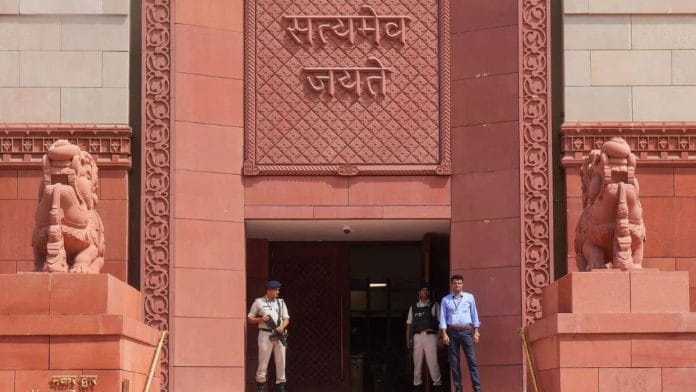
New Delhi: The glass enclosure for the media in the Parliament complex that invited criticism from journalists and Opposition leaders is likely to be a permanent feature with the Lok Sabha secretariat contemplating a “regulated” space for the press, ThePrint has learnt.
Other additional facilities, such as a reception area for all, are also in the pipeline.
“There is an idea that journalists should not assemble at the Makar Dwar — the entry point to Parliament and that there should be a regulated and designated space for media people,” a source in the government told ThePrint.
Leader of Opposition (LoP) and Congress MP Rahul Gandhi, Samajwadi Party (SP) chief Akhilesh Yadav and RJD Rajya Sabha MP Manoj Jha have vociferously protested confining the media inside a room. The Lok Sabha Speaker, who heads the Lok Sabha Secretariat, Monday also met journalists and assured them their issues would be looked into.
Sources privy to the planning also told ThePrint that to man these additional facilities, the secretariat may further increase the number of Central Industrial Security Force (CISF) personnel in the complex. Currently, approximately 3,300 CISF personnel are deployed to take care of security and carry out various duties such as searching, frisking, scanning baggage and vehicles entering the parliamentary complex.
“The scale and number of CISF deployment in the complex is only going to go up because of the new amenities,” another government source said.
The government reassessed the security of the Parliament complex in the aftermath of the security breach last December, when two men with smoke canisters had jumped on Lok Sabha benches from the visitors’ gallery. The Ministry of Home Affairs then stationed the CISF in the premises, initially for security purposes.
ThePrint had reported that the CISF in May had taken full command of all critical aspects, such as the CCTV control room, vehicle access, and management rights of the pass sections at reception counters of both the Lok Sabha and the Rajya Sabha.
Following this, there was an “understanding” that the CISF would also get the protocol responsibility which was earlier entrusted to the Parliamentary Security Services. This led to concerns over the autonomy of the Lok Sabha Secretariat, considering the CISF was largely unaware about protocols in place for serving MPs.
(Edited by Tikli Basu)
Also read: India’s TV, radio industries are sinking. TRAI must address overregulation of legacy media