



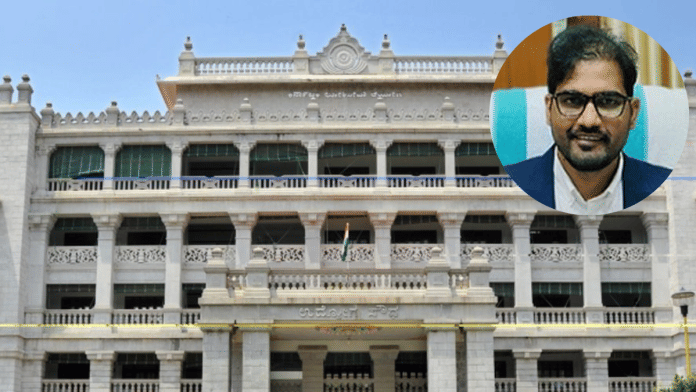
Bengaluru/New Delhi: IAS officer Gyanendra Kumar Gangwar had made a name for himself in giving motivational speeches and lectures to civil service aspirants.
His speeches were often peppered with ‘Shayaaris’ (Urdu couplets), philosophical lessons and a regular reiteration of his All India Rank in the Union Public Service Commission (UPSC): 195.
“Speaking of confidence and intent, that one breakthrough gives you the feeling that I can achieve anything. After that, I did not need any motivation, a guardian or teacher. I had this self-motivation that if I can reach this level, I can do anything,” Gangwar, the then chief executive officer of Karnataka’s Bidar district, says in one such speech made six years ago at a media summit.
Cut to today. The IIT-Kanpur graduate is in judicial custody after arrest by the Enforcement Directorate (ED) in a money laundering case linked to the alleged Karnataka Public Service Commission (KPSC) recruitment irregularities.
The 2016 batch IAS officer was the KPSC Controller of Examinations at the time of the alleged paper leak. His last responsibility was the Director, Department of MSMEs under the commerce and industries ministry.
Gangwar, according to the ED, allegedly leaked the question paper and answers for a January 2026 exam recruiting 400 veterinary officers. The ED arrested him 18 September when he was already in the custody of the Criminal Investigation Department (CID) in the same case.
Also Read: Karnataka fake medicine racket: Alleged kingpin held at Bengaluru airport after month-long manhunt
How ‘scam’ came undone
In January, the competitive exam was held to fill 400 posts for veterinary officers in the Department of Animal Husbandry and Fisheries. According to the ED, a person, identified as Arif, approached candidates, demanding Rs 70 lakh to provide answers to the question paper.
All Karnataka State Student Association (AKSSA) president Kanta Kumar approached the KPSC office with evidence, including a pen drive containing audio recordings of phone calls. Since then, multiple police complaints filed by candidates and other stakeholders have led to the unravelling of the scandal’s scale.
Of the 1,400 candidates who sat in the recruitment test, 329 were selected the next month. But when the KPSC published an eligibility list, it had only names and registration numbers of the candidates.
The middlemen allegedly had all the details. That manipulation did not end there as the alleged scam involved direct physical or digital manipulation of OMR answer sheets in lieu of money, as per an inquiry by the KPSC.
The ED stepped in to probe the money laundering angles after the CID had arrested Gangwar on 17 September and the alleged middleman Basavaraj Kannale the next day. It searched the premises of KPSC office-bearers, as well as those of successful candidates already under the commission’s scanner.
Based on an analysis of documents and loose sheets recovered during searches, the ED connected the dots on the modus operandi and the mathematics behind the question paper leak, with Gangwar at the core.
“Statements from the concerned property manager and candidates corroborated the use of the premises for the alleged distribution of the leaked question paper. Further investigation revealed that Basavaraj Kannale had a close association with the then Controller of Examination at KPSC, Gyanendra Kumar Gangwar,” the ED’s remand application said.
“As per the material collected during the investigation, Gangwar allegedly provided the Veterinary Officers’ question paper with answers to Basavaraj Kannale on 07/01/2026 through an HP pendrive. Kannale allegedly sourced candidates, initially demanded about Rs 80 lakh per candidate and subsequently reduced the amount to Rs 40 lakh, stating he had helped nine candidates by providing the leaked paper.”
Kannale allegedly assembled a group of 20 candidates at a villa in North Bengaluru a day before the examination, where questions handed over to him on a pendrive were shared with the students.
The alleged middleman, according to the ED, collected funds amounting to Rs 1.5 crore in advance as a bribe from the students, of which Rs 1.30 crore was handed over in cash to Gangwar. The part of the funds received from Kannale was used to purchase a flat in his brother’s name while around Rs 23 lakh was spent on purchasing gold jewellery for his fiancée, it alleged.
In its remand application seeking Gangwar’s custody, it alleged that he failed to explain cash deposits totalling Rs 15.39 lakh in his sister-in-law’s bank account and Rs 10.94 lakh in his brother’s bank account in 2025.
These “transactions and assets”, the ED argued, “require detailed financial investigation to determine whether any part thereof represents proceeds of crime or has been acquired/utilised through the alleged illicit gratification”.
Not the first instance?
The ED has documented several such alleged incidents where money was collected as advance and later handed to Gangwar. However, this was not the first time such an incident came to light, nor is this the only department under the scanner.
In July 2023, then Chief Minister Siddaramaiah constituted the Justice (retd.) B. Veerappa-led committee to probe the alleged scam involving Police Sub-Inspector (PSI) recruitment. The committee submitted its report in April, recommending further inquiry by the CID.
As many as 54,041 candidates appeared for the PSI exams held in October 2021 for 545 posts. When the results were announced in July 2022, several students objected to the way the marks were awarded. Investigations found that some ranked candidates attempted barely any questions but were awarded high marks, fueling speculation of mass irregularities.
Then in opposition, the Congress party used the scam as a poll platform to target the Bharatiya Janata Party (BJP) government. The ruling Congress has denied any wrongdoing in the ongoing probe, including the alleged involvement of the now suspended KPSC chairperson Shivashankarappa S. Sahukar.
According to the ED, Sahukar’s daughter Suma appeared for the Industrial Extension Officer exam on 13 July 2025 under Category 3B of the state backward classes list.
She had submitted an income certificate claiming that her family’s annual income was Rs 40,000. Appointed a KPSC member in September 2019, Sahukar was drawing a basic salary of Rs 2.05 lakh which rose to Rs 2.25 lakh when he became the head, according to the ED.
(Edited by Tony Rai)