






India likely grew at more than 7% last quarter, a pace most major economies would envy. Yet, that may still be too slow to deliver on Prime Minister Narendra Modi’s dream of a developed nation.
Modi wants India to achieve that status by 2047, the centenary year of its independence from British rule. Getting there would require the world’s sixth-largest economy to grow at 9.25% annually for 21 years, according to Ashok Lahiri, a senior official at the country’s apex government-run think-tank.
The ambition, branded Viksit Bharat — or Developed India— has become a centerpiece of Modi’s third term. However, assuming the current rate of growth, India’s economy would fall short of his vision, according to several economists.
Growth averaged 6.3% between 2000 and 2024, well below the current potential rate of 7.5%-8%. The economy has grown at or above 9.25% just three times over the past 50 years — 1975, 1988 and 2021.
Achieving the target “would require an exceptionally strong and sustained acceleration in growth,” which will “become increasingly difficult as the economy expands and the base becomes larger,” said Alexandra Hermann Prasad, a London-based economist with Oxford Economics.
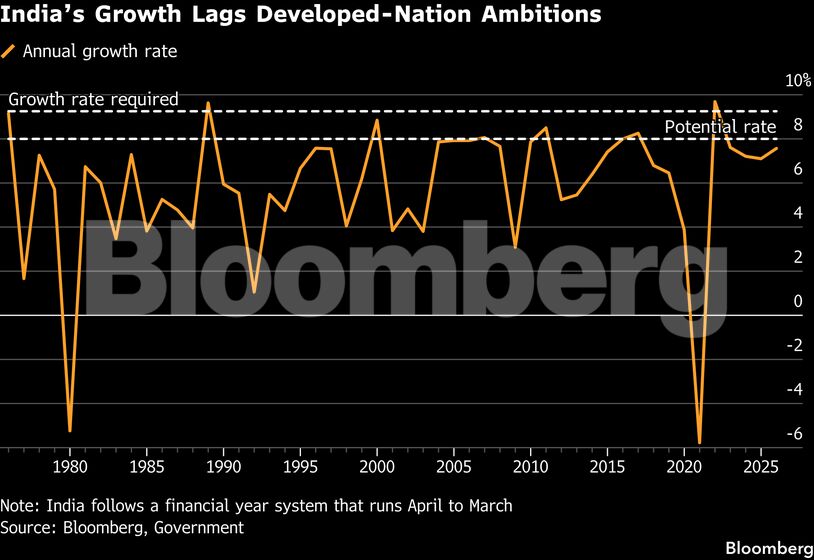
Data Monday will likely show the economy expanded 7.3% last quarter from a year ago, slowing from 7.8% in the previous three months.
Growth below 8% could leave India vulnerable to the so-called middle-income trap, where rising wages erode a country’s low-cost advantage before productivity and skills improve enough to compete with richer economies.
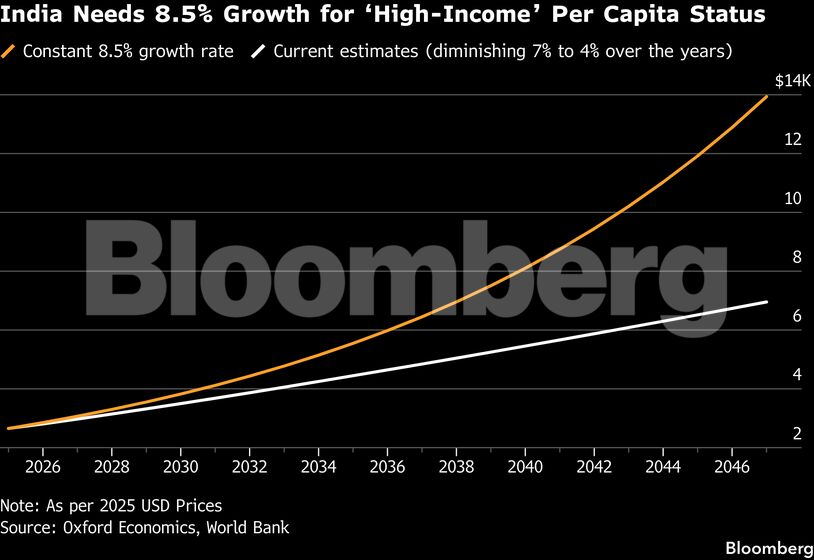
And the distance to high-income status is stark. India’s per-capita income was $2,813 in 2025 and would need to rise more than sixfold to around $18,000 by 2047 to cross that threshold, according to NITI Aayog’s Lahiri.
There are “significant vulnerabilities,” in India’s economy, said Lavanya Venkateswaran, economist at Oversea-Chinese Banking Corp. She pointed to the country’s current-account and budget gaps as well as reliance on volatile capital inflows to finance its external balance as risks.
That’s partly why the nation’s appeal among foreign investors is waning, with the Indian rupee the worst-performing currency in Asia this year so far. India replaced Indonesia as Asia’s least-preferred stock market in an August survey of fund managers by Bank of America Corp.
One solution is expanding manufacturing, economists say. And, that’s on the Modi government’s agenda too, though the sector has stayed stagnant at around 16%-17% as a share of India’s gross domestic product for more than a decade. That’s compares with Modi’s 25% aim.
Economists say boosting high-tech exports, encouraging more private investment and reducing reliance on imported energy are other ways to accelerate economic momentum.
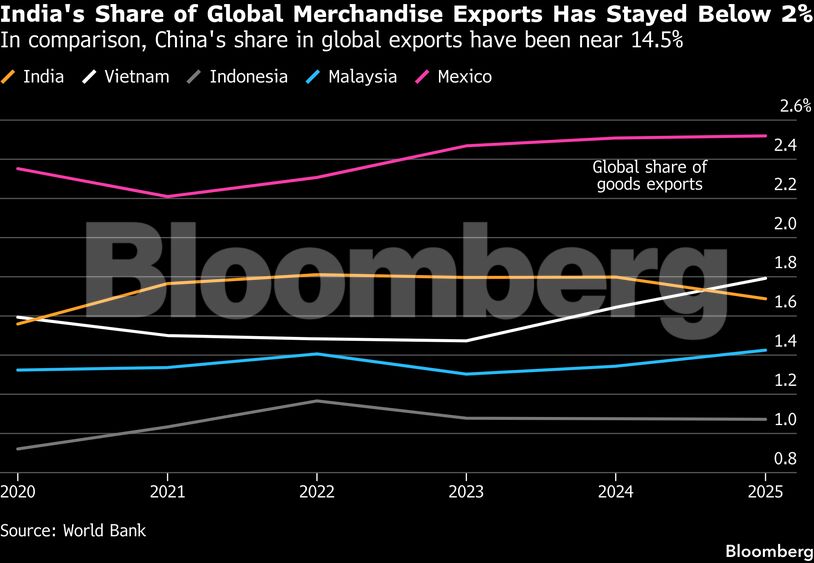
India accounts for less than 2% of global goods exports, compared with China’s more than 14%, underscoring the gap the country needs to close to become an industrial powerhouse.
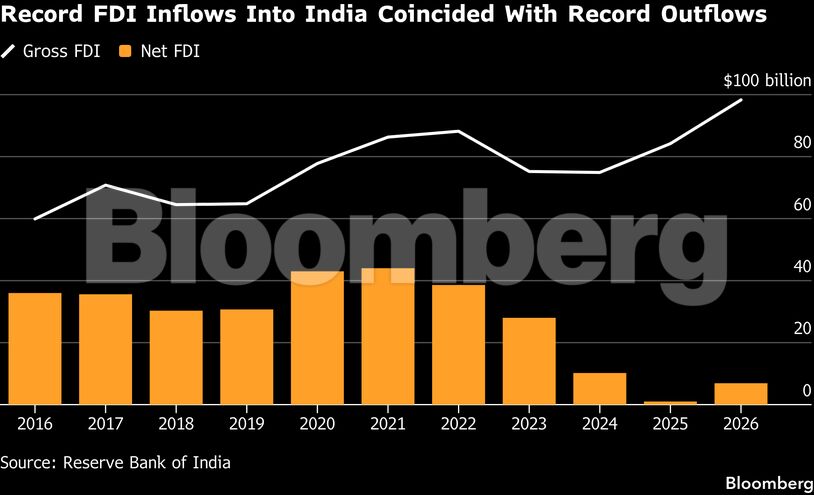
India also needs to lure international investors into its manufacturing sector. Indeed, two of the country’s most senior ministers last week took India’s growth story to global investors, seeking fresh capital from the US, Canada and Japan.
While India has attracted record amounts of foreign direct investment, it has struggled to keep that capital invested. Recent years have also seen domestic firms stepping up investments abroad, while foreign investors in Indian startups have cashed out earlier investments.
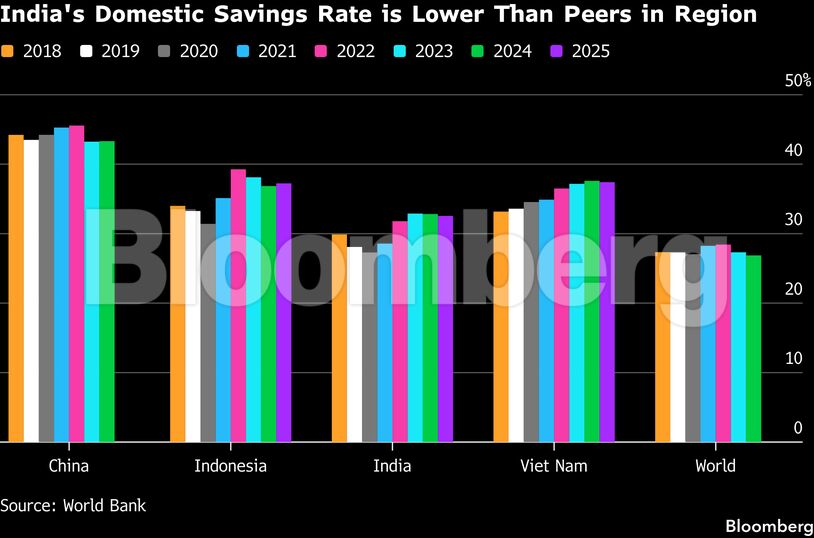
Domestic savings will also be crucial to financing India’s growth ambitions. While the country saves more than the global average, its savings rate trails several Asian peers and is far below China’s. Relatively low incomes also limit how much households can put aside after paying for everyday needs.
That matters because savings provide a relatively cheap pool of domestic capital to fund new factories, infrastructure and other investment. A sustained decline would leave India more reliant on costlier borrowing or foreign capital to finance the growth it needs.
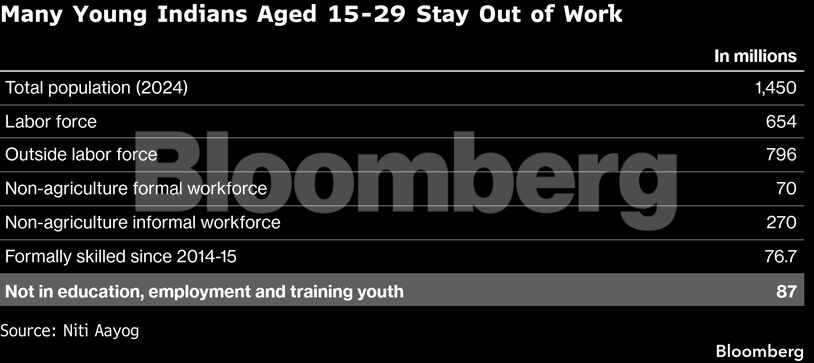
India also risks squandering a demographic dividend expected to last another three decades, without better jobs and skills, economists said.
A recent Niti Aayog report, drawing on 2021 surveys, found nearly 87 million Indians aged 15 to 29 were neither working nor in education or training. A shortage of quality jobs has pushed almost 60% of the workforce into self-employment, much of it in agriculture which is usually low paying.
“Given India’s macroeconomic stability and a government that claims to be reform-oriented, the key questions to be asked are why has the investment cycle remained at nascent stages for years now and why is net FDI close to zero,” said Shumita Deveshwar, chief economist at GlobalData.TS Lombard. “Why aren’t there nearly enough jobs to cater to a young, growing workforce?”
Without private investment and faster jobs growth, sustaining GDP growth rates of 6%-plus will be a “tough ask, let alone growth rates of 8%-plus that are needed for India’s economy to be a developed nation,” she said.
Disclaimer: This report is auto generated from the Bloomberg news service. ThePrint holds no responsibility for its content.