



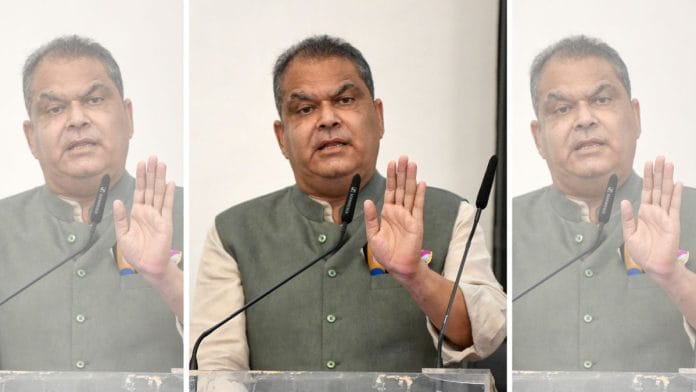

New Delhi: Movement of a shipment containing 54 units of iPhone 14 from Karol Bagh in Central Delhi to the customs at the Indira Gandhi International Airport in 11 minutes. Thirty minutes to receive the shipment, check International Mobile Equipment Identity (IMEI) logs, repack into 56 cartons, prepare export documents and deliver a consignment of 560 handsets to a customs broker. These are the “operationally impossible” scenarios cited by the Enforcement Directorate (ED) in its prosecution complaint against former Punjab Cabinet minister Sanjeev Arora, alleging that details of the export operations maintained by his firm are inconsistent with legitimate trade.
In its prosecution complaint filed before a special Prevention of Money-Laundering Act (PMLA) court in Gurugram last week, the agency has flagged what it called “inconsistencies” with the export details maintained by Arora’s firm, Hampton Sky Realty Limited (HSRL, formerly known as Ritesh Properties and Industries).
Considered a heavyweight in the Bhagwant Mann-led Aam Aadmi Party (AAP) government in Punjab, Arora was arrested in May by the ED in a money-laundering case related to alleged movement of illicit funds in the garb of exporting Apple iPhones. The agency has alleged that Arora’s sham transactions generated proceeds of crime amounting to Rs 102 crore, including around Rs 15 crore in Goods and Services Tax (GST) refunds.
Arora has been lodged in jail in Haryana since his arrest, and his bail plea is pending before the Punjab and Haryana High Court.
During court proceedings in Gurugram, Arora’s defence team, including advocates Puneet Bali and Arjun Dewan, questioned the authority of the ED to register a case for cheating without submitting the victim of the forgery allegedly hatched by Arora and his firm.
They also rebutted the ED’s allegations, saying that HSRL exported more than 13,000 mobile phones and that Customs authorities allowed the duty drawback processes only in accordance with Standard Operating Procedure (SOP) governing export of mobile phones and electronic devices. They also alleged that the investigating officer jumped to the conclusion without verifying details of exports to the foreign entities from the Customs department in India and the UAE.
‘Trade-based’ money laundering
Arora has claimed that his firm, Hampton Sky Realty, was exporting iPhones to Dubai after purchasing them from domestic suppliers. The ED alleges that a majority of exports were destined for Fortbel Telecom FZCO and Dragon Global FZCO in the UAE, which were not independent third-party buyers but were connected to his firm. Both of these UAE-based firms were beneficially owned by Rahul Aggarwal, a former associate of the Findoc group, a major investor in Arora’s HSRL, according to the ED’s prosecution complaint.
The agency relied on the examination of 43 shipping bills submitted by the Chief Financial Officer of HSRL, and made an example of inconsistencies in at least four.
An e-way bill (Electronic Way Bill) is a mandatory document required for transporting of goods valued at more than Rs 50,000, both domestically and for exports. These e-way bills pertained to consignments consisting primarily of “Non‑Activated” Apple iPhones, allegedly processed through a single customs broker, and destined for a single buyer, Dubai-based Fortbel Telecom FZCO. All these export operations took place in a short window between 7 and 28 July 2023.
The ED has alleged that analysis of the export record book of Arora’s firm suggests the system-captured timestamps in the Electronic Data Interchange (EDI) of the Customs showed the Let Export Order (LEO) was recorded on the same evening, in a span of one to two minutes apart from each other, despite consignments claimed to be comprising hundreds of individually IMEI‑bearing devices. An IMEI is a unique 15-digit numeric fingerprint assigned to every mobile phone and cellular-connected device.
“Such a compressed interval is inconsistent with any meaningful physical or IMEI‑wise examination and suggests that examination was not actually carried out on the basis of the goods purportedly exported,” the agency alleged.
Giving specific examples of these “operationally impossible” export scenarios, the agency alleged that in one shipping bill, 54 units of iPhone 14 were shown to have been dispatched from Karol Bagh at 4.21 pm on 20 July 2023. The same consignment was recorded in the export book of Arora’s firm, as filed at IGI Air Cargo at 4.32 pm the same day—claiming that the consignment had moved from Karol Bagh to the firm’s office in Ghitorni, where packaging and documentation work was done—to the airport just 11 minutes.
Similarly, in another shipping bill, Arora’s firm had shown it had sourced 560 handsets from five suppliers across four states, and consolidated and exported them within 48 hours.
However, the agency alleged that one leg of the purchase was recorded in an inward e-way bill and that even those goods left Ghaziabad at 13:24 hours, reached the firm’s office at Ghitorni at 3 pm, and the shipping bill was submitted to customs at 3.29 pm.
“That leaves barely 30 minutes to receive, IMEI‑log, repack into 56 cartons, prepare export documents and deliver to the customs broker— an operational impossibility,” the agency further alleged.
Against the entry of one more shipping bill, the agency alleged that Arora’s firm claimed that a consignment containing iPhones and MacBooks was dispatched from Kolkata on 25 July, and that the consignment was filed for export at 1.16 pm the next day in Delhi. The agency alleged that, for such a scenario to have actually occurred, the consignment must have travelled at 84 kmph, since Kolkata is more than 1,400 km from the national capital.
Additionally, the ED alleged that HSRL’s own documents claimed that export consignments carried no normal trading margins and that profits were to be realised only through GST refunds and other export incentives extended by the government. According to the agency, this recurring pattern of monetising incentives and claiming trades without margins is a recognised feature of trade‑based money laundering.
Moreover, the agency alleged that, in some cases, funds were remitted to Arora’s firms even before domestic sellers had issued bills for the sale of mobile phones to his firms, and in other cases, funds were remitted in excess of the value of the exports.
For example, the agency cited a shipping bill, which suggested that the overseas buyer had remitted a full consideration amount of $3.14 lakh around three‑and‑a‑half hours before domestic suppliers even generated e‑way bills for the dispatch of goods.
In another transaction related to sourcing handsets from four states, the agency alleged that the buyer had remitted $ 6.11 lakh in two advance payments, which exceeded the overall value of the export.
Through this extensive modus operandi, Arora’s firm generated proceeds of crime, amounting to approximately Rs 102 crore, through 43 shipping bills, the agency alleged, adding that this quantum of proceeds of crime includes export remittances of Rs 86.87 crore, a GST refund of Rs 15.63 crore, and incentives in the form of duty drawback of Rs 48.53 lakh.
(Edited by Nardeep Singh Dahiya)