



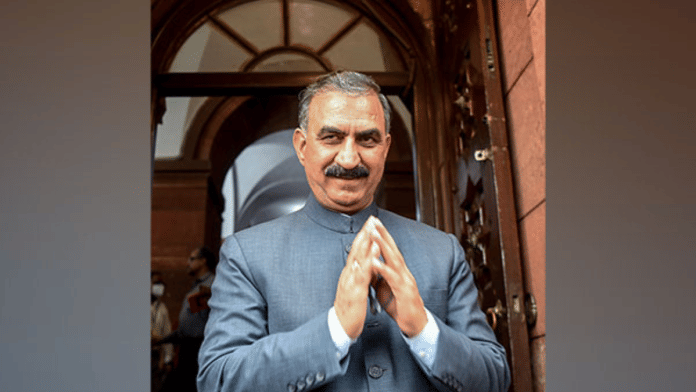
Shimla: The Himachal Pradesh government has proposed downsizing the sanctioned strength of the state’s civil servants, with Chief Minister Sukhvinder Singh Sukhu saying the exercise could save the state around Rs 200 crore annually.
A cadre review has been completed and the proposal sent to the Centre for approval, a senior civil servant told ThePrint. The move is being pushed by the Sukhu government as part of its efforts to cut administrative expenditure and make better use of a bureaucracy that the chief minister says is larger than what the state currently needs.
Himachal has 153 sanctioned Indian Administrative Service (IAS) posts, 96 Indian Police Service (IPS) posts and 118 Indian Forest Service (IFoS) posts. With a population of roughly 70 lakh, this translates into about 21.8 IAS, 13.7 IPS and 16.8 IFS officers for every 10 lakh people—a relatively high bureaucratic density when compared with the neighbouring states of Uttarakhand and Punjab.
The difference is particularly striking in the case of the IAS. Uttarakhand, with an estimated population of around 1.2 crore, has an authorised strength of 126 IAS, 75 IPS and 112 IFS officers—roughly 10.5 IAS, 6.2 IPS and 9.3 IFS officers per 10 lakh people. Punjab, with about 3.14 crore people, has 231 IAS, 172 IPS and 61 IFS posts, translating into around 7.4 IAS, 5.5 IPS and just 1.9 IFS officers per 10 lakh population.
On Monday, Sukhu said that the state does not need so many officers at present. “This number of officers is not needed in Himachal right now. Many officers are under-worked and their full capacity is not being utilised,” the chief minister said during an informal interaction with journalists at his official residence ‘Oakover’ in Shimla.
Sukhu said he personally wanted to bring the IAS strength down to around 100-110 posts. The inevitable resentment among some IAS officers has meant that the government is currently looking at keeping the strength at around 130.
The proposed downsizing comes at a time when Himachal is struggling with a high debt burden and rising expenditure. A large part of the state’s resources goes towards salaries, pensions and repayment of debt, leaving relatively less fiscal space for development and capital expenditure.
A senior Finance Department official told ThePrint that the exercise would certainly result in some savings, though he was not aware of the detailed calculations behind the government’s Rs 200-crore estimate.
“This move will certainly save some money. I am not aware of the breakup or details of Rs 200 crore, but it will save some money. However, it is up to the Centre to accept this proposal of the state. As far as finances are concerned, you can imagine — the government is pruning the cadre, which means there is not much left to do,” the official said.
An officer from the Personnel Department told ThePrint: “This move, if approved by Centre, will not save Rs 200 crore immediately but in the longer run.”
The proposal will require the Centre’s approval since the sanctioned strength of the All India Services cadres is determined through the Central government’s cadre review process. The government is also encouraging officers to opt for Central deputations and, according to Sukhu, is no longer holding back such files. Twenty-five IAS officers of the Himachal cadre are currently on central deputation, along with 24 IPS and 17 IFS officers.
The government is separately looking to cut the number of vehicles available to field officers from 56 to 30 and is working towards shifting government vehicles to electric vehicles, Sukhu said.
The move has drawn criticism from the BJP, with party legislator Rakesh Jamwal questioning whether cadre reduction is really the answer to the state’s financial problems. “Reducing the IAS-IPS cadre and claiming that it will save Rs 200 crore is nothing but an attempt to pull wool over the eyes of the people. The real question is why officers do not want to work in Himachal and why experienced officers are increasingly choosing Central deputation,” Jamwal said.
He also asked the government to explain why a large number of officers were seeking central assignments if the problem was simply that the state had more officers than work. “If officers are under-worked, as the Chief Minister says, then the government must explain why their skills are not being utilised effectively,” Jamwal said.
Himachal Pradesh’s outstanding debt has crossed the Rs 1 lakh crore mark. The pressure is compounded by high committed expenditure on salaries, pensions and debt servicing. In the 2025-26 budget, the government’s own breakup showed that of every Rs 100 it spends, Rs 25 goes towards salaries, Rs 20 towards pensions, Rs 12 towards interest payments and another Rs 10 towards repayment of debt. A further Rs 9 goes as grants to autonomous institutions, leaving only about Rs 24 out of every Rs 100 for development and other activities, including capital works.
The fiscal stress has deepened with the gradual reduction in the Revenue Deficit Grant (RDG), an important source of support for Himachal’s finances. The RDG fell from Rs 6,258 crore in 2024-25 to Rs 3,257 crore in 2025-26, as recommended under the 15th Finance Commission, while Goods and Services Tax (GST) compensation had already ended in June 2022. With the state’s own revenues unable to bridge the gap created by its high committed expenditure, the government has increasingly been forced to look at expenditure cuts, additional borrowing and measures to raise revenue.
(Edited by Nardeep Singh Dahiya)
If the entire IAS and IPS Officers are removed and replaced with respective departmental Professionals, not only thousands of Crores of expenditure could be saved, but also the ‘Ease of doing Business’ will improve dramatically.
Anyone who wages a war against bureaucrats will have my support even if it’s Congress. Every party needs to be on board.
I know they have not really waged a war against the bureaucracy but it’s still something. The day we pass a bill to curtail the hegemony of the bureaucracy is the day this country will truly be free and prosperous. I am disappointed that BJP is succumbing to their pressure.