


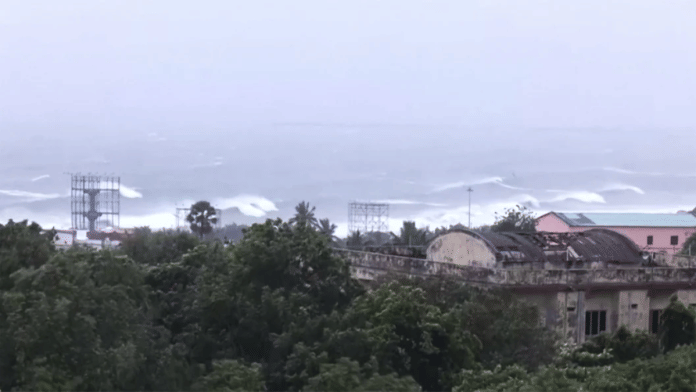
Hyderabad: By the end of 3 November, after being hit by two very severe cyclonic storms—Arnab and Murasu—within a week, the Andhra Pradesh government should have been counting casualties, with now-usual scenes of district officials wading through waist-deep water, taking stock of lives and livestock.
The cyclones were terrible: metre-high stormwaves surging into the coastal nodes of Bapatla and Prakasam districts, the coastline pounded by heavy rain that destroyed more than 52,000 hectares of crops, and sustained winds of up to 150 kmph leaving death and devastation in their wake.
Yet, the aggression and fury roaring in from the Bay of Bengal did not turn into a nightmare, and the southern peninsula’s blackout that was to last more than 10 days was restricted to a mere 24 to 36 hours, senior officials from the Andhra Pradesh government told ThePrint.
“By all historic metrics, we should have been submerged in water, and our districts would have been cut off completely, with the power, communication, and transportation lines snapping almost immediately. But we pre-empted the cyclone, and were tracking it day and night since the beginning of October. This helped us stay ahead of the storm and minimise death and tackle the aftermath of the fury with a degree of readiness that is unprecedented,” Prakhar Jain, Chief Executive Officer of Real-Time Governance Society (RTGS), and Managing Director of the Andhra Pradesh State Disaster Management Authority (SDMA), told ThePrint.
As a result, despite cyclones Arnab and Murasu making landfall at two ends of the coast at Konaseema and Prakasam districts, the state reported a total of 12 lives lost and damages amounting to Rs 4,526 crore compared to the 63 dead and devastation worth Rs 22,000 crore reported during Cyclone Hudhud in 2014.
Hours after Arnab made landfall between Kakinada and Konaseema, Chief Minister N. Chandrababu Naidu reminisced about the Diviseema cyclone that ravaged Andhra Pradesh in the 1970s, claiming 40,000 lives. “I have been witness to the cyclones since the 1977 Diviseema one and I can tell you how technology and advanced disaster management have dramatically reduced casualties in the state. We may not be able to avert natural disasters, but surely can reduce the loss of life and minimise damage to property, including energy infrastructure,” Naidu said while briefing the press.
How the catastrophe was pre-empted
A week before the first cyclone struck Kakinada, a sleepy town of retirees, India Meteorological Department officials sounded a dire warning: “Prepare for the worst,” the Andhra administration was told, as wind speeds were expected to be around a menacing 170-180 kmph.
A synchronised counter-offensive was planned. More than 87,000 people were evacuated in hours, and a seamless grid made up of teams from the National Disaster Response Force (NDRF), the Andhra State Disaster Relief Force, fire services, and district police operated as sheets of rain fell incessantly. Hundreds of thousands of acres of paddy and horticulture crops had already been flattened in the fertile delta areas of West and East Godavari districts.
“With people being evacuated, our next priority was to ensure we coordinated the efforts without any lag. A centralised war room was set up, and the Real-Time Governance Society (RTGS) department became the nodal centre,” K.S. Vishwanathan, Director of the Department of Information and Public Relations (DIPR), told ThePrint.
Driven by Artificial Intelligence-powered forecasting that achieved a stunning 90 per cent accuracy rate, RTGS planners tracked the micro-movements of the two cyclones, enabling local district collectors to orchestrate shifting of lives and livestock long before the first gale hit.
Recognising that one of the greatest threats to a cyclone-hit population is the loss of power, the Andhra government ensured that a plan was in place to erect tens of thousands of poles once wind speeds dropped. More than 30,000 electric poles were felled by falling trees, with each village reporting an average of 30 to 40 fallen poles.
Anticipating such a situation, the state government had already reached out to Telangana to dispatch 500 staffers from the power distribution company, and they were immediately deployed in north coastal Andhra, officials from the Eastern Power Distribution Company Limited, told ThePrint.
As news of the second cyclone closing in came in, more people were pressed into service. The state government had already deployed 32,000 officials on cyclone duty, tasked with varied responsibilities from evacuation to relief and rescue. “The chief minister, who made personal calls to Telangana’s chief minister and deputy chief minister, in turn reached out to both chief ministers in Tamil Nadu and Karnataka, who were asked to help with personnel and senior engineers to coordinate with district officials in coordinating power restoration,” Prakhar Jain said.
The 1,500 discom staffers from the three states were complemented by 11,000 Andhra Pradesh personnel from the southern, central, and eastern power distribution companies who worked round the clock to restore power to villages across the state. “Within 10-12 hours, all 33 substations were functional in the northern Andhra region, and all zillas, mandals, and villages were connected to the grid. During Hudhud, it took us at least seven to 10 days to restore power. Our next step was to ensure the aquaculture firms where seafood is ready for export were supplied with uninterrupted power,” Ramakrishna, Senior Engineer, Andhra Pradesh Eastern Power Distribution Company Limited (APEPDCL), said.
Without the 11KV feeders that were connected to the 33 substations, the last-mile connectivity would not have been possible, SDMA officials said.
Andhra Pradesh officials who spoke to ThePrint said the natural devastation was met with a textbook display of planning and quick, on-the-ground implementation.
Rations for November were distributed a week before Cyclone Arnab’s anticipated landfall so that homes dependent on the public distribution system (PDS) would not be disadvantaged. All district collectors were handed numbers of contractors who could provide earth movers and other equipment to clear roads and move trees. “Knowing that communication lines would be severed, we did not want the district administration to be handicapped by lack of power and telecom lines,” an official in Eluru, where a cloudburst was reported, said. In addition, drones were used to map areas where waterlogging was reported so that the NDRF and SDRF teams could immediately coordinate with collectors to ensure people in low-lying areas were moved to safety.
“All our force deployment was data-driven. We used the services of the National Remote Sensing Agency (NRSA) to survey areas that were otherwise inaccessible,” said Prakhar Jain. Citizens were encouraged to report problems on the ManaMitra application (WhatsApp Governance) and a ticket was raised to address various issues.
In schools where the evacuees were housed, large community kitchens were set up to ensure they did not go hungry. “Commodities were already stocked at centres to last at least a week since there were two cyclones back to back,” said a West Godavari district official, stating that the level of preparedness was unprecedented. The state government’s announcement of Rs 3,000 per family as cyclone relief made people cooperate with the officials and move to safer zones as they were assured of restocked belongings.
Commending the Andhra government’s efforts in managing the cyclones and their aftermath efficiently, M. Shashidhar Reddy, former vice-chairman of the National Disaster Management Authority, said data-driven governance has changed the vocabulary of disaster management in India. “Our forecasting capabilities and climate modelling systems have changed dramatically. What could have otherwise been a historic human tragedy has now been turned into a masterclass in institutional resilience,” he told ThePrint.
Andhra Pradesh has a history with cyclones like no other state in India, the RTGS and SDMA head recounted. From losing 40,000 people in the Diviseema cyclone to evacuating six lakh people in the 1990 cyclone, Andhra has reported a record number of rescue and rehabilitation procedures in the past.
“Technology has helped us move from relief and rescue to restoration, rehabilitation, and recovery in the minimum time possible,” DIPR Director K.S. Vishwanathan said. “It has also enabled us to coordinate better with various agencies and minimise duplication.”
(Edited by Nardeep Singh Dahiya)
Also Read: Rayalaseema rising: Andhra CM Naidu lays foundation for Rs 1 lakh crore horticulture hub, ISA