



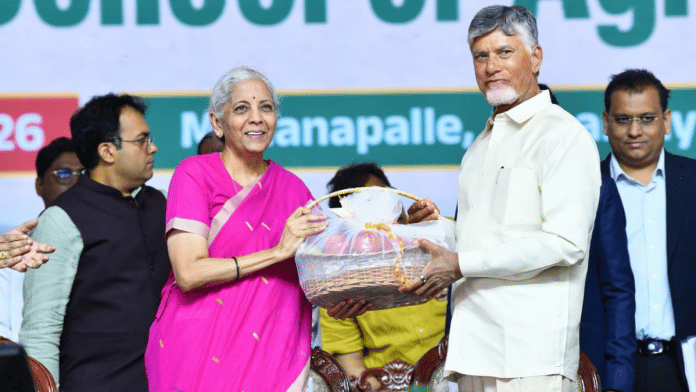
Hyderabad: After a slew of comprehensive irrigation projects in the arid Rayalaseema region, the Centre and Andhra Pradesh have joined hands to lay the foundation of India’s largest global horticulture hub at Madanapalle.
Spearheaded by Chief Minister N.Chandrababu Naidu, the ambitious project pledges Rs 1 lakh crore to benefit a million farmers and turn Rayalaseema into India’s premier ‘fruit bowl’.
“For Andhra Pradesh and the wider Indian agricultural landscape, the hub represents a major leap toward precision farming, value addition, and enhanced export capabilities. By focusing on lucrative crops like dragon fruit, avocado, and berries alongside local staples,” Naidu said at the foundation stone laying ceremony for the horticulture hub and the Indian School of Agriculture (ISA).
The project falls under the larger ‘Rayalaseema Rising’ initiative and is designed to be executed in three phases. The funding model relies on a strategic public-private partnership: the Centre has pledged to infuse Rs 40,352 crore, to be divided amongst core irrigation, horticulture development, and road networks, while the state government and the private sector would mobilise the remaining Rs 60,000 crore.
The comprehensive blueprint spans 10 districts (eight Rayalaseema districts, Prakasam, and Markapuram), 201 clusters, and thousands of villages, to expand existing cultivation by 6 lakh hectares and double regional production to 435 lakh metric tonnes.
The existing area under horticulture cultivation is 8.41 lakh hectares, and with the additional 6 lakh hectares, the total cultivable land under horticulture would be 14.41 lakh hectares.
Andhra Pradesh’s Rayalaseema region had four districts before it was bifurcated in 2014. Later, four more districts were carved out of Kurnool, Kadapa, Anantapur, and Chittoor, taking the count to eight.
Naidu, Union Finance Minister Nirmala Sitharaman, and Deputy Chief Minister K.Pawan Kalyan called for the state to expand cultivation, modernise infrastructure, and build global export pathways for high-value crops.
Rayalaseema’s horticulture hub is a one-of-a-kind initiative, Sitharaman said, adding that the Centre would facilitate the World Bank’s participation through specialised lending programmes.
According to the government, special emphasis will be placed on promoting crops such as mango, banana, tomato, pomegranate, dragon fruit, avocado and berries. The government will also encourage private-sector investments in food processing plants and export infrastructure to provide value addition for agricultural produce and improve farmers’ incomes.
“As part of the initiative, an additional ayacut of 9 lakh acres will be created, while irrigation facilities in 4.3 lakh acres will be stabilised. Of the Rs 40,352 crore to be provided by the government, Rs 20,884 crore will be allocated for irrigation, Rs 15,000 crore for horticulture development and Rs 4,562 crore for roads. Major irrigation projects, drip irrigation systems, road infrastructure and logistics facilities will be developed as part of the comprehensive plan,” a government release said.
Naidu and his deputy Kalyan also laid the foundation stone for the ISA in Madanapalle.
Modelled on the lines of the Indian School of Business (ISB), which played a significant role in promoting industrial and business education in Hyderabad, Telangana, the proposed institution will focus on advancing agricultural development through modern technology, research and innovation.
Calling the ISA the farmer’s own ISB, Reliance Industries Limited executive director Anant Ambani said Reliance’s role would be to make the farmers the CEO of their farms through increased income for farmers.
“Reliance is partnering with the government to build rural enterprises, strengthen villages, and directly elevate the lives of local farmers. The Indian School of Agriculture will provide technology-driven guidance to farmers and develop solutions to address key challenges in the agricultural sector,” Anant said.
The ISA, he said, will focus on modern technology, scientific research, digital agriculture, precision farming, crop monitoring, smart irrigation, and market intelligence.
Located at a 100-acre site, the institution is expected to serve as a centre for agricultural innovation, equipping farmers with advanced knowledge, technological solutions and market-oriented practices to improve productivity, sustainability and profitability in the agriculture and allied sectors.
Backed by Reliance Industries, the technology-driven institution aims to create a highly sophisticated supply chain by integrating smart irrigation, food processing plants, and advanced digital logistics. The hub is positioned to set a national benchmark for escalating farmers’ incomes and securing India’s footprint in global food markets.
(Edited by Tony Rai)