



Hyderabad: In Andhra Pradesh’s high-octane political theatre, a script is being rewritten, and this time round, Chief Minister N. Chandrababu Naidu is executing his most critical software update yet.
For decades, Naidu’s political identity was anchored in the sleek, iconic Cyber Towers building in Hyderabad’s Hi-Tech City. In the political landscape of the late 1990s, Naidu was the consummate ‘CEO-CM’, a leader who spoke the language of microchips, global investors, and deregulation. From Microsoft to Google and the Indian School of Business to the Insurance Development Regulatory Authority—India headquarters of all were established in Hyderabad at his behest.
But while that urban-centric brand won him international plaudits, it cost him his crown. The ghost of the 2004 and the subsequent 2014 electoral rout after Andhra’s bifurcation was blamed squarely on severe rural distress and acute droughts. Telugu Desam Party (TDP) politburo members say this has long haunted the party.
But today, Naidu is flipping the script. While he has not abandoned his corporate efficiency or data-driven instincts, he has redirected them from software parks to water pipes. In a calculated bid to dismantle the Opposition’s “anti-farmer” narrative, the man who once brought Microsoft to Hyderabad is now trying to bring water to the state’s absolute tail-end.
From pixels to pipes: The water grid strategy
Water is Andhra’s most aggressive political battleground, and Naidu is treating it like a corporate turnaround project. In 2024, the National Democratic Alliance (NDA) administration led by the TDP unveiled a massive Rs 35,000 crore irrigation roadmap aimed at fast-tracking 36 priority projects.
At the centre of this strategy is the Polavaram National Irrigation Project, pitched as the ultimate crown jewel of his water doctrine. Naidu is pushing for full completion by the summer of 2027. Alongside it, marquee projects like the Veligonda Project—Phase I of which was dedicated to the nation in August 2026—and the Rs 4,910 crore Chintalapudi Lift Irrigation Scheme are being leveraged to bring localised relief to historically parched districts.
In the chronically drought-prone Rayalaseema region, his government has deployed a massive infrastructure push targeting the accelerated revival of the Handri-Neeva Sujala Sravanthi (HNSS) projects. Together, the HNSS and Veligonda have effectively secured 52 TMC of additional water capacity to stabilise and expand cultivation across nearly 14 lakh acres.
Concurrently, in the agrarian heartland of the Krishna-Godavari Delta, his focus on river interlinking and canal modernisation has secured vital tail-end allocations. Coupled with heavily subsidised micro-irrigation schemes that are transforming the arid hinterlands into high-yield horticulture hubs, this aggressive focus on water security serves a dual purpose.
The state has introduced a first-of-its-kind ‘Irrigation & Water Calendar’ that sets hard deadlines for project execution and water release dates, allowing farmers to scientifically align their crop cycles. Furthermore, AI and data firms like Vassar Labs have been deployed to run high-precision water auditing, mapping rainfall and reservoir inflows in real time to counter droughts proactively.
Pattabhiram Kommareddy, a prominent TDP leader, said that Naidu’s focus on Farmers Producer Organisations (FPOs) and deep-tech farming represents “visionary economics”. “On Naidu’s watch, farming is being actively transformed into a profitable, corporate-style startup environment designed to appeal to rural youth,” he told ThePrint.
Countering the opposition YSR Congress Party’s (YSRCP) allegations that the party remains elite-centric, senior TDP minister Anam Venkata Ramana Reddy relies heavily on data and statistics. Anam was tasked with the responsibility of frequently highlighting concrete welfare measures, such as the Annadata Sukheebhava scheme and direct input subsidies, to project the alliance government as fundamentally farmer-first.
Overcoming the ghost of 2004
Political observers agree that this makeover is a vital, survival-driven pivot to shed historical liabilities.
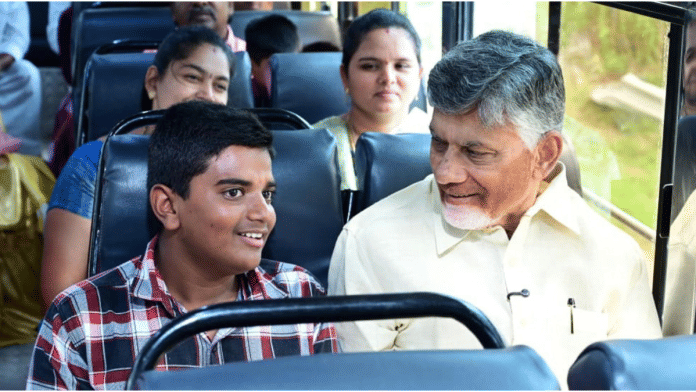
Telakapalli Ravi, a veteran political analyst in Andhra Pradesh, said that Naidu has always been intensely aware of his historical “urban-only” vulnerabilities from 2004. “Naidu’s current pro-farmer optics—like high-profile village visits and driving tractors—are calculated moves to bridge the massive rural-urban divide that previously cost him power,” he said.
Looking at the broader strategic timeline, the political strategist said that the image makeover serves a dual purpose. He said that it acts as a short-term buffer against rural anti-incumbency due to the El Niño effect while simultaneously setting a smooth, universally acceptable transition path for the next generation of TDP leadership.
Similarly, seasoned political commentator Dr K. Nageshwar observes that Naidu isn’t abandoning his corporate ‘CEO-CM’ persona entirely. “He is instead applying tech-corporate efficiencies—like drone deliveries, AI agronomists, and real-time monitoring—directly to rural administration to neutralise the welfare monopoly of the Opposition,” Nageshwar told ThePrint.
In defence of this brand makeover, the TDP’s communications machinery has mounted an aggressive defence of this rebranding, framing it as structural economic evolution rather than a mere public relations exercise.
Party spokesperson Jyotsna Tirunagari, a prominent leader who was inducted into the Politburo during the recent Mahanadu, said the party’s communication strategy is focused on the economic upliftment of rural families, actively working to dismantle the “corporate-first” tag in public discourse.
The long game
Leaders in the party as well as external analysts believe this makeover will fundamentally alter the political calculus of Andhra Pradesh ahead of the 2029 Assembly and general elections. By embedding a deeply “farmer-friendly” framework into the party’s DNA now, Naidu is ensuring the TDP can permanently hollow out the YSRCP’s traditional rural vote bank.
More importantly, leaders such as Pattabhiram, who are part of Nara Lokesh’s team, suggest that it is an exercise in permanent legacy building. “IT parks and cyber cities are transient, vulnerable to shifting economic winds. But changing the geography of a state by creating permanent drought resilience anchors a leader’s legacy into the very soil. If computer screens defined Naidu’s rise in the 20th century, the flowing canals of Polavaram and Veligonda will lead the political discourse in 2029,” he said.
What the BJP and Jana Sena are saying
Politically, Naidu is directly diluting the traditional anti-incumbency built on agrarian distress, creating a formidable electoral bulwark of rural loyalty, and successfully positioning the ruling coalition as the primary architect of Andhra Pradesh’s agricultural survival. These have translated into political gains, with alliance member Jana Sena Party’s (JSP) legislators openly declaring support for the NDA alliance to continue into 2029.
BJP Andhra President P. V. N. Madhav told ThePrint that maintaining a strong, independent grip on the rural masses ensures easier promotion of the Centre’s and the state’s schemes. “A successful implementation makes both our parties look good without us having to fight for credit among the most vulnerable and influential voters in our state—the farmers. It has helped us put up a united front as we go into the local body elections,” he said.
For the Pawan Kalyan-led Jana Sena, a swift delivery of the irrigation projects in the Uttarandhra region has helped stem fears of non-performance, given that the party is in power for the first time in Andhra Pradesh. In the northern part of the state, where there is a significant Kapu caste voter base, the administrative actions at the village level have allowed Jana Sena’s four MLAs to fall back on the irrigation projects to entrench themselves deeper in the region.
JSP MLA Panchakarla Ramesh Babu, who delivered an emotional speech during the official release of water into the Polavaram Left Canal, said, “MLAs and MPs of all three parties stood together, wiping our tears as the Godavari water made its way to the parched lands of Uttarandhra. It fulfilled a six-decade-long dream for the region’s people. Good economics is definitely good politics, and we hope that these will translate into wins during the corporation and municipality elections.”
(Edited by Viny Mishra)
Also read $92 mn to $609 mn: Andhra FDI inflows surged after Jagan-era slowdown, TDP credits policy reset