





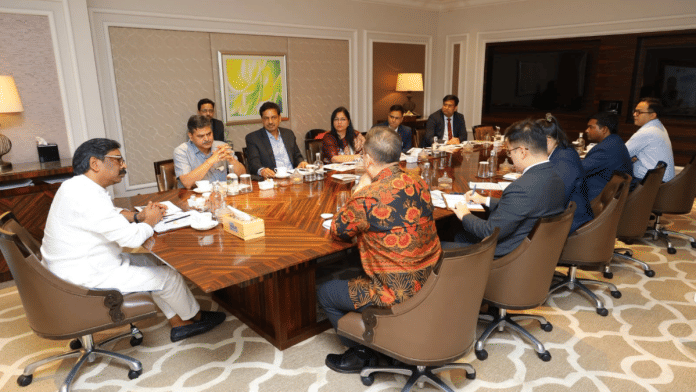


New Delhi: Jharkhand’s identity should not be defined only by mines but also by minds, Chief Minister Hemant Soren said as he presented the state’s first Artificial Intelligence policy, proposing to integrate AI into governance, agriculture and mineral resource administration.
He unveiled the draft Jharkhand Artificial Intelligence (AI) Policy 2026–31 on 8 July under Vision 2050 at the two-day National Stakeholders’ Convention in New Delhi.
The draft policy places AI for governance, agriculture and rural livelihood, healthcare and public health, and mineral resource administration as the priority pillars, claiming to be consistent with the broader national emphasis on “AI for All” and NITI Aayog’s Responsible AI approach.
Speaking at the inaugural programme, Soren laid out his vision for Jharkhand combining the state’s industrial capacity with AI and technology.
“Our identity should not be defined only by mines, but also by minds. We should not be known only for our resources, but also for our research. It should not be just about extraction, but also about innovation. And it should not be only about growth, but also about inclusive growth as well,” he said,
Under the draft AI policy, the Chief Minister Data Intelligence Programme (CM-DIP) platform was introduced as one of the governance “game-changers”. It promises real-time monitoring, tracing inconsistencies, and countering bottlenecks, thus providing efficiency in governance.
Along with CM-DIP, a health and nutrition vigilance system (HNVS) and Critical Minerals Administration System (CMAS) initiatives were also introduced.
In the initial phases, the draft AI policy focuses on the establishment of the State AI Mission, the development of institutional frameworks, and the initiation of pilot projects in selected sectors.
Later on, it envisages scaling its use cases, developing AI infrastructure, and expanding capacity-building programmes. In the final phase, the policy intends to fully integrate AI across departments, establish a mature innovation ecosystem, and sustain adoption of AI in governance and industry.
The Convention, which was jointly organised by the Departments of Information Technology, Industries and Tourism, brought together leading industry experts, policy-makers, and development partners from India and abroad.
Representatives of companies such as Google, Microsoft, and KPMG were also in attendance.
Along with the AI policy, the state government also rolled out drafts of the Jharkhand Industrial Investment Promotion Policy (JIIPP) 2026 and the Jharkhand Textiles, Apparel & Footwear Policy 2026. During the second day of the National Stakeholders Convention, the Jharkhand Chief Minister also held Business-to-Government (B2G) meetings for investment, digital innovation, and the state’s overall development.
During the Convention, the state government signed a total of 14 Memoranda of Understanding (MoUs) worth Rs 99,000 crore across key sectors to strengthen strategic partnerships and accelerate the state’s economic growth.
Of these, 10 MoUs were signed by the Department of Industries, two by the Department of Information Technology, and two by the Department of Tourism.
Under Vision 2050, the government intends to establish more than 50 Global Capability Centres, support over 1,000 AI startups, and create more than 100,000 AI-enabled employment opportunities.