



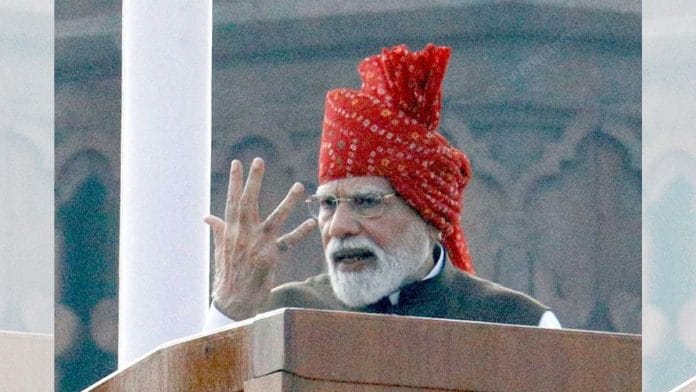
New Delhi: Prime Minister Narendra Modi Saturday laid out a seven-point roadmap for achieving the Viksit Bharat ambition by 2047, calling for faster reforms, stronger domestic capabilities and greater global competitiveness.
Speaking from the ramparts of the Red Fort on India’s 80th Independence Day, he said that India must follow what he described as ‘Saptadhara’—seven streams of growth—over the next five to seven years.
“We need to increase the speed of reforms. This is not a compulsion or buzz-word, it is our conviction. We are aboard the reform express. We are moving towards next-level reforms,” Modi said in his speech, adding that India had to move on from the idea of ‘Saptasindhu’ (land of seven rivers) of self-reliance to ‘Saptadhara’ in the coming years.
PM’s new roadmap comes at a time when the global economy and supply chains remain vulnerable to geopolitical tensions—Russia-Ukraine war and ongoing conflict in West Asia—besides disruptions to trade and energy flows forcing countries to reassess their dependence on external markets. Modi stressed the need for India to strengthen its manufacturing base, technological capabilities and defence preparedness, while expanding its role in the global economy.
Together, the seven streams of ‘Saptadhara’ are intended to make India more competitive, self-reliant and technologically strong, while using its cultural influence to help achieve the goal of a developed India by 2047.
1) Manufacturing
The PM identified manufacturing as India’s first priority, and the need to focus on building the entire value chain from components to finished products. He said Indian industry must compete globally on cost, quality and scale, while making precision manufacturing and zero-defect products its hallmarks.
He also emphasised how India has to be ‘atmanirbhar’ (self-reliant) so that it doesn’t have to rely on any other country. He cited the example of how India is understanding the value of chips, and has set up three semiconductor plants.
According to a recent NITI Aayog report, India’s manufacturing sector has struggled to increase its contribution to the economy, with its share in gross value added (GVA) remaining largely unchanged at around 16-18 percent over the past two decades. GVA is a measure of the total value of goods and services produced in a country’s economy.
2) Farming & food processing
The second stream under Saptadhara, Modi said, could play a major role in India’s journey to becoming a developed economy.
The focus, he noted, would be on using the country’s agricultural strength to create greater value beyond primary production.
3) Technology
Technology and innovation form the third pillar. Modi pointed to areas, such as space, quantum technology and robotics, saying that India must become an innovation hub and take its digital public infrastructure to other countries.
He also stressed the need for India to develop and deploy indigenous 6G technology.
4) Gati Shakti
The fourth stream focuses on faster and better connectivity.
Modi called for seamless links between cities through high-speed rail, modern highways, inland waterways and multi-modal logistics, while emphasising port-led development.
5) Raksha Shakti
The fifth stream is aimed at reducing India’s dependence on foreign defence supplies. Modi said self-reliance in defence had become essential in an uncertain world.
He also highlighted drones, hypersonic technologies and cyber security as sectors that require greater domestic capabilities.
6) Green & Blue Economy
The sixth stream covers green mobility, clean manufacturing, coastal tourism and fisheries.
Modi said India should not only respond to climate challenges, but also develop solutions that can be offered to the world.
In his address, he also mentioned how India is working on Free Trade Agreements with 40 countries. “These trade agreements are a big opportunity. I want to tell our MSMEs, please do not let up this opportunity. Indian products should reach the world. We have to meet global standards, improve on what is available in the world. From Keralam to Gujarat, and Tamil Nadu to Bengal, our seafood export opportunities have increased.”
7) Soft power
The seventh and final stream is soft power, which, Modi said, India must use to expand its global influence. He pointed to yoga, holistic healthcare, films, gaming, tourism and the country’s creative industries as areas with significant potential.
“Yoga has connected the world,” he said, adding that India should also focus on tapping the growing concert economy and create an environment that attracts global artists and events.