





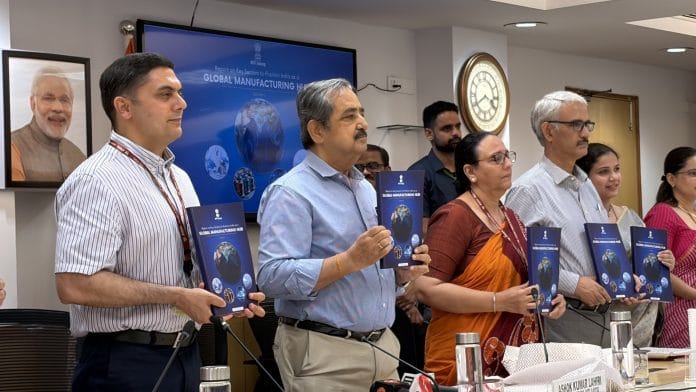


New Delhi: India needs to sharply expand its manufacturing scale, improve competitiveness and move deeper into global value chains if it wants to emerge as a global manufacturing hub, according to a new NITI Aayog report released Thursday.
The report, titled ‘Key sectors to Position India as a Global Manufacturing Hub Volume-1’, noted that India’s manufacturing sector accounts for 17.5 percent of its gross value added (GVA), a share that has remained broadly stagnant at around 16-18 percent for the past two decades. GVA is the measure of the total value of goods and services which is produced in a country’s economy.
India’s share in global manufacturing value grew from about 1.5 percent in 1995 to only 3.2 percent in 2023. In contrast, China’s share has increased from about 5 percent to nearly 32 percent during the same period.
The report said India has an opportunity to close this gap as global companies are now diversifying supply chains and seek alternatives to concentrated manufacturing locations. But the report also cautioned that the country cannot rely only on expanding production or assembly. It needs to build scale, raise productivity, develop technological capabilities and increase its presence in global production networks.
“It’s about building productive capacity, increasing productivity, improving competitiveness and expanding India’s presence in global markets,” NITI Aayog vice chairman Ashok Kumar Lahiri said at the launch of the report.
NITI Aayog in collaboration with Crisil Intelligence, assessed 62 manufacturing sectors and identified 12 with the potential that could help India in emerging as a global leader. Some of the manufacturing sectors identified are automobiles, chemicals, capital goods, electronics, pharmaceuticals, defence and drones, food processing, textiles, steel, leather and footwear, telecom equipment, and solar PV manufacturing.
The first volume of the study examines four of these sectors (chemicals, textiles, telecom and network equipment, and solar PV manufacturing) and outlines sector-specific measures to address their challenges. The remaining eight sectors will be covered in subsequent volumes.
Where India has an opportunity
Chemicals offer significant room for expansion as global supply chains diversify away from China. India only accounts for about 8 percent of the major import market in 2024, while domestic chemical consumption is projected to reach USD 290-310 billion by FY 2030.
The report says India needs chemical production to grow about 14 percent annually to capture this opportunity.
The textile sector offers another major opportunity because of their employment intensity and established manufacturing base. India is the sixth-largest textile and apparel exporter, with a 4.1 percent share of global exports in 2024.
But the report says improving productivity, scaling up man-made fibre production, modernising micro-small and medium enterprises (MSMEs) and expanding market access will be critical.
Telecom equipment gives India a strategic opportunity with the rising demand from 5G and digital infrastructure. But India’s exports were only USD 0.6-1 billion annually between 2020 and 2024, compared with imports of USD 4-5 billion. With more than 80 percent of critical components sourced from China, the report recommends greater localisation of component manufacturing, technology transfer, joint ventures and industrial clusters.
Solar PV manufacturing has also emerged as a fast-growing opportunity for India. Module manufacturing capacity rose to 100 gigawatts (GW) in August 2025 from 2.3 GW in 2014, while cell manufacturing capacity increased to 25 GW from less than 1.2 GW.
The report said rising solar installations will create strong domestic demand, but India needs to strengthen its domestic manufacturing ecosystem to compete globally.
What is holding India back
Across sectors, the report identifies import dependence, fragmented supply chains, infrastructure and logistics gaps, limited domestic value addition, technology constraints and skill shortages as key hurdles.
It says India must move beyond “assembly-led or low-value manufacturing” and towards deeper participation in global value chains. According to NITI Aayog, addressing these problems is essential to help Indian companies grow and compete globally.
It recommends better infrastructure, manufacturing clusters, investment in technology and skill development, and easier access to global markets. The report also said policies should be designed differently for different sectors, as the challenges faced by textiles, chemicals, telecom equipment and solar manufacturing are different.
Lahiri said the government’s role was to remove the hurdles that prevent businesses from investing and expanding. “We must diagnose the problem and solve it.” He also stressed on the need for Indian manufacturers to build scale and compete with global players.
According to the report, India cannot become a manufacturing hub simply by producing more. It needs companies that can produce at scale, compete on cost and quality, and adopt new technology.
(Edited by Pakhi Khare)
Also Read: India’s use of Quality Control Orders hurting MSMEs & supply chains, needs a rethink—CSEP study