



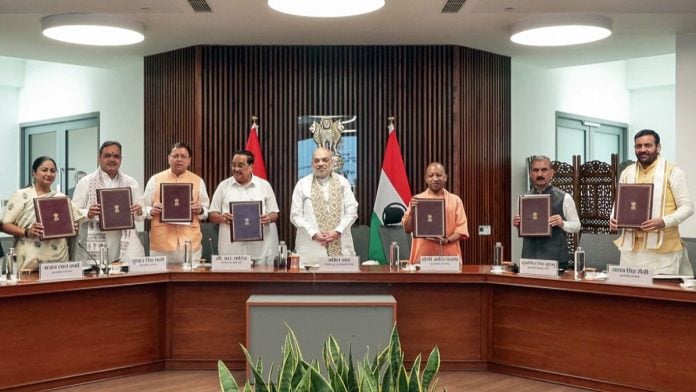
New Delhi: On Tuesday, the chief ministers of six states—Uttar Pradesh, Uttarakhand, Himachal Pradesh, Rajasthan, Delhi and Haryana—gathered in the Capital to sign an agreement on the Kishau multi-purpose project.
The project envisages a 232.6-metre-high concrete gravity dam with a storage capacity of 1,562 million cubic metres on the Tons river that flows along the border of Uttarakhand and Himachal Pradesh. It will help irrigate 97,000 hectares of land and generate 1,476 million units of clean hydropower. Delhi will be the biggest beneficiary of the project.
This is, however, not the first such project where chief ministers of six states have come together to resolve long-pending water disputes. Since 2018, the Modi government has quietly moved ahead to work with states on resolving long-pending water disputes.
Union Home Minister Amit Shah said that the agreement for the Kishau multi-purpose project is the tenth water dispute that his government has helped resolve. Some of these disputes were 50 years old.
ThePrint takes a look at the other water projects that the government has helped resolve in the last eight years.
Lakhwar Multi-Purpose Project
On 28 August 2018, Union Road Transport and Highways minister Nitin Gadkari, handling the water resources, river development and Ganga rejuvenation portfolio since September 2017, signed a Memorandum of Understanding (MoU) with the chief ministers of Uttar Pradesh, Rajasthan, Uttarakhand, Haryana, Delhi and Himachal Pradesh for the construction of Rs 3966.51 crore Lakhwar Multi-Purpose project in the Upper Yamuna Basin.
Upper Yamuna refers to the stretch of the Yamuna from its origin to the Okhla Barrage in Delhi. Initially approved in 1976, the project was suspended in 1992. It envisages construction of a 204 m-high concrete dam across the Yamuna near Lohari village in Dehradun district of Uttarakhand with a live storage capacity of 330.66 million cubic metres or MCM. One MCM equals a billion litres.
This storage will provide irrigation for 33,780 hectares of land and availability of 78.83 MCM of water for domestic, drinking and industrial use in the six basin states. The project, executed by M/s Uttarakhand Jal Vidyut Nigam Limited, will also generate 300 MW of power. Larsen & Toubro is undertaking the civil works for the project.
Status: Civil construction is currently underway; completion is scheduled for 2031.
Shahpur Kandi Dam Project
Punjab and Jammu and Kashmir signed an agreement on 8 September 2018 to restart work on the Shahpur Kandi Dam Project on the Ravi in Punjab, bordering Jammu and Kashmir. The Rs 3,300-crore project comprises a 55.5-metre-high dam and two hydropower plants with an installed capacity of 206 MW. The project, being implemented by Punjab, will help minimise some of the water of the Ravi that is currently going waste through the Madhopur Barrage downstream to Pakistan. It will also help irrigate 37,173 hectares of land in Punjab and Jammu and Kashmir.
The project was approved in 2008, but work started on it only in 2013. A year later, work was stopped following issues raised by the Jammu and Kashmir government.
Status: The dam is complete and operational. But the full benefit of the project — irrigation and power generation — will be realised only after completion of the power plants. The two hydropower plants are expected to be completed by the end of 2027.
Renukaji Multi-Purpose Dam Project
It was again Nitin Gadkari, who as water resources minister signed the MoU with chief ministers of six states—Uttar Pradesh, Rajasthan, Haryana, Delhi, Uttarakhand and Himachal Pradesh—on January 11, 2019 for the construction of Renukaji Multi-Purpose Dam project in the Upper Yamuna Basin.
It has been conceived as a storage project on the Giri river, a tributary of the Yamuna, in Sirmour District of Himachal Pradesh. A 148-metre high rock-filled dam will be constructed for supply of 23 cumecs of water to Delhi and other basin states. A cumec is a unit of volumetric flow rate, equalling a cubic metre of water per second.
The project will also generate 40 MW of power during peak flow. After the construction of the dam, the flow of the Giri will increase about 110 per cent, which will meet the drinking water needs of Delhi and other basin states to some extent in lean season.
Investigation works for the project started way back in 1976, but disputes among states meant construction works could not be started. The total cost of the project was estimated (at 2015 prices) at Rs 4596.76 crore, with the cost of the power component at Rs 277.33 crore.
Status: Work is underway and the project is targeted to be completed by 2032.
Ken-Betwa Link Project
The agreement to implement the Ken-Betwa river link project was signed by the Union Jal Shakti ministry and the governments of Madhya Pradesh and Uttar Pradesh on 22 March 2021. The foundation stone of the project was laid by Prime Minister Narendra Modi on 25 December 2024, marking the implementation of one of the crucial river inter-linking projects in the country.
The project will help irrigate 10.62 lakh hectare annually and provide drinking water to about 62 lakh people in the drought-prone Bundelkhand region of Madhya Pradesh and Uttar Pradesh. A total expenditure of ₹10,536.12 crore has been incurred as of December 2024, with substantial budgetary provisions for FY 2024-25 to ensure continued momentum.
Status: The dam is under construction, while work on the canal is yet to begin. The Lower Orr Project, Kotha Barrage, and Bina Complex Multi-Purpose Project are under construction. Preparation of Detailed Project Reports (DPRs) of other state-specific projects in Madhya Pradesh and Uttar Pradesh is also under finalisation stage. The project is scheduled for completion in 2030.
Parbati-Kalisindh-Chambal River Link project
With an eye to address the water shortage in their respective states, Madhya Pradesh and Rajasthan signed the agreement to implement the Rs 72,000-crore Parbati-Kalisindh-Chambal river linking project in December 2024.
The project envisages interlinking of rivers of the Chambal basin, including the integration of Eastern Rajasthan Canal Project for optimum water resources utilisation in Madhya Pradesh and Rajasthan. Once complete, the project will provide drinking water to 21 newly constituted districts of eastern Rajasthan and towns and villages that fall on the route.
The project will also provide water to meet industrial demand of the Delhi-Mumbai Industrial Corridor besides irrigating more than 2.5 lakh hectare of new command area, stabilising the existing command area of about 1.5 lakh hectares in Rajasthan, and provide annual irrigation to 6 lakh hectares in Madhya Pradesh and drinking water supply to several districts, including Shivpuri, Gwalior, Bhind and Malwa region.
Status: DPRs pertaining to the Rajasthan components have been completed and submitted to the Central Water Commission (CWC) under the Ministry of Jal Shakti for techno-economic appraisal. The project is targeted for completion by June 2028.
Underground pipeline to transfer water from Hathinikund to Yamuna
On 29 June 2026, Rajasthan and Haryana signed an agreement for implementation of the Yamuna Water Project. Under this agreement, approximately 580 MCM of water will be conveyed from the Yamuna Canal to Rajasthan via three underground pipelines.
The project aims to deliver Rajasthan’s share of Yamuna water from the Western Yamuna Canal through these underground pipelines. It will enable Rajasthan to effectively utilise the water allocated to it under the 1994 agreement regarding the sharing of usable surface water in the Upper Yamuna Basin and ensure a continuous supply of drinking water to the arid and low-rainfall regions of Rajasthan and foster socio-economic development, thereby benefiting millions of people.
The estimated cost of the project is Rs 34,102.24 crore.
Status: The DPR of the project has been prepared according to which a raw water reservoir at Hasiyawas in Rajasthan with total storage capacity of about 386 MCM is earmarked exclusively for drinking water supply. The DPR envisages time required for construction of the project as 72 months from the date of award.
Rehabilitation of families displaced by Narmada Project
On 7 July 2026, a historic agreement regarding the settlement of outstanding payments was signed among the Narmada Award beneficiary states—Maharashtra, Gujarat, Rajasthan, and Madhya Pradesh—in the presence of the Union Home Minister.
This agreement resolves long-standing disputes among these states concerning cost-sharing for the construction of the Sardar Sarovar Project, with the outstanding dues being resolved through a one-time settlement.
Status: With the one-time settlement, the dispute over outstanding dues among the four states stands resolved.
Sharing of water between Bihar and Jharkhand in Sone basin
On 30 August 2026, a 25-year old dispute regarding sharing of Sone river water between Bihar and Jharkhand was resolved when the chief ministers of the two states signed an inter-state memorandum of agreement in the presence of Union Home Minister Amit Shah. The agreement will provide irrigation water to lakhs of farmers in large rural areas of Bihar and Jharkhand, along with drinking water for the people.
Status: With the signing of the agreement, the Indrapuri Dam, also called the Sone barrage across the Sone river bordering Jharkhand will become fully operational.
Agreement for construction & implementation of Yamuna Water Project
The chief ministers of Rajasthan and Haryana signed an agreement in New Delhi for the construction and implementation of the Yamuna Water Project on 29 June 29 2026, resolving the nearly three-decade-old water-related problem faced by the people of the two states.
As part of the agreement, approximately 580 million cubic metres of water will be supplied from the Yamuna Canal to Rajasthan through 295 km of three underground pipelines from July to October. These three pipelines, with a diameter of more than 3.6 metres, will provide drinking water to the people of both Rajasthan and Haryana.
Status: The DPR of the project is under examination.
(Edited by Nardeep Singh Dahiya)
Also Read: Inside the second partition of India-Pakistan—the full story of the Indus Waters Treaty