



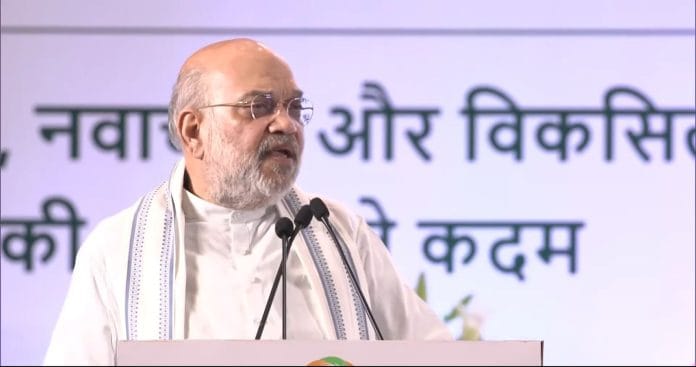
New Delhi: Union Home and Cooperation Minister Amit Shah Monday said the cooperative sector was neglected for decades and received a new push only after the Narendra Modi government created a separate Ministry of Cooperation in 2021.
Speaking at the ministry’s fifth foundation day celebrations, Shah said the sector was earlier treated as secondary, but has been given a new direction since the ministry’s creation. “Earlier, cooperative sector was given a second-grade treatment but Narendra Modi government has given it a new direction by setting up an independent ministry,” Shah said.
Calling it a significant day for the cooperative movement, he said the country has more than 8.5 lakh cooperative societies with over 32 crore members today.
Recalling the ministry’s formation in 2021, Shah said its creation had initially faced criticism over concerns that the Centre would interfere in a subject that is handled by states. “I want to tell those people who opposed the idea of separate Cooperation Ministry that in last five years, even states run by Opposition governments have never questioned any policy of the Central government,” Shah said.
Reviewing the ministry’s work over the past five years, Shah said several reforms had been undertaken to modernise the cooperative ecosystem. “In the last 5 years, we have achieved numerous significant accomplishments. We have undertaken commendable work in the direction of making the cooperative system modern, transparent, technology-enabled, and competitive,” he said.
He said the cooperative movement, once largely confined to agricultural credit, dairy, fertiliser distribution and rural services, has now expanded into secondary and tertiary sectors. According to Shah, the sector will play an important role in achieving the goal of Viksit Bharat by 2047.
Highlighting the performance of urban cooperative banks (UCBs), Shah said their profits have nearly doubled over the past five years, while gross non-performing assets (GNPAs) declined from 12.8 per cent to 6.2 per cent and net NPAs fell from 6 per cent to 0.7 per cent.
GNPAs represent the share of total loans that have turned bad, while NNPAs reflect the residual stress after banks make provisions for potential losses.
Emphasising the need for professional management in cooperatives, Shah said the creation of Tribhuvan Sahkari University in Anand, Gujarat, will help train professionals for the cooperative sector. “Our goal is to implement professional management in a phased manner from primary cooperative societies to top institutions. This will increase transparency in appointments, improve work efficiency, and also put an effective check on corruption related to appointments,” Shah said.
He also said BJP-led governments have consistently created new institutions for social welfare, citing the creation of the Ministry of Tribal Affairs under former Prime Minister Atal Bihari Vajpayee and the Ministry of Jal Shakti under Prime Minister Narendra Modi in 2019.
Next steps
Outlining the ministry’s future roadmap, Shah said Bharat Taxi will be expanded to 500 cities and towns across all states over the next two years.
He also announced that a new life insurance cooperative society will soon be launched to expand insurance services through the cooperative network in association with IFFCO-Tokio General Insurance Company.
Shah said the Bharatiya Beej Sahakari Samiti Limited (BBSSL), a multi-state cooperative society established in 2023, is expected to become India’s largest non-government seed production organisation within the next three years. He said the society will provide farmers with pure, unadulterated seeds, distribute high-yielding varieties and help conserve traditional Indian seeds.
The foundation day celebrations also saw the release of model bye-laws for dairy cooperative societies and a commemorative publication documenting the ministry’s achievements over the past five years.
The event also featured the signing of a memorandum of understanding between BBSSL and the Indian Council of Agricultural Research (ICAR) to strengthen India’s seed ecosystem. Another key announcement was the conversion of 50,000 Primary Agricultural Credit Societies (PACS) into e-PACS as part of the government’s push to digitally empower grassroots cooperative institutions.
(Edited by Nardeep Singh Dahiya)
Also Read: Products straight to consumers, aid for producers. Bharat Organics looks to disrupt organic market