



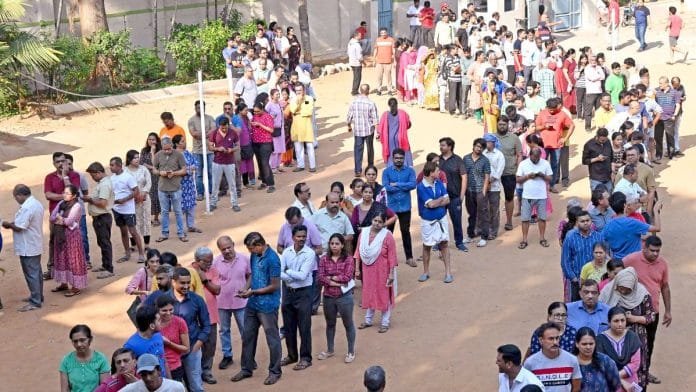
Bengaluru: Nearly half of the existing electorate in India’s IT Capital has been flagged as ASDDO—absent, shifted, deceased, duplicate or other—amid the ongoing SIR exercise in Karnataka, data from the state election authorities shows.
According to data released by Karnataka Chief Electoral Officer (CEO) Thursday, 49.42 lakh of Bengaluru’s 1.03 crore registered voters have been placed under the ASDDO category. The voters can dispute the status to avoid removal by 8 August.
“Citizens who have any objections or grievances regarding the ASDDO information may approach the concerned Booth Level Officer (BLO) or Electoral Registration Officer (ERO). Necessary action will be taken to dispose of such objections and complaints through a simplified and time-bound process,” read a statement by the Greater Bengaluru Authority (GBA).
GBA data shows that 47.68 percent of Bengaluru’s total electorate is classified as flagged entries. Of these, 7.98 lakh voters are absent, 3.15 lakh deceased, 33.8 lakh have permanently shifted out, and 60,005 are duplicates.
Maheshwara Rao, GBA Chief Commissioner, said that representatives of various political parties have requested an extension of the deadline to submit objections, as some more enumeration forms are yet to be collected.
For several years now, advocacy groups and others have demanded a revision of the city’s voter lists.
Experts say that urban voter rolls can have potential flaws, like over-inclusion and duplication due to infrequent updation.
A 2015 study by civic rights advocacy group Janaagraha looks at errors of deletion, which refer to names that are on the electoral list but should not be, and vice versa.
Srikanth Viswanathan, the Chief Executive Officer at Janaagraha, said that the state election authorities should provide more details on how these ASDDO numbers were arrived at. “The primary issue is whether legitimate voters have been left out because of the tight timelines and undue pressure on BLOs. That the voter turnout would be understated is a secondary issue. We definitely need better systems around maintaining quality voter lists in our cities, given the rate of migration to and movement within cities,” he told ThePrint.
Bengaluru has had no civic elections for its city corporation since September 2020 and the Karnataka government has given assurances that the polls will be held before year-end.
SIR has also become a political flashpoint as the local body polls draw nearer.
Bengaluru, which is home to over 1.4 crore people, or a quarter of Karnataka’s total population, has long seen poor voter turnouts in elections.
In the 2023 assembly elections, Bengaluru’s four divisions—North, South, Central and Urban—recorded around 54.5 percent voter turnout, despite the state recording one of its highest polling percentages at 72.81 percent. In 2018, the polling percentage was 72.13 percent, of which Bengaluru’s four zones recorded around 58 percent.
“This is good. This is the reason for the low voting %. Large nos dead shifted etc. good to clean up,” T.V. Mohandas Pai, Chairman of Aarin Capital, wrote in a post on X.
According to a statement by the CEO of Karnataka, as of 16 June this year, there are 5,54,32,314 electors on the state’s voter roll. Of these, 1,10,50,144—or 19.93 percent—have been flagged as ASDDO.
There are 16,12,634—or 2.91 percent—who are untraceable or absent, while 66,43,426 voters—or 11.98 percent—who have permanently moved out of the state.
Further, 2.95 percent, or 16,32,816 voters, are deceased, and 0.84 percent, or 4,67,820 voters, are classified in the others category.
The draft electoral roll will be published on 17 August.
(Edited by Mannat Chugh)
Also Read: Karnataka Congress seething after Cabinet rejig. Resignation, resentment and a Shivakumar warning